Earthquakes occur every year in Colorado and of course daily across the globe. Our new earthquake pages help you keep an eye on the temblors.
While Colorado isn’t often considered a prime location for earthquakes, temblors can and do occur in the state every year. Many are in less populous locations but can be damaging. Our revamped earthquake page(s) help you keep tabs on the rumbling earth.
Other locations on the globe are certainly more prone to devastating quakes. To help view these events which occur with startling frequency, we created a global earthquake page. This shows all magnitude 4.0 temblors within the past 7 days.
Both of these pages are available via the links below or in the almanac menu to the left.
While normally not particularly active, there are approximately 100 potentially active faults in Colorado and more than 400 temblors of magnitude 2.5 have occurred in the state since 1870. The state’s largest quake occurred on November 7, 1882 along the northern Front Range and measured 6.6 on the Richter Scale.
According to the Colorado Division of Emergency Management, the costliest quake was a 5.5 magnitude temblor that occurred on August 9, 1967 and was centered near Commerce City. The quake caused more than $1 million worth of damage and is thought to have been caused by the injection of liquid waste into the earth at the Rocky Mountain Arsenal.
Longtime Denver area residents well remember the shaking that occurred with regularity from the mid-60s through the early 80s due to the activity at the Arsenal.
April 28 to May 4: This Week in Denver Weather History
As we begin to enter the month of May, Denver’s weather starts to make the move toward spring severe weather and snow becomes less common. Looking back at this week in Denver weather history, there has been some snow but lightning and hail are more typical of the types of extreme weather we would expect to see.
From the National Weather Service:
27-28
In 1919…rainfall totaled 2.03 inches for the two days… Along with a trace of snowfall. Northwest winds were sustained to 24 mph with gusts to 26 mph on the 27th.
In 1975…high winds gusting to 85 mph severely damaged a mobile home in Boulder and caused other minor damage. West winds gusted to 46 mph at Stapleton International Airport on the 28th.
In 1996…heavy snow fell over portions of the Front Range foothills west of Denver. Snowfall amounts ranged from 4 to 7 inches. Only 0.3 inch of snow fell at the site of the former Stapleton International Airport. North winds gusted to 41 mph at Denver International Airport on the 27th.
28
In 1894…southwest winds were sustained to 35 mph with gusts as high as 60 mph.
In 1896…apparent post-frontal bora winds from the northwest were sustained to 43 mph with gusts as high as 56 mph. Rainfall totaled 0.22 inch.
In 1990…high winds raked the northeastern plains and eastern foothills from Boulder north. Wind gusts to 70 mph were recorded in Boulder. West winds gusted to 41 mph at Stapleton International Airport.
In 2001…a 21-year-old man was struck by lightning along the shoulder of I-225 near Parker road. His brother’s car had broken down and he stopped to help. The bolt briefly stopped the man’s heart and caused the right side of his body to go numb.
In 2003…severe thunderstorms produced large hail across southern metro Denver. Hail to 1 3/4 inches in diameter fell in Englewood and 2 miles east of Centennial Airport. Hail as large as 1 1/2 inches in diameter fell in Aurora near Cherry Creek. Other large hail reports included 1 inch hail near Bennett…and 7/8 inch hail in greenwood village and at centennial airport.
28-29
In 1950…snowfall totaled 6.3 inches at Stapleton Airport…but only 3.5 inches over downtown Denver.
In 1960…heavy snow fell at Stapleton Airport where 8.6 inches of snow were measured. North winds gusted to 38 mph. Most of the snow…6.9 inches…fell on the 29th.
29
In 1898…apparent thunderstorm winds were sustained from the southwest to 58 mph with gusts to 66 mph.
In 1909…north winds were sustained to 44 mph behind an apparent cold front. These were the strongest measured winds of the month that year.
In 1962…heavy snowfall totaled 6.4 inches at Stapleton Airport where northeast winds gusted to only 17 mph. Snow fell all day…but the most on the ground was only 1 inch due to melting.
In 1991…two men were struck by lightning while golfing in Cherry Hills just south of Denver. The two received only minor burns. Shortly afterward…lightning struck a home in cherry hills village several times…leaving numerous holes in the roof. No injuries were reported.
In 1993…localized strong winds occurred at Jefferson County Airport near Broomfield where gusts to 63 mph were recorded. The strong winds were the result of a probable microburst.
In 2000…several severe thunderstorms producing large hail and destructive winds rumbled across northern metro Denver. Thunderstorm wind gusts reached 81 mph near Hudson with hail as large as 3/4 inch in diameter at Longmont. Several homes and vehicles sustained damage. The strong winds uprooted trees and downed utility poles…causing scattered outages. Lightning sparked a house fire in Boulder. The fire damaged a portion of the roof and a bedroom on the third floor. Thunderstorm winds gusted to 53 mph at Denver International Airport.
In 2003…lightning struck a chimney at a residence in Hiwan in Evergreen…sending stones flying as far as 150 feet. Electrical equipment in some nearby homes also failed. Damage to the residence…in addition to electrical equipment…was estimated at 100 thousand dollars. Severe thunderstorms produced large hail to 1 inch in diameter near Hudson and Sedalia and to 3/4 inch near Parker. Hail as large as 1 3/4 inches was measured 9 miles north of Sedalia.
Denver recorded a record low temperature on the morning of April 23, the fifth cold temperature record of the month that has been tied or broken.
Just before midnight last night the mercury dropped to 21 degrees at Denver International Airport setting a record low temperature for the date of April 22. The breaks the previous record for the date of 22 degrees set 139 years ago in 1874.
Here in Thornton we couldn’t quite match that with a low temperature yesterday of 22.6 degrees.
Illustrating just how cold it was, the average low temperature for both yesterday’s and today’s date is 35 degrees. To date Denver’s average temperature during the month of April is an amazing 7.5 degrees below average.
This record is the fifth cold temperature weather record set or tied this month. Record low temperatures have previously been recorded on April 9, April 10 and April 16. Also, a record low maximum was measured on April 9.
April 21 to April 27: This Week in Denver Weather History
While significant snow events become less frequent this time of year, our look back at this week in Denver weather history shows that they can still occur even toward the end of April. Thrown into the mix is a variety of spring severe weather including tornadoes and deadly lightning.
From the National Weather Service:
19-21
In 1984…a large snowstorm buried most of Colorado under a thick mantle of wet snow. Total snow amounts ranged from 10 to 20 inches across metro Denver and a whopping 20 to 40 inches in the adjacent foothills. The snow closed roads and damaged electrical transformers…causing numerous power outages. Nearly 14 inches (13.6) of snow fell at Stapleton International Airport where the combination of snow and wind closed all but one runway…resulting in the cancellation of many flights. Both I-70 and I-76 were closed to the east of Denver.
19-22
In 1933…a major storm dumped 16.8 inches of snowfall over downtown Denver when rain changed to snow during the early morning of the 20th and continued through midday of the 22nd. Most of the snow fell on the 21st. Due to melting… The most snow on the ground was 10.5 inches at 6:00 pm on the 21st. Before the snow started…a strong cold front on the evening of the 19th produced north winds sustained to 35 mph with gusts to 37 mph. The strong winds deposited a thin layer of dust on the city. North to northwest winds were sustained to 31 mph with gusts to 35 mph on the 20th and to 29 mph with gusts to 32 mph on the 21st.
20-22
In 1957…strong and gusty south to southeast winds raked metro Denver each day. The strongest wind gust of 55 mph occurred on the 21st when blowing dust briefly reduced the visibility to 3/4 mile at Stapleton Airport.
20-23
In 1989…unusually warm weather resulted in several daily temperature records being broken in Denver. The high temperature of 89 degrees on the 21st exceeded the record maximum for the month at that time. Daily record high temperatures were either exceeded or equaled with 83 degrees on the 20th…88 degrees on the 22nd…and 85 degrees on the 23rd. The low temperature of 55 degrees on the 22nd equaled the record high minimum for the date.
21
In 1885…rain changed to snow during the early morning and was the heaviest snow of the season. Total snowfall was estimated at 8.0 inches over downtown Denver…but the snow melted rapidly on the ground as it fell. However… The weight of the snow…as well as northwest winds sustained to 29 mph downed telegraph and telephone wires. Several large branches of trees were also broken by the weight of the snow. Precipitation totaled 1.01 inches from the storm.
In 1887…west winds were sustained to 47 mph.
In 1932…the temperature dipped to a low of only 60 degrees… The all-time record high minimum for the month.
In 1988…a small tornado was observed by National Weather Service employees about 3 miles northwest of Thornton. It was on the ground for about 2 minutes. No damage was reported. Later…lightning struck two 14-year-old girls on a softball field in Westminster. One was killed…while the other suffered moderate injuries. Northwest winds gusted to 44 mph at Stapleton International Airport behind a cold front.
In 2010…severe thunderstorms produced large hail…strong winds and a tornado across parts of Adams…Arapahoe… Elbert…and weld counties. The hail…up to 1.50 inches in diameter…came down so heavy along parts of I-70 and I-76 that snowplows had to be called out to remove it. Numerous vehicles were damaged by hail. In weld County…very heavy rain and hail accompanied thunderstorm winds up to 75 mph. Hail up to 1.50 inches was reported near Bennett; 1.25 inches…5.3 miles east of Englewood; 1.0 inch size hail near Buckley Field; with 0.88 inch size hail near Boulder. A weak tornado touched down briefly in Elbert County…about 9 miles southwest of Deer Trail…but did no damage. Several minor accidents were reported with snowpacked and slick road conditions along with very low visibilities. Minor street flooding was reported in southeast Aurora. Denver International Airport recorded 0.30 inches of rainfall. Also…a peak wind gust to 36 mph from the southeast was observed at the airport.
Mother Nature can be a fickle lady as we are now seeing. While the calendar says spring, she is quite content to visit wintry weather on us once again.
As expected a three-day long event is occurring that will bring heavy, wet snow to the area and winter-like temperatures. While not unusual for this time of year, it certainly has many longing for the delayed arrival of spring.
We will be monitoring monitoring the storm very closely and posting regularly to our Facebook page and Twitter feed. You can follow along in real time below. We are also on Google+ here.
Denver set its fourth cold temperature record so far this month.
Our unseasonably cold April continues. Following a healthy show of snow yesterday temperatures dropped this morning to a low of 22 degrees as measured at Denver International Airport. This ties the record low for the date last set in 1999.
Here in Thornton we matched DIA’s number with a low of 22 degrees this morning. Both marks are far below the Denver low temperature average for April 16 of 33 degrees.
This is the fourth cold temperature related record set so far this month.
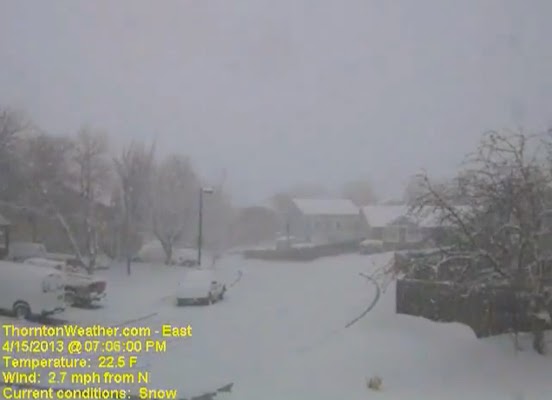
April 15, 2013 - Snow far exceeding forecast amounts made for a wintry tax day in Thornton. (ThorntonWeather.com)
Mother Nature delivered a potent blast of wintry weather for Tax Day catching forecasters and residents off guard. The mid-April snowstorm brought a hefty shot of snow and cold temperatures to Denver and northeastern Colorado.
Two days before the event models pointed to significant snowfall for Tax Day. Soon however those same models shifted their target to the north and the metro area was only expected to receive light snow.
The heavy snow moved further south than anticipated however and by mid-afternoon on Monday, April 15 the storm was getting started in earnest. Snowfall rates of up to 2 inches per hour were seen from then through midnight.
The video below captures 24 hours of the event from 6:00am on April 15 to 6:00am to April 16. Only light snow is seen through about 2:00pm on the 15th before things really start to pick up.
Heavy snow in early spring in Colorado is not unheard of by any means with six of Denver’s top 24 snowstorms having occurred during April. The snowstorm that struck the Mile High City however caught forecasters and…
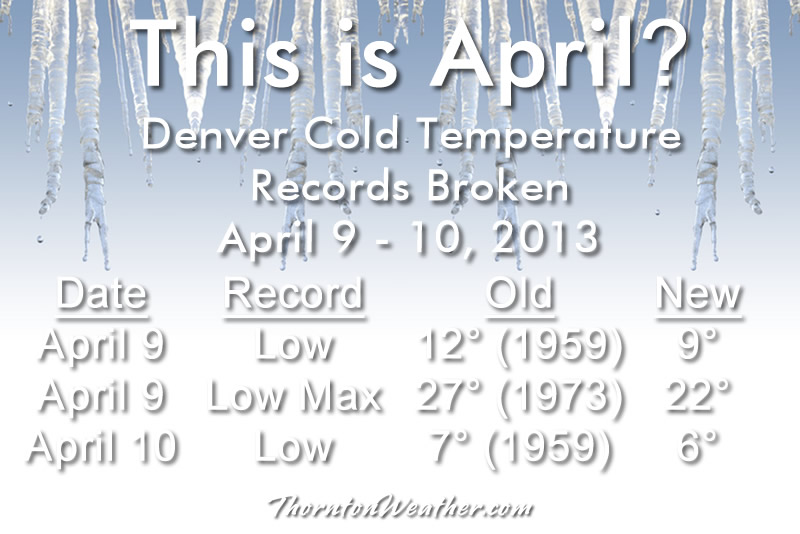
April 9th and 10th brought Denver's first record low temperatures since October 10, 2009. Click the image for a larger view.
While April may normally be associated with showers, Mother Nature sometimes throws us a curveball. Such was the case with the bitter cold temperatures she delivered that broke records, one dating back more than 50 years ago.
Denver’s official temperature as measured at Denver International Airport dropped to 9 degrees just before midnight last night. This sets a new record low temperature for April 9, easily besting the previous record of 12 degrees set in 1959. Here in Thornton our low was 10.4 degrees.
Additionally, a new record low maximum temperature was recorded yesterday as well. The ‘high’ temperature was 22 degrees, recorded shortly after midnight. The previous record low maximum for April 9 was 27 degrees set in 1973. The 22 degree reading was the sixth coldest high temperature ever recorded in April. Thornton was slightly warmer with a high of 24.9 degrees.
As the cold front moved out, the chilly temperatures lingered into the morning of April 10. The mercury at DIA dropped to 6 degrees setting a new record low temperature for the date and making it the fourth coldest low temperature ever recorded in April. The previous record low for the date was 7 degrees set in 1959. In Thornton the temperature hit a low of 6.7 degrees right at 6:00am.
It is interesting to note that these are the first daily cold weather related records Denver has set in more than two years.
Old Man Winter isn’t done with Colorado yet. Monday brought unseasonably warm temperatures and a chance for thunderstorms. Monday night and into Tuesday we can expect a healthy shot of snow and some temperatures tomorrow more like we expect in January.
We will be monitoring monitoring the storm very closely and posting regularly to our Facebook page and Twitter feed. You can follow along in real time below. We are also on Google+ here.



 Mother Nature can be a fickle lady as we are now seeing. While the calendar says spring, she is quite content to visit wintry weather on us once again.