
|
The typhoon with international name “Soudelor” (International Name) continues to gain strength and expected to enter the Philippine Area of Responsbility (PAR) by Wednesday morning, the Philippine Atmospheric Geophysical and Astronomical Services Administration (PAGASA) said in its weather bulletin issued at 11 a.m. on Tuesday. PAGASA said that as of 10 a.m. The Typhoon “Soudelor” was… Continue reading Update: Typhoon Soudelor continues to intensify |
Over 100 dead in India floods
|
New Delhi (dpa) – More than 100 people have been killed, most of them in India’s eastern states, during heavy rains and floods over the past week, officials said Monday. More than 4 million people in 10,000 villages were affected in the states of West Bengal, Orissa and Manipur after cyclone Komen struck the region on… Continue reading Over 100 dead in India floods |
July 2015 weather recap: Cooler than normal temps, a bit drier than average
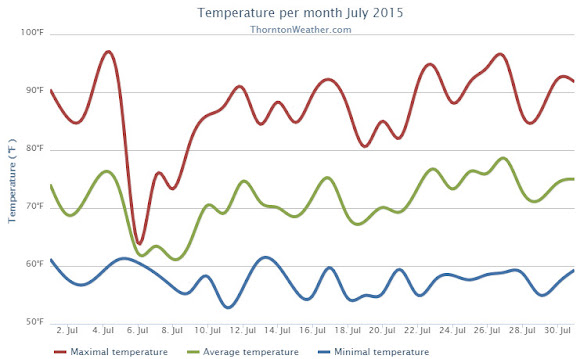
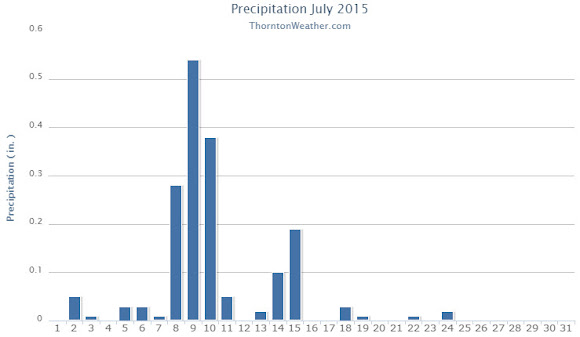
The month of July continued the recent trend of cool, damp weather. By the time it was said and done though, while temperatures overall were below average, precipitation fell short of normal.
Temperatures were at or above normal for the first few days allowing for a pleasant Independence Day.
The day after, however, a monsoonal weather pattern cooled things down and brought most of the month’s moisture over the following 10 days.
Ridging then built and we settled into a relatively normal period for the final two weeks although precipitation became scarcer.
Thornton saw an average temperature for July 2015 of 71.2 degrees. This was a good bit below the long term Denver average of 74.2 degrees. Out at Denver International Airport where the Mile High City’s official measurements are taken, the average for the month was 72.8 degrees.
Our temperatures ranged from a high of 96.1 degrees on the 27th down to a low of 53 degrees on the 11th. Denver saw a maximum of 97 degrees and a minimum of 52 degrees.
Denver averages 2.16 inches of precipitation during July. Thornton fell a bit short of that mark recording 1.76 inches. At the airport, only 1.06 inches was recorded.
Click here to view Thornton’s July 2015 climate report.
CLIMATE REPORT
NATIONAL WEATHER SERVICE BOULDER, CO
202 PM MDT SAT AUG 1 2015

...................................

...THE DENVER CO CLIMATE SUMMARY FOR THE MONTH OF JULY 2015...

CLIMATE NORMAL PERIOD 1981 TO 2010
CLIMATE RECORD PERIOD 1872 TO 2015

WEATHER         OBSERVED          NORMAL  DEPART  LAST YEAR`S
                 VALUE   DATE(S)  VALUE   FROM    VALUE  DATE(S)
                                          NORMAL
................................................................
TEMPERATURE (F)
RECORD
 HIGH             105   07/20/2005
 LOW               42   07/04/1903
                        07/31/1873
HIGHEST            97   07/27                        100  07/07
LOWEST             52   07/28                         55  07/17
                                                          07/16
AVG. MAXIMUM     87.6              89.4    -1.8     88.3
AVG. MINIMUM     57.9              58.9    -1.0     60.6
MEAN             72.8              74.2    -1.4     74.5
DAYS MAX >= 90     16              16.0     0.0       17
DAYS MAX <= 32      0               0.0     0.0        0
DAYS MIN <= 32      0               0.0     0.0        0
DAYS MIN <= 0       0               0.0     0.0        0
PRECIPITATION (INCHES) RECORD
MAXIMUM         6.41   1965
MINIMUM         0.01   1901
TOTALS           1.06              2.16   -1.10     3.85
DAILY AVG.       0.03              0.07   -0.04     0.12
DAYS >= .01        12               8.3     3.7        8
DAYS >= .10         3               4.3    -1.3        6
DAYS >= .50         0               1.4    -1.4        2
DAYS >= 1.00        0               0.7    -0.7        2
GREATEST
 24 HR. TOTAL    0.33   07/18/15                    2.85  07/29/14
                        07/18/15                          07/30/14

SNOWFALL (INCHES)
 TOTAL            0.0                                0.0

DEGREE_DAYS
HEATING TOTAL       5                 6      -1        5
 SINCE 7/1          5                 6      -1        5
COOLING TOTAL     251               289     -38      304
 SINCE 1/1        409               444     -35      431

FREEZE DATES
RECORD
 EARLIEST     09/08/1962
 LATEST       06/08/2007
EARLIEST                        10/07
LATEST                          05/05
..................................................

WIND (MPH)
AVERAGE WIND SPEED              9.3
RESULTANT WIND SPEED/DIRECTION   3/176
HIGHEST WIND SPEED/DIRECTION    46/320    DATE  07/15
HIGHEST GUST SPEED/DIRECTION    60/330    DATE  07/15

SKY COVER
POSSIBLE SUNSHINE (PERCENT)   MM
AVERAGE SKY COVER           0.60
NUMBER OF DAYS FAIR            4
NUMBER OF DAYS PC             22
NUMBER OF DAYS CLOUDY          5

AVERAGE RH (PERCENT)     52

WEATHER CONDITIONS. NUMBER OF DAYS WITH
THUNDERSTORM              0     MIXED PRECIP               0
HEAVY RAIN                3     RAIN                       1
LIGHT RAIN               16     FREEZING RAIN              0
LT FREEZING RAIN          0     HAIL                       0
HEAVY SNOW                0     SNOW                       0
LIGHT SNOW                0     SLEET                      0
FOG                       7     FOG W/VIS <= 1/4 MILE      0
HAZE                      6

-  INDICATES NEGATIVE NUMBERS.
R  INDICATES RECORD WAS SET OR TIED.
MM INDICATES DATA IS MISSING.
T  INDICATES TRACE AMOUNT.
Thornton’s August weather preview: Cooler weather arrives
As summer vacations wind down and families prepare to send their kids back to school in August, Colorado weather also starts to settle down. The chances for severe weather decrease markedly during August and by the end of the month daytime temperatures are dropping quite a bit as well.
Find out more about what lies ahead with Thornton’s August weather here.

July 2015 top shots: Monthly photo slideshow

Colorado offers outdoor opportunities unlike any other state and while the summer heat settles in, photos of the amazing scenes across our state provide a view into why we love it here so much.
The weather this time of year has a pretty standard pattern of quickly warming temperatures followed by afternoon thunderstorms that can cool things down. These storms sometimes provide a good bit of ‘excitement’ and are a prime photo subject.
- Slideshow updated July 31, 2015
Recreationalists head outdoors and take advantage of urban, suburban and rural opportunities. As they do, our abundant wildlife that is found just about anywhere comes into focus.
Showcasing images captured by ThorntonWeather.com readers as well as some of our own, our monthly slideshow covers the entire gamut of weather and nature related imagery. Sunsets, sunrises, wildlife and of course every type of weather condition are vividly depicted.
To learn more about how to send your photo to us for inclusion in the slideshow, see below the slideshow.
| [flickr_set id=”72157656079164135″] |
What is missing in the slideshow above? Your photo!
Our monthly photo slideshow is going to feature images that we have taken but more importantly images that you have captured. The photos can be of anything even remotely weather-related.
Landscapes, current conditions, wildlife, pets, kids. Whimsical, newsy, artsy. Taken at the zoo, some other area attraction, a local park, a national park or your backyard. You name it, we want to see and share it!
Images can be taken in Thornton, Denver or anywhere across the extraordinary Centennial State. We’ll even take some from out of state if we can tie it to Colorado somehow.
We’ll keep the criteria very open to interpretation with just about any image eligible to be shown in our slideshows.
What do you win for having your image in our slideshow? We are just a ‘mom and pop’ outfit and make no money from our site so we really don’t have the means to provide prizes. However you will have our undying gratitude and the satisfaction that your images are shared on the most popular website in Thornton.
To share you images with us and get them included in the slideshow just email them to us or share them with ThorntonWeather.com on any of the various social media outlets. Links are provided below.
So come on, get those camera’s rolling!
- Email: info@ThorntonWeather.com
- Facebook: https://www.facebook.com/ThorntonWeather
- Google+: https://plus.google.com/+Thorntonweather
- Twitter: @ThorntonWeather (https://twitter.com/thorntonweather)
Climate change ‘urgent and growing threat’ to national security: Pentagon
|
A new Pentagon report says that climate change is an “urgent and growing threat to our national security” and blames it for “increased natural disasters” that will require more American troops designated to combat bad weather. Some studies have questioned whether such a trend exists. Says the Pentagon report released Wednesday, “Global climate change will have… Continue reading Climate change ‘urgent and growing threat’ to national security: Pentagon |
Freakishly High Temperatures Trigger Tajikistan Floods
|
Mudflows and flooding triggered by an ice melt in the central Asian country of Tajikistan have displaced more than 600 people, according to the International Organization for Migration (IOM). Usually high summer temperatures in Tajikistan, home to 8.4 million people, caused a glacial melt on July 16. The resulting water runoff hit the Shughnon district in… Continue reading Freakishly High Temperatures Trigger Tajikistan Floods |
July 26 to August 1: This week in Denver weather history
Weather can be deadly – we are all well (hopefully) aware of that. Looking at this week in Denver weather history we are reminded of that and the tragedy that weather can bring to our state. We see numerous cases of lightning causing death and injury but no one incident highlights the dangers of weather more than what occurred on July 31, 1976. The Big Thompson Flood was Colorado’s worth weather-related disaster and claimed 144 lives. More details on all these events are below.
13-5
In 2008…a streak of 26 consecutive days of 90 degrees shattered the previous record of 18 consecutive days established in 1901 and 1874. Ironically…no new single day record high temperatures were set in the month of July. In August however…a record of 104 degrees was set on the 1st…and another record of 103 degrees was set on the 2nd. In addition…a record low min of 70 degrees was set on August 2nd.
18-2
In 1987…a streak of 16 consecutive days of 90 degrees ranked 4th on the list of hot streaks. The record of 24 consecutive days was established in the summer of 2008.
26
In 1891…a thunderstorm produced sustained northeast winds to 44 mph with gusts to 60 mph and 0.16 inch of rain.
In 1894…a thunderstorm produced sustained southwest winds to 36 mph with gusts to 58 mph…but only 0.04 inch of rain.
In 1910…the high temperature reached 100 degrees in downtown Denver.
In 1959…a Denver man was stunned while standing by a car that was struck by lightning. He was treated for burns and shock at a local hospital. Thunderstorm winds gusted to 55 mph at Stapleton Airport.
In 1983…two heavy thunderstorms hit the northern and western suburbs. The first drenched Northglenn with an inch of rain in 30 minutes. The second storm dumped an inch or more of rain in Idaho Springs and Evergreen. The heaviest rainfall… 2.90 inches in an hour…caused minor street flooding in Golden.
In 1984…heavy early morning thunderstorms drenched the foothills southwest of Denver. Rainfall to 1 1/2 inches in just 30 minutes occurred between Evergreen and Conifer. In nearby turkey creek canyon…1.80 inches of rain was recorded in 35 minutes.
In 1985…a long rope-like white tornado touched down 5 miles east of Erie and stayed on the ground…mainly over an open field…for 18 minutes. However…the twister damaged a few cars on I-25 and injured 3 people from broken glass. The storm flipped over a van…blew out car windows…and ripped a highway sign. It also blew an outbuilding off its foundation. A tornado also touched down briefly 8 miles north of Bennett. No damage was reported from this storm.
In 1988…a 9-year-old girl was slightly injured by lightning in Parker.
In 2003…a severe thunderstorm in and south of Franktown produced hail as large as 1.75 inches in diameter.
26-27
In 1885…heavy cloudbursts on the palmer divide south of Denver caused flooding on Cherry Creek in the city overnight. The high water washed away street and railroad bridges and a few houses. The flood waters completely inundated the rail yards in lower downtown. This was the worst flood on Cherry Creek since May 19-20…1864…but the damage was mitigated by stream improvements and fewer structures near the channel. There was also no simultaneous flood on the South Platte River to slow the flow of water through the city. Rainfall in the city was only 0.08 inch on the 26th.
27
In 1897…an apparent dry microburst produced sustained west winds to 48 mph with gusts to 60 mph and a trace of rain.
In 1901…a thunderstorm produced north winds to 38 mph with gusts to 41 mph and rainfall of only 0.01 inch in downtown Denver. This was the only measurable rainfall of the month… Making this the driest July on record.
In 1953…an unconfirmed tornado in south Lakewood touched down briefly and abruptly dissipated. No damage was reported from the twister.
In 1955…the public sighted a funnel cloud estimated at 500 feet above the ground near the western edge of Lowry Field. Wind estimates up to 60 mph were reported in the vicinity.
In 1956…a severe thunderstorm produced 3/4 inch diameter hail and wind gusts to 48 mph at Stapleton Airport where rain fall totaled 1.08 inches.
In 1965…a tornado was sighted 21 miles south of Denver in Douglas County. No damage was reported.
In 1977…a thunderstorm wind gust to 51 mph was recorded at Stapleton International Airport. A funnel cloud was sighted by an aircraft east of Parker.
In 1982…heavy rain doused Boulder with 1 1/2 to 3 inches of rain over a short period of time…causing extensive street flooding.
In 1984…strong thunderstorms drenched several areas. Rainfall of 1.04 inches occurred in just 20 minutes at Boulder. Downpours also hit Aurora and northeast Denver… Delaying flights at Stapleton International Airport for an hour. Up to 3/4 inch of rain fell in central Aurora in 15 minutes.
In 1989…lightning hit a home in Littleton…setting a bed on fire. Damage was confined to the bedroom.
In 1994…lightning struck a furniture store in Boulder… Igniting a fire which caused major damage to the building and contents.
In 1997…lightning sparked a fire…causing extensive damage to a home in Watkins. Heavy rain caused Lena Gulch to surge 2 feet over its banks in Golden. The fire department had to rescue a man when his van stalled in high waters. High waters from swollen creeks and streams washed out bridges and several sections of road in southeast Aurora. A 200-to-300 foot section of road was washed away where Picadilly Street dips across coal creek. Three youths had to be rescued when they became stranded by rapidly rising water in another normally dry creek bed.
In 1999…lightning was suspected of igniting a fire which caused substantial damage to a farm in Hudson. The blaze destroyed a 10-foot by 60-foot metal pole barn…a pick-up truck…a SUV…a boat and trailer…3 four wheeler vehicles… And other farm equipment.
In 2007…a man was struck and killed by lightning while jogging at Matthews Winters Park in Morrison.
Continue reading July 26 to August 1: This week in Denver weather history
2005’s Hurricane Katrina led to improvement in storm forecasting
|
FORT LAUDERDALE, Fla. — Hurricane Katrina, the most-destructive and third-deadliest storm in U.S. history, also was a force for change, spurring major advancements in forecasting and communication. Since its rampage in late August 2005, scientists have developed several new high-tech tools to better predict the strength and track of storms, in hopes of preventing a similar… Continue reading 2005’s Hurricane Katrina led to improvement in storm forecasting |
July 19 to July 25: This week in Denver weather history
This week in weather history we really begin to see the arrival of monsoon season and the heavy rains and flooding it can bring to the Thornton and Denver area. Be sure to check out the events on the 23rd and what the heavy rain brought to the Thornton area in 2004.
1-31
In 2012…it was the hottest July on record in Denver since weather records began in 1872. The average temperature for the month was 78.9 degrees which was 4.7 degrees above normal. There were 27 days in which the high temperature equaled or exceeded 90 degrees…which established a new record. There were also 7 days in which the temperature equaled or exceeded 100 degrees which tied the record set in 2005.
7-25
In 1934…a streak of 15 consecutive days of 90 degrees ranked 5th on the list of hot streaks. The record of 24 consecutive days was established in the summer of 2008.
13-5
In 2008…a streak of 26 consecutive days of 90 degrees shattered the previous record of 18 consecutive days established in 1901 and 1874. Ironically…no new single day record high temperatures were set in the month of July. In august however…a record of 104 degrees was set on the 1st…and another record of 103 degrees was set on the 2nd. In addition…a record low min of 70 degrees was set on august 2nd.
18-19
In 2003…heavy rain producing thunderstorms caused flash flooding across southern metro Denver. Automated rain gages measured 2 to 3 inches of rain in less than an hour. The heavy rainfall caused many intersections and underpasses to flood…stranding motorists. Sections of I-25 and I-225 were closed due to the high water.
18-2
In 1987…a streak of 16 consecutive days of 90 degrees ranked 4th on the list of hot streaks. The record of 24 consecutive days was established in the summer of 2008.
19
In 1875…recent heavy rains produced high waters on many creeks and rivers in the area…which threatened the destruction of property at some locations. Cherry Creek in the city was running the highest in 10 years. Heavy rain in the mining regions over the last 2 days resulted in water running “everywhere” and the suspension of some work.
In 1881…a thunderstorm passing across the city produced lightning with no rain. A woman was seriously injured when struck by lightning several blocks from the weather office in downtown Denver.
In 1934…the temperature reached a high of 100 degrees in downtown Denver.
In 1965…hail…rain…and lightning hit west metro Denver. Hail stones as large as 1 1/2 inches in diameter accumulated to a depth of 2 inches in Evergreen where 2.95 inches of rain in 2 hours caused some flooding in the business section of the town. Lightning caused some power outages.
In 1973…two funnel clouds were observed 5 miles southeast of Littleton. The same funnel clouds were observed for 20 minutes…5 miles west and 5 miles west-southwest of Arapahoe County airport…now Centennial Airport.
In 1975…lightning injured a man in Denver and caused power outages in Aurora…Lakewood…Westminster…and west Denver.
In 1984…strong thunderstorm winds gusting to 45 mph shattered 7 large plate glass windows at Stapleton International Airport.
In 1985…a tornado touched down in the surrey ridge area of northern Douglas County…just west of I-25. Ten homes were damaged; one under construction was nearly destroyed. Two vehicles were thrown off I-25 injuring three people. A pick-up truck was thrown 50 feet by the twister. In addition…a cluster of severe thunderstorms pounded all of metro Denver with torrential rain…hail…and wind. The heaviest rain fell in Aurora where one location reported 2.37 inches in just 40 minutes. One location in northeast Aurora received a total of 4.30 inches from the storm. There was extensive street and basement flooding…and a number of roads were damaged or washed out. An Aurora boy suffered minor injuries when he was washed into a drainage ditch. Golf ball size hail in Aurora piled up to 5 inches deep. An inch of rain fell in 20 minutes at Stapleton International Airport…closing it to air traffic for an hour. Up to 1 1/2 inches of rain fell in just 15 minutes over central Denver with the high water closing I-25. The water was so deep on the freeway…that one vehicle was completely submerged and people were diving into the water from the freeway overpass. Three homes in Littleton were damaged by lightning. Wind blew out several windows from a high rise apartment building in southeast Denver. Rainfall totaled 1.51 inches at Stapleton International Airport.
In 1997…torrential rain and damaging hail pummeled eastern sections of metro Denver. Hail up to 1.25 inches in diameter fell at the national weather service office on the site of the former Stapleton International Airport. The hail continued for about 15 minutes and accumulated to a depth of 2 to 3 inches…causing extensive damage to cars in the area. Heavy rainfall totaled 3.83 inches in about an hour from the nearly stationary thunderstorm. Numerous cars stalled along I-70…and several homes were flooded in east Denver. The roof of a building collapsed under the weight of the water. The next day several “fatalities” were discovered near the national weather service office; two prairie dogs were found dead along with three rabbits that either drowned or were killed by the large hail.
In 1999…lightning struck two residences in Littleton…but caused only minor damage. Lightning triggered a fire at a residence in cherry hills village. A small portion of the roof and ceiling were damaged before the fire could be extinguished.
In 2000…hail as large as 1.25 inches in diameter fell near Roggen northeast of Denver.
In 2004…heavy rainfall caused flooding on the Virginia Canyon Road near Idaho Springs…which had to be closed for repairs.
In 2006…the temperature climbed to a high of 100 degrees. The high temperature was not a record maximum for the date.
In 2007…a severe thunderstorm produced large hail…up to 1 inch in diameter…about 6 miles north of Northglenn.
19-23
In 2005…the high temperature climbed above 100 degrees on each of the 5 days with readings of 101 on the 19th…105 on the 20th…104 on the 21st…and 102 on both the 22nd and 23rd. A new record maximum temperature for the month of July of 105 degrees was set on the 20th…which also equaled the all time record maximum for Denver of 105 degrees first set on august 8th in 1878. Daily maximum temperature records were set on each day…and the 5 day period equaled the record for the most consecutive days of 100 degrees or more first set from July 4th through 8th in 1989. The intense heat resulted in a high use of electricity for cooling purposes. The demand for electric power exceeded the supply and rolling black-outs… Each lasting about an hour…were scheduled across metro Denver during the afternoons and early evenings.
20
In 1898…an apparent thunderstorm produced sustained northwest winds to 45 mph with gusts to 51 mph.
In 1939…the high temperature reached 102 degrees in downtown Denver. This was the highest temperature recorded since august 8…1878…a period of 61 years…and the third highest temperature of record at the time. Six miles to the east… At Denver municipal airport…the maximum temperature reached 104 degrees. A dry period during mid-July…combined with low relative humidities…resulted in an unusually large number of forest fires in the mountains west of Denver.
In 1941…an afternoon thunderstorm caused two lightning deaths. The men were struck by lightning near the Denver airport.
In 1951…a thunderstorm wind gust to 54 mph was recorded at Stapleton Airport.
In 1965…heavy rain west of Denver damaged roads and bridges. Two bridges in Golden were washed out. Lightning in Denver caused some power failures and fires…mostly in the northeast section of the city. Heavy rain caused street flooding in the city of Denver. Hail as large as 1/2 inch in diameter and 0.40 inch of rain in 5 minutes were measured at Stapleton International Airport where precipitation totaled 1.09 inches. Lightning damaged a house in Littleton…and caused a power outage in idaho springs.
In 1973…lightning damage was reported west of Arvada.
In 1975…heavy rains caused flash flooding across metro Denver…resulting in the closing of several streets and damage to numerous homes and businesses. Hail 1/2 to 3/4 inch in diameter was reported.
In 1976…heavy thunderstorms caused flooding of streets in southeast Denver and western Arapahoe counties. A total of 3.35 inches of rain was measured at Kassler southwest of Littleton.
In 1978…a girl was injured by lightning at a country club southwest of Denver.
In 1984…heavy rain was reported just east of Buckley Field in Aurora where 1.15 inches fell in just 45 minutes.
In 1986…thunderstorms dumped heavy rain across metro Denver causing extensive street flooding…power outages…and basement flooding. The greatest recorded rainfall was 4.39 inches in Lakewood. In extreme northwest Denver…2.29 inches of rain fell in just 20 minutes. Arvada was drenched with 2.60 inches of rain…and over an inch fell in southeast Denver and adjacent sections of Aurora.
In 1990…heavy thunderstorm rains caused flash flooding in sections of Littleton where 1.20 inches of rain fell in less than 30 minutes. The deluge caused dry creek to jump its banks…causing damage to residential streets…curbs…and sidewalks. Nearly 100 vehicles were stranded for a time in fender-deep water when sewers and drainage ditches became choked with debris. The heavy runoff submerged many Littleton streets and intersections.
In 1992…strong thunderstorms moved slowly through east metro Denver…producing rainfall up to 2.50 inches in a short time. Weather spotters reported 0.75 to 1.00 inch of rain in less than 30 minutes. Many areas of southeast Denver were flooded…including I-25 where up to 6 feet of water filled some underpasses. Hail to 3/4 inch in diameter fell in Aurora.
In 1995…a tornado touched down briefly in an open field near Strasburg. Thunderstorm winds gusted to 58 mph at Centennial Airport.
In 1996…strong thunderstorm winds damaged the building of a telephone installation company in the city of Denver.
In 1998…the high temperature reached 100 degrees at Denver International Airport.
In 2006…heavy rainfall in the overland wildfire burn area caused minor flash flooding in Jamestown. The roads behind the Jamestown fire hall were washed out…when a culvert was blocked by debris. A rockslide was also reported in town.
In 2009…a severe thunderstorm produced damaging winds… Large hail and very heavy rain across the western and southern suburbs of Denver. Widespread damage was observed in the cities of Arvada…Lakewood and Wheat Ridge. The intense straightline winds were the result of a wet microburst which downed hundreds of trees and snapped power poles. Wind gusts to 80 mph were reported along with hail up to 1 3/4 inches in diameter. The combination of wind and hail caused widespread damage to homes and vehicles. The damage claim estimates totaled 350 million dollars; about 32900 claims were filed for homes…while another 19500 claims were filed for vehicles. As many as 90000 homes and businesses were left without power. In some areas it took up to 3 days to completely restore electrical service. Minor injuries were reported from broken glass during the storm…but no one was hospitalized. The storm crippled the computers at the Colorado crime information center in Lakewood for nearly 3 hours. One weak tornado touched down near Parker but did no damage. In southern weld County… Severe thunderstorms produced widespread damage over 150 square miles of farmland. In all…400 farms were directly impacted by severe weather. Damage to crops alone was estimated to 3 million dollars. At Denver International Airport…a peak wind gust to 48 mph was observed from the northeast. In addition…1.01 inches was measured at the airport.
In 2013…severe thunderstorms produced large hail… Ranging in size from nickel to golf ball…across portions of Arapahoe… Denver…Elbert and Weld counties. In addition… Damaging wind gusts to 60 mph snapped large tree branches in Thornton and 3 miles west-southwest of Buckley AFB. In Bennett…hail up to 1 1/2 inches in diameter was reported. At Denver International Airport…a peak wind gust to 58 mph was recorded from the northeast.
Continue reading July 19 to July 25: This week in Denver weather history