Denver tied the record high temperature for the date today.
At 3:44pm today, the temperature at Denver International Airport reached 84 degrees. This tied the record high temperature for October 18th set in 2003 and 1958. The average temperature for this date is 68 degrees so we exceeded that by a large margin.
From record setting cold last week to record setting warmth this week – you have to love Colorado weather!
Here in Thornton we were actually a touch warmer reaching 85.9 degrees. We have one more day of above normal temperatures ahead on Monday before we see a change that will bring cooler temps and possibly rain and snow.
October 18 to October 24 - This week in Denver weather history
This week is an extremely eventful one in Denver weather history with a wide variety of conditions having been experienced in the past. Wind and snow are probably the two most dominant items, none more so than the blizzard that struck 12 years ago on the 24th. That storm ravaged the city, closed the airport and highways and was responsible for four deaths.
From the National Weather Service:
From the 17th to the 19th:
In 1908…a moist…heavy…wet snowfall totaled 13.0 inches in downtown Denver over the 3 days. Rain from early morning on the 17th changed to snow by late afternoon and continued through the late morning of the 19th. Due to temperatures in the 30’s and melting…the most snow on the ground was only 5.0 inches at 6:00 pm on the 18th. Northwest to northeast winds were sustained between 12 and 20 mph during the storm. Precipitation totaled 1.82 inches.
On the 18th:
In 1875…the haze was so dense that the mountains were not visible from downtown Denver for most of the day.
In 1937…a vigorous cold front produced north winds sustained to 32 mph with gusts to 41 mph. Rain and snow totaled 0.16 inch. Post-frontal snowfall of 0.8 inch was the only snowfall of the month.
In 1960…post-frontal upslope rain changed to snow. Snowfall was 2.2 inches at Stapleton Airport where precipitation (rain and melted snow) totaled 1.58 inches.
In 1971…wind gusts to 48 mph were recorded in downtown Boulder. West winds gusted to 30 mph at Stapleton International Airport.
In 1999…heavy snow developed in the foothills west of metro Denver with lesser amounts across the city. Snowfall totals included: 7 inches near Nederland…6 inches in Boulder…and 5 inches at Chief Hosa. Only 1.2 inches of snow were measured at the site of the former Stapleton International Airport.
From the 18th to the 23rd:
In 2003…an extended warm spell resulted in 5 new temperature records. The high temperature of 84 degrees on the 18th equaled the record high for the date. High temperatures of 86 degrees on the 19th…83 degrees on the 21st…and 84 degrees on the 22nd were record highs for the dates. Low temperature of 49 degrees on the 23rd was a record high minimum for the date. Low temperatures during the period were in the 40’s and lower 50’s.
On the 19th:
In 1887…northwest winds sustained to 42 mph were recorded in the city.
In 1982…3 to 6 inches of snow fell over northwest metro Denver…including Boulder. Only 1.2 inches of snowfall were recorded at Stapleton International Airport where north winds gusted to 35 mph. This was the first measurable snowfall of the season.
Record setting cold arrived in Denver, breaking three records and nearly hitting a fourth.
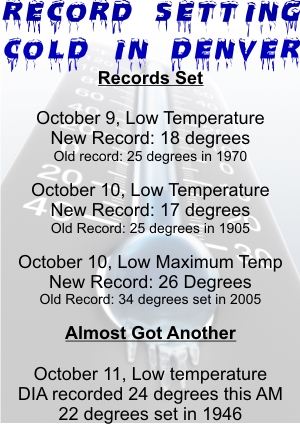
Following on two low temperature records Friday and Saturday, a third was set Saturday when the mercury climbed to a high of only 26 degrees. That easily smashed the previous record low maximum for the date of 34 degrees set in 2005.
Friday night the cold front moved in and temperatures plummeted 23 degrees in five hours. Before midnight the mercury read 18 degrees thus shattering the old low temperature record for October 9th of 25 degrees. That record dated to 1970.
Saturday morning the low temperature at Denver International Airport dropped to 17 degrees. That set a new record low temperature for October 10th as well. The previous record low of 25 degrees was set more than a century ago in 1905.
A fourth record, for Sunday’s low temperature, was within reach but the mercury didn’t quite dip far enough. The record low for the date is 22 degrees, set in 1946. This morning the temperature at DIA dropped to 24 degrees which while chilly, didn’t quite go far enough.
Sunday will be the first time since Friday night with temperatures above the freezing mark in Denver although it will remain 20 degrees cooler than normal. The forecast high today is 49 degrees whereas the average for this date is 69 degrees.
For the Rockies game, at the first pitch the temperature will be around 38 degrees. The mercury will slowly drop during the game and be down to around 35 by 11:00pm.
The Rockies aren’t the only game in town today either. The Denver Broncos host the New England Patriots at 2:00pm. For the game at Invesco Field at Mile High, it should be great football weather. It will be 47 degrees at kickoff and remain right in that vicinity throughout. A slight breeze around 5 mph will make it feel a touch cooler than that.
For the longer term, temperatures throughout the week will remain cooler than normal. Columbus Day temps will actually be a touch cooler than today before we start a slight warm-up for the rest of the week.
October 11 to October 17 - This week in Denver weather history
A very eventful week of weather in Denver weather history. Many notable items have occurred and many also incorporate one of two conditions – wind or snow. Probably the most famous event was the Bronco Blizzard on October 15, 1984. That storm which hit its height during a Monday Night Football game between the Broncos and the Packers is probably one of the most memorable ever for longtime Denver residents.
10-11
In 1986…the first significant snowstorm of the season produced 2 to 5 inches of snow over metro Denver with 5 to 10 inches in the foothills west of Denver. Wondervu recorded the most snow from the storm…13 inches. The heavy wet snow caused numerous power outages. The storm was accompanied by strong north winds with gusts to 41 mph recorded on the 10th. The first snowfall of the season totaled 3.1 inches at Stapleton International Airport with only one inch on the ground due to melting. The strong cold front accompanying the storm cooled the temperature from a high of 73 degrees on the 10th to a high of only 33 degrees on the 11th…which was a record low maximum for the date.
10-12
In 1969…the second heavy snowstorm in less than a week dumped nearly a foot of snow across metro Denver and plunged the area into extremely cold temperatures for so early in the season. Snowfall totaled 11.0 inches at Stapleton International Airport. North winds gusting to 26 mph produced drifts up to 2 feet deep. Temperatures dipped from a high of 52 degrees on the 10th to a record low for the date of 10 degrees on the 12th. There was additional damage to trees and power and telephone lines from heavy snow accumulations and icing. Travel was restricted or blocked by drifting snow in both the mountains and on the plains east of Denver.
11
In 1997…damaging winds ahead of an approaching storm system developed in the foothills and spread across metro Denver. Winds gusted to 88 mph at Conifer…71 mph at the National Center for Atmospheric Research on the mesa in Boulder… And 53 mph at Denver International Airport. Several trees and street signs were blown down with scattered power outages reported throughout metro Denver. In Arvada…a car window was blown out by a strong wind gust.
11-12
In 1901…an apparent cold front produced northeast winds sustained to 42 mph with gusts to 48 mph on the 11th. General rain changed to snow overnight and totaled 2.0 inches. This was the first snowfall of the season. Total precipitation was 0.32 inch.
The Arctic blast of cold air that has settled in across much of the nation’s midsection arrived in Colorado Friday night and allowed the Mile High City to set two low temperature records. Two more records may be set today and tonight before we start to warm up on Sunday.
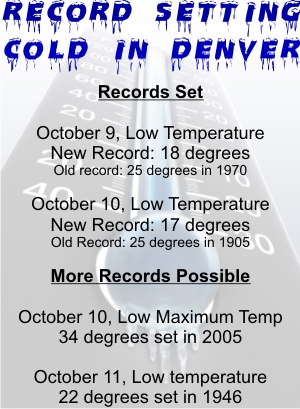
Friday night the cold front moved in and temperatures plummeted 23 degrees in five hours. Before midnight the mercury read 18 degrees thus shattering the old low temperature record for October 9th of 25 degrees. That record dated to 1970. Thornton was a touch warmer than the official station at DIA as we recorded a low of 19.7 yesterday.
This morning the low temperature at Denver International Airport has dropped to 17 degrees. That sets a new record low temperature for October 10th as well. The previous record low of 25 degrees was set more than a century ago in 1905. At ThorntonWeather.com we have been a bit chillier having recorded a low of 16.3 degrees this morning.
The record low maximum temperature for today is 34 degrees, set in 2005. With temperatures today forecast to struggle to get above freezing, that could be the third record set.
Lastly, a fourth record is possible and indeed, quite likely. The record low temperature for the 11th of October (Sunday) is 22 degrees set in 1946. Current forecasts put the overnight low Saturday night / Sunday morning as possibly hitting down the mid to upper teens thus setting up the potential to break that record.
That would be four record setting cold temperature records in a 48 hour span!
As the Colorado Rockies return home to play game 3 of the National League Divisional Series against the Philadelphia Phillies, the weather could prove to be a tougher opponent than the opposing team. As we forecast early this week, a major blast of Arctic air will be arriving over Colorado tonight and will send thermometers plunging, possibly into record setting territory.
Over the next 48 hours, Denver could break three, very chilly records:
The record low temperature for Denver on the 10th of October (Saturday), the day of the game, is 25 degrees. That was set more than 100 years ago in 1905. Tonight’s / tomorrow morning’s forecast low temperatures are expected to be in the low 20’s.
The record low maximum temperature for the 10th is 34 degrees, set in 2005. Tomorrow’s forecast high temperature is expected to be in the mid 30’s.
The record low temperature for the 11th of October (Sunday) is 22 degrees set in 1946. Current forecasts put the overnight low Saturday / Sunday morning as possibly hitting down to 17 degrees.
Of the three, it seems pretty likely we will break the first and the third record listed. The second one is a bit up in the air.
October 4 to October 10 - Today in Denver weather history
A very eventful week in Denver weather history with a wide variety of events from snow to summer-like severe weather. Most notable is five years ago today when multiple tornadoes touched down in the Brighton area. Read more about it below and check out the video on Examiner.com.
From the National Weather Service:
From the 3rd to the 4th:
In 1969…the first snowfall of the season totaled 16.0 inches at Stapleton International Airport. There was a thunder snow shower on the evening of the 3rd…but otherwise little wind with the storm. The greatest snow depth on the ground was 8 inches due to melting. Heavy wet snow accumulated on trees…which were still in full leaf…and caused widespread damage from broken limbs and downed utility lines.
From the 3rd to the 5th:
In 1984…the remnants of pacific hurricane polo produced heavy rain over northeastern Colorado. Most locations received between 1.00 to 2.50 inches of rain…but 3.45 inches fell in Littleton. Rainfall totaled 1.73 inches at Stapleton International Airport…where north winds gusted to 24 mph.
On the 4th:
In 1912…sustained south winds to 55 mph with gusts to 60 mph raised the temperature to a high of 83 degrees… The warmest temperature of the month that year.
In 1924…west winds were sustained to 46 mph with gusts to 50 mph in the city. The apparent Bora winds cooled the temperature to a high of 57 degrees from a high of 70 degrees on the 3rd.
In 2004…several small tornadoes touched down near Brighton… Barr lake…and Hudson in Adams and southern weld counties. Most of these caused no damage. However…a small tornado 5 miles southeast of Brighton caused extensive damage to a recreational vehicle and severely damaged a barn. The barn was torn from its foundation…and the roof was thrown 100 feet. Four llamas in the barn were injured when it collapsed.
Two days in a row Denver has set or tied record low temperatures.
On Friday at 5:55am the temperature at Denver International Airport dropped to 26 degrees easily setting a new low temperature record for October 2nd. The previous record of 30 degrees was set in 1999 and also in 1959. This was the first freeze of the season. Thornton however remained above the freezing mark with a low of 33.1 degrees.
Following on yesterday’s record setting cold, the Mile High City tied a 109 year old low temperature record this morning. The temperature at Denver International Airport dipped to 31 degrees tying the record low for this date last set in 1900. Unlike yesterday, Thornton was actually cooler than the official Denver temperature having recorded a low of 28.2.
The average date of Denver’s first freeze is October 7th so we are a bit ahead on timing. The earliest date Denver has received freezing temperatures is September 8th which occurred in 1962. The latest date was in 1944 when the mercury didn’t dip to freezing until November 15th.
With the first full month of fall here, October usually brings one of the quietest weather months in the Denver area with plenty of mild, sunny days and clear, cool nights. The month actually has our second highest amount of sunshine with 72 percent with September having the most with 74 percent. Interestingly enough, the month following, November, is one of the lowest sunshine months with only 64 percent. Typically October brings our first real taste of winter with the first freeze on average coming on the 7th of the month and the first snow on the 15th of the month.
Average temperatures in October steadily drop throughout the month. On the first we average 72 degree highs but by the 31st that drops to 59 degrees. October also sees our average low temperatures start to reach below freezing as well. At the start of the month we will average 42 degrees as the low temperature but by the end of the month the mercury dips to 30 degrees. This truly begins the sign that winter is approaching.
ThorntonWeather.com has been featured on the City of Thornton’s cable access channel show Thornton 360. The interview which was conducted in June 2009 features the site’s chief amateur meteorologist Tony Hake discussing the features of ThorntonWeather.com, his interest in the weather and more.
Be sure to check out the video below and let us know what you think. You can also watch it on channel 8 throughout the month of September if you have Comcast cable TV.
ThorntonWeather.com would like to thank the City of Thornton’s Communications Department for their work. Oftentimes we forget how many people it takes to make a city of over 100,000 residents run as well as Thornton does and the city’s employees continually perform above and beyond!
On to the show:
Weather, natural disasters & climate news and information.


 The Rockies aren’t the only game in town today either. The Denver Broncos host the New England Patriots at 2:00pm. For the game at Invesco Field at Mile High, it should be great football weather. It will be 47 degrees at kickoff and remain right in that vicinity throughout. A slight breeze around 5 mph will make it feel a touch cooler than that.
 The Arctic blast of cold air that has settled in across much of the nation’s midsection arrived in Colorado Friday night and allowed the Mile High City to set two low temperature records. Two more records may be set today and tonight before we start to warm up on Sunday.
 Two days in a row Denver has set or tied record low temperatures.
 ThorntonWeather.com has been featured on the City of Thornton’s cable access channel show Thornton 360. The interview which was conducted in June 2009 features the site’s chief amateur meteorologist Tony Hake discussing the features of ThorntonWeather.com, his interest in the weather and more.