Satellite image of Tropical Storm Alex as it prepares to cross the Yucatan Peninsula. (NOAA / Google Earth) Click the image for a complete slideshow of the storm and its forecast path.
The first named storm of the 2010 hurricane season is being watched closely by not only areas at threat from landfall but also those working to clean up the Gulf oil spill. Tropical Storm Alex continued to move to the northwest where it threatens to find warmer water and become a hurricane.
The National Hurricane Center (NHC) places the center of Alex at the current time 75 miles east of Belize City. The storm is packing winds of 45 mph and moving to the west-northwest at 9mph.
On its current path, Alex will reach the coast of Belize and the Yucatan Peninsula late today and move across the peninsula on Sunday. By Sunday night or early Monday morning, it will have transited land and emerge in the Bay of Campeche.
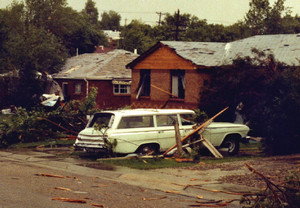
On June 3, 1981, Thornton was the site of the most destructive tornado in the history of the Denver metro area. The City of Thornton is now evaluating options to warn residents of severe weather threats. (City of Thornton archives)
Visitors to ThorntonWeather.com have often asked us if the city was taking any steps to protect its citizens and warn them about severe weather. The city – and Adams County – are lacking any type of alert system. Following last year’s ‘Summer of Storms,’ we were told the city would look into it.
Current options for citizens range from the Emergency Alert System used by television and radio broadcasters, free and pay Internet services as well as NOAA Weather Radio All Hazards (weather radio). As we have discussed previously, these systems have their limitations.
At this week’s city council update session, the Thornton City Council heard a presentation from city staff on the alternatives available. Utilizing Reverse 911 and contracting with a third party provider were two of the items discussed.
Read the presentation city staff gave to the Thornton City Council below
In trying to identify ways to keep citizens aware of deteriorating weather conditions, city staff told council, “Technology is changing so quickly that supporting a single system would not be efficient.”
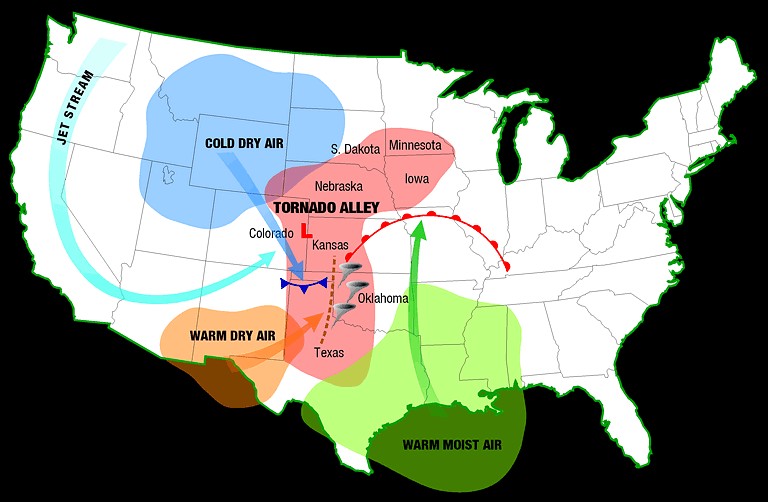
The Denver area is at the western edge of Tornado Alley and as we have seen historically and in recent days, the danger is real. Click image for larger view. Image courtesy NOAA.
Rather than implement their own system, staff recommended the city rely upon the federal government and the Federal Emergency Management Agency’s (FEMA) forthcoming Integrated Public Alert and Warning System (IPAWS).
Slated for widespread deployment in 2010, IPAWS will take the old Emergency Alert System and move it into the modern age by leveraging new communication technologies such as email and cellular phones.
Mayor Erik Hansen told ThorntonWeather.com, “The City of Thornton recognizes the dangers of severe weather and we are actively working to identify solutions to protect its citizens.”
While the city waits for IPAWS, staff said they recommend the “development of a Weather Awareness Public Education Program that would be implemented in the spring of each year.” They further would work to encourage residents to purchase weather radios.
ThorntonWeather.com’s Take
We are pleased that the city is finally taking some steps in the right direction – albeit 29 years late.
NOAA Weather Radio All Hazards is essential to protecting you and your family.
The implementation of a severe weather education program is also a step in the right direction, assuming it takes the form of something more substantial than the simple brochure the city developed this year.
Each spring the National Weather Service (NWS) offers storm spotter training seminars. These would likely be overkill for average citizens however we think it would be ideal for the City of Thornton to partner with the Denver / Boulder NWS office to offer education sessions for citizens. These could be taped and then shown on Channel 8 and on the city’s website.
We do have our reservations about waiting for and relying on the forthcoming IPAWS system when commercial systems are available, proven and ready now for the city to implement. Big government projects rarely are completed on time and often do not perform as expected. Hopes are high for IPAWS but we are cautious on giving it any sort of endorsement.
Granted, severe weather on par with the 1981 tornado is rare however last year’s severe weather and the Windsor tornado of two years ago show the danger is present. If a warning system saves one life, the cost incurred is well worth it and we hope the city continues to stay on top of this issue – we will certainly be watching.
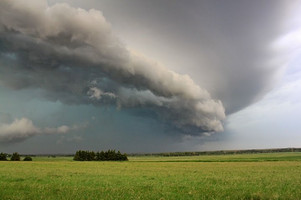
A shelf cloud moves across Nebraska farmland. (Tony Hake / ThorntonWeather.com)
Certainly the highlight of storm chasing is tornadoes and ThorntonWeather.com’s Storm Chase 2010 had plenty of those – five in one day in fact. However, as great of satisfaction can be derived from simpler, less violent storms. The images from a week of chasing on the Great Plains show the fury and the beauty of Mother Nature.
Storm chasing is as much an art as a science – there are no guarantees that tornadoes will appear as forecast. Other types of severe weather and the amazing structure they display can bu just as impressive.
Scud clouds hovering over a coal train in Nebraska, egg sized hail pummeling storm chaser vehicles, the sun setting on the Oklahoma plains and the now infamous Baca County, Colorado tornado ripping through ranchland all were highlights of Storm Chase 2010.
The images in the slideshow below represent some of the most stunning and beautiful images captured during the week.
The Memorial Day tornado in Baca County, Colorado near Campo was the highlight of a week of storm chasing but it wasn’t the only exciting thing to happen. (Tony Hake / ThorntonWeather.com)
We have said before that storm chasing is as much an art as a science and it can very much be feast or famine. Both extremes were seen over the course of a week of storm chasing on the Great Plains by ThorntonWeather.com.
We hope our site visitors were checking out the Storm Chase 2010 Examiner where we were documenting our chase across America’s heartland. With stories, photos and video, the entire incredible week has been described in detail.
The first tornado of that day near Pritchett, Colorado allowed chasers to witness the complete tornado genesis. As massive amounts of air were sucked into a storm cell and the clouds swirled menacingly above, a small funnel cloud soon grew into a powerful tornado.
Two other tornadoes and an incredible hail storm on the virtually barren ranchland followed. The main event was yet to come however.
About eight miles south of Campo, Colorado, a massive supercell seemed poised to generate a tornado. Chasers waited anxiously as the sky grew darker on the plains. A funnel cloud formed and was cheered on as it grew closer to the ground.
Before long the tornado was on the ground moving at a leisurely 10 mph – its slow pace allowing for plenty of time to capture amazing photos and video of the event. The Baca County tornado would draw national media attention and will possibly go down as the most picturesque of all twisters during the 2010 tornado season.
While the Memorial Day tornadoes would be the last seen during the week, they were not the last extraordinary weather event witnessed by the storm chasers.
Storm Chase 2010 intercepted a flying saucer over western Kansas at the end of a very long chase day. (Tony Hake / ThorntonWeather.com)
Central Nebraska proved to be the backdrop for another day of weather beauty. Waiting patiently at a small town gas station, multiple super cells moved across the area and chasers were on the move. From highways to dirt roads, the chasers saw the storms generate amazing shelf clouds and funnel clouds.
In the end, the group of storm chasers covered over 2,500 miles across five states. They witnessed many funnel clouds and amazing storm structures and of course five tornadoes, two of which were at close range. For many it was truly a once in a lifetime experience that allowed them to see Mother Nature’s fury up close and personal.
Complete stories, photos and video from Storm Chase 2010:
The growing environmental disaster in the Gulf of Mexico from the Deepwater Horizon oil rig explosion and leak will likely take years to recover from. A new image released by NASA shows the extent of the oil slick as it continues to encroach on shoreline around the Gulf.
From NASA:
Oil on water has many appearances. In this photo-image, acquired by the Moderate Resolution Imaging Spectroradiometer (MODIS) on NASA’s Terra satellite on June 7, 2010, at least part of the oil slick is pale gray. A large area of oil is southeast of the Mississippi Delta, at the site of the leaking British Petroleum well. Traces of thick oil are also visible farther north.
Not all of the oil that is in the Gulf is visible here. The image shows regions of heavy oil where the oil smoothes the surface and reflects more light than the surrounding water. Lighter concentrations and streamers are not visible. The Deepwater Horizon Unified Response reported oil washing ashore and immediately offshore in eastern Alabama and northwestern Florida on June 7, and this oil is not visible in the image.
Several other features may mask the oil in the image. Pale white haze (possibly smoke from fires in Central America) hangs over the Gulf, partially obscuring the view of the oil slick. The oil slick also blends with sediment washing into the Gulf from the Mississippi River. The sediment plume is tan and green. Because the sediment also reflects more light than clear water, it may be masking the presence of oil in the water. West of the mouth of the Mississippi River, sunlight reflecting off the surface of the water (sunglint) turns the water silvery white. In this region, it is difficult to see sediment and oil, but NOAA maps of the extent of the oil spill on June 7 report oil throughout sunglint region.
The large image provided above is the highest-resolution version of the image available. The MODIS Rapid Response System provides twice-daily images of the Gulf of Mexico.
ThorntonWeather.com is ready to begin the hunt for tornadoes!
Storm Chase 2010 is making final preparations to take to the Great Plains on Saturday. With severe weather forecast for the northern plains, the opportunity is too good to resist so the hunt begins a day early.
The Storm Prediction Center has placed a slight risk for severe weather on an area from northeastern Colorado into Nebraska and then north from there. The risk for tornadoes is relatively small but even if we don’t see a twister, there is a good chance to witness some great storm structure as well as strong winds and hail.
The tour we are a part of isn’t officially supposed to start until tomorrow and we must be in Denver this evening to meet with the rest of the group. As such, today’s chase will be relatively short and won’t cover too much of a distance.
Roger Hill, famed storm chaser and tour leader, will outline the plans for the chase later today but we are anticipating we will hunt northeastern Colorado and western Nebraska. If all goes according to plan, we should be on the road by noon (MDT) and on our way to the target area.
We will be bringing along Examiner and ThorntonWeather.com readers on this great chase. There are no guarantees because as we all know, Mother Nature is far from reliable – six days on the plains could yield little more than rain. However, confidence is high that you will be taken on a virtual ride unlike any other with videos, photos and more from the road.
To keep things simple, ThorntonWeather.com’s chief amateur meteorologist will be primarily posting things to the Storm Chase 2010 Examiner’s home page. To be sure you don’t miss a thing, check the Storm Chase 2010 Examiner’s home page regularly. Be sure to click the “Subscribe” link at the top of the page and you will be emailed whenever a new story is posted.
ThorntonWeather.com's chief amateur meteorologist will be on the hunt for tornadoes starting next week. Be sure to follow along!
Severe weather season brings danger and destruction to the Great Plains of the United States. No other place on earth sees as many tornadoes as this region and now ThorntonWeather.com is going to go on the hunt in an attempt to witness Mother Nature’s fury up close and personal.
As we have pointed out before, the owner and operator of ThorntonWeather.com writes weather, disaster and climate news for Examiner.com. This allows Tony to share his passion for the topics and also helps to pay for all the great features ThorntonWeather.com visitors enjoy.
Starting Sunday, May 30th and for the six days following, one Examiner will seek out and attempt to witness and document these events. World famous storm chaser Roger Hill will serve as tour guide and teacher for the Examiner and a group of weather enthusiasts as they hunt the ultimate prize – tornadoes.
An average of over 1,300 tornadoes have struck the United States in each of the last three years claiming more than 200 lives total. These devastating events can strike with little warning and with a fury unseen with any other natural phenomena.
We will be bringing along Examiner and ThorntonWeather.com readers on this great chase. There are no guarantees because as we all know, Mother Nature is far from reliable – six days on the plains could yield little more than rain. However, confidence is high that you will be taken on a virtual ride unlike any other with videos, photos and more from the road.
To keep things simple, ThorntonWeather.com’s chief amateur meteorologist will be primarily posting things to the Storm Chase 2010 Examiner’s home page. To be sure you don’t miss a thing, check the Storm Chase 2010 Examiner’s home page regularly. Be sure to click the “Subscribe” link at the top of the page and you will be emailed whenever a new story is posted.
From Hurricane Andrew to Hurricane Katrina, the names given one of the earth’s most devastating disasters become part of our history and are forever associated with the death and destruction they bring. For the 2010 hurricane season, the names chosen run through 21 letters of the alphabet from Alex to Walter.
During World War II, the practice of naming storms only for women became common practice but in 1951 the United States changed that and began naming them using the phonetic alphabet. By 1953 however the practice of naming them for women returned. In 1979 the current system which includes male and female names was adopted.
Storms get their name when they reach 39 mph (34 knots) and are then officially a tropical storm. In the North Atlantic, the World Meteorological Organization determines what names will be used for a given season on a six year rotating basis with one of 21 letters of the alphabet used in order. The letters Q, U, X, Y, and Z are not used due to the lack of names available using those and the names that are chosen alternate male and female.
Should the situation arise where all 21 names are used during a season, any additional storms are named after the letters of the Greek alphabet (Alpha, Beta, Gamma, etc). Only one time have there been enough storms to exceed the usual 21 names – In 2005 there were 27 named storms.
When a storm has caused extensive damage or death, the World Meteorological Organization can vote to retire a name. There are currently 74 retired names including 2005’s Hurricane Katrina and 1992’s Hurricane Andrew.
More hurricane news from the Natural Disasters Examiner:
Hurricanes are a deadly and devastating annual ritual for much of the Gulf Coast and East Coast of the United States. With June 1st being the unofficial start of hurricane season, President Barack Obama proclaimed this week National Hurricane Preparedness Week.
Hurricane Isabel is seen on September 15, 2003 from the International Space Station. (NASA)
Throughout the week the National Hurricane Center (NHC) will be releasing information designed to inform and educate residents of areas that are at risk for hurricanes. This annual event is crucial to ensuring that residents are adequately prepared for hurricane season and the hazards these monstrous storms can present.
In the proclamation, Obama wrote, “I urge individuals, families, communities, and businesses to take time to plan for the storm season before it begins. While hurricane forecasting has improved, storms may still develop with little warning. For Americans in hurricane threatened areas, knowledge and preparation are pivotal to ensure emergency readiness and responsiveness.”
Read the complete text of the proclamation below
All indications are that the 2010 hurricane season will be one of the biggest in recent years. Colorado State University’s forecast team has said that there is a 69% chance a major hurricane will make landfall in the United States this year. The National Hurricane Center is already tracking an area of interest that it says has a medium chance to become the first named storm of the season.
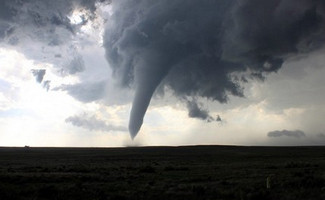
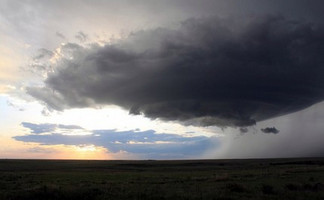
A powerful half-mile wide tornado ripped through South Dakota on Saturday, May 22, 2010. (NWS) Watch video of the twister and see a slideshow of the damage below.
A massive tornado reminiscent of a famous tornado in the state’s history ripped through central South Dakota on Saturday. The powerful twister appears to have been an EF3 tornado packing winds of over 160 mph and while damage to homes was recorded, miraculously no one was injured.
Supercell thunderstorms began forming on the South Dakota plains yesterday afternoon and began spawning tornadoes. The twisters were reported near the towns of Bowdle, Hosmer, Ipswich and Wetonka.
The National Weather Service’s Aberdeen, SD office reported that the largest of these appears to have done at least EF3 level damage, a level classified as “severe.” The twister tore through parts of Brown and McPherson Counties coming closes to the town of Bowdle.
The storm damage evaluation is ongoing but National Weather Service personnel said the tornado was at least one-half mile wide at its largest. No injuries were reported however three farms were damaged and numerous power lines were downed.
Images of the storm drew parallels to a tornado on June 24, 2003 that struck the town of Manchester, South Dakota. That twister, rated an F4, destroyed the town and to this day it has not been rebuilt. The photos of both events looked eerily similar.






.jpg "A powerful half-mile wide tornado ripped through South Dakota on Saturday, May 22, 2010. (NWS) Watch video of the twister and see a slideshow of the damage below.")
