All posts by Thornton Weather

ThorntonWeather.com is your local source for live Thornton, Colorado weather conditions and news!

More than 5,000 homes evacuated as Orange County fire grows to 6,000 acres

LOS ANGELES — A wind-fed wildfire surged over the Anaheim Hills on Monday, burning several homes and forcing thousands to evacuate as fire crews struggled to battle the rapidly growing blaze. The fire broke out around 9:20 a.m. near the 91 Freeway and Gypsum Canyon Road, and quickly leaped the California 241 toll road. It raced… Continue reading More than 5,000 homes evacuated as Orange County fire grows to 6,000 acres

Engineers: Lives Lost in Mexico Quake Could Have Been Saved

Nearly two-thirds of the buildings that collapsed in Mexico City’s monstrous earthquake last month were built using a construction method that is now forbidden in seismic hotspots in the United States, Chile and New Zealand, according to new data compiled by a team of structural engineers at Stanford University. The suspect building technique called flat slab… Continue reading Engineers: Lives Lost in Mexico Quake Could Have Been Saved

September 2017 weather recap: Month starts warm and dry, ends cool and damp

The month of September 2017 saw significant differences between the start and the end.  The first two-thirds of the month were extraordinarily dry with temperatures well above normal. The last 10 days brought a big change though with damp conditions and much cooler conditions.

High pressure dominated the region for the first few weeks of the month.  During this period when we normally see cooler temperatures, we instead saw highs oftentimes at or above 90 degrees and a couple of record high readings.  Additionally, it was exceedingly dry with Thornton only received 0.03 inches of precipitation through the first 22 days of the month.

Big changes arrived and the last nine days of the month stood it stark contrast to the rest of September. Low pressure and a series of disturbances brought much cooler temperatures and much-needed precipitation, including snowfall in the high country. Seven out of the last eight days saw below normal high temperature readings and enough precipitation fell to push us to just above normal.

Thornton’s overall average temperature for the month came in at 62.4 degrees.  This was a full degree cooler than Denver’s long term September average of 63.4 degrees.  Out at DIA where Denver’s official measurements are taken, it was a good bit warmer with an average temperature of 65.1 degrees.

Temperatures in Thornton ranged from a high of 98.5 degrees on the third and a low of 40.9 degrees on the morning of the 29th.  Denver saw their high of 97 degrees on the third as well and their coldest reading of 40 degrees on the 20th.

Two record high temperatures were officially set or tied for the Mile High City.  The high temperature of 97 degrees on the third tied the record high for the date.  A reading of 92 degrees on the 21st set a new record high for that date.

In terms of precipitation, Denver averages 0.96 inches during September.  Thornton tallied 1.05 inches in the rain bucket while Denver bested us with 1.26 inches.

Click here to view Thornton’s September 2017 climate report.

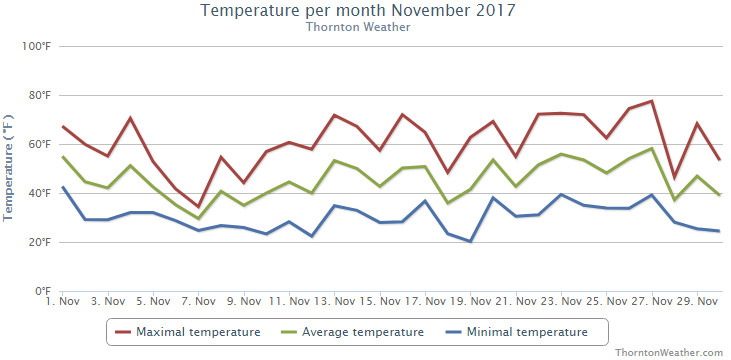
Thornton, Colorado’s September 2017 Temperature Summary. (ThorntonWeather.com)
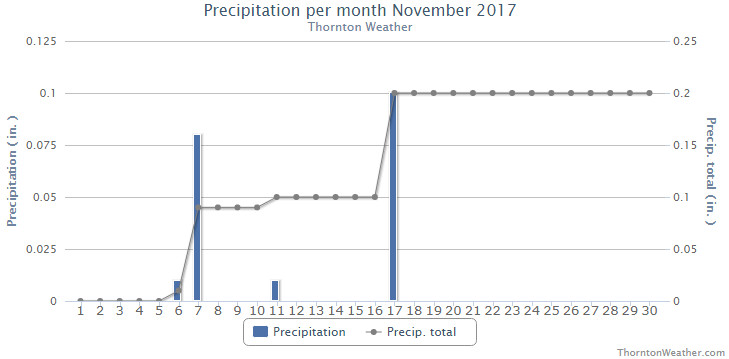
Thornton, Colorado’s September 2017 Precipitation Summary. (ThorntonWeather.com)

From the National Weather Service:

CLIMATE REPORT
NATIONAL WEATHER SERVICE DENVER/BOULDER CO
244 AM MDT SUN OCT 1 2017

...................................

...THE DENVER CO CLIMATE SUMMARY FOR THE MONTH OF SEPTEMBER 2017...

CLIMATE NORMAL PERIOD 1981 TO 2010
CLIMATE RECORD PERIOD 1872 TO 2017

WEATHER         OBSERVED          NORMAL  DEPART  LAST YEAR`S
                 VALUE   DATE(S)  VALUE   FROM    VALUE  DATE(S)
                                          NORMAL
................................................................
TEMPERATURE (F)
RECORD
 HIGH              97   09/03/2017
                        09/06/2013
                        09/05/2013
 LOW               17   09/29/1985
HIGHEST            97R  09/03        91       6       93  09/05
LOWEST             40   09/20        35       5       37  09/10
AVG. MAXIMUM     79.0              78.5     0.5     82.3
AVG. MINIMUM     51.3              48.3     3.0     49.7
MEAN             65.1              63.4     1.7     66.0
DAYS MAX >= 90      9               3.4     5.6        6
DAYS MAX <= 32      0               0.0     0.0        0
DAYS MIN <= 32      0               0.8    -0.8        0
DAYS MIN <= 0 0 0.0 0.0 0 PRECIPITATION (INCHES) RECORD MAXIMUM 5.61 2013 MINIMUM T 1892 1944 TOTALS 1.26 0.96 0.30 0.28 DAILY AVG. 0.04 0.03 0.01 0.01 DAYS >= .01         6               6.5    -0.5        4
DAYS >= .10         2               3.3    -1.3        1
DAYS >= .50         1               0.6     0.4        0
DAYS >= 1.00        0               0.1    -0.1        0
GREATEST
 24 HR. TOTAL    0.83   09/23 TO 09/23           09/12 TO 09/12

SNOWFALL (INCHES)
RECORDS
 TOTAL             0.0
TOTALS            0.0               1.3

DEGREE_DAYS
HEATING TOTAL     122               125      -3       64
 SINCE 7/1        130               141     -11       79
COOLING TOTAL     131                76      55       99
 SINCE 1/1        880               764     116      861

FREEZE DATES
RECORD
 EARLIEST     09/08/1962
 LATEST       06/08/2007
EARLIEST                        10/07
LATEST                          05/05
...................................................

WIND (MPH)
AVERAGE WIND SPEED              9.6
RESULTANT WIND SPEED/DIRECTION   2/165
HIGHEST WIND SPEED/DIRECTION    40/020    DATE  09/19
HIGHEST GUST SPEED/DIRECTION    48/030    DATE  09/19

SKY COVER
POSSIBLE SUNSHINE (PERCENT)   MM
AVERAGE SKY COVER           0.50
NUMBER OF DAYS FAIR            9
NUMBER OF DAYS PC             15
NUMBER OF DAYS CLOUDY          6

AVERAGE RH (PERCENT)     48

WEATHER CONDITIONS. NUMBER OF DAYS WITH
THUNDERSTORM              0     MIXED PRECIP               0
HEAVY RAIN                1     RAIN                       1
LIGHT RAIN               10     FREEZING RAIN              0
LT FREEZING RAIN          0     HAIL                       0
HEAVY SNOW                0     SNOW                       0
LIGHT SNOW                0     SLEET                      0
FOG                       8     FOG W/VIS <= 1/4 MILE      1
HAZE                     10

-  INDICATES NEGATIVE NUMBERS.
R  INDICATES RECORD WAS SET OR TIED.
MM INDICATES DATA IS MISSING.
T  INDICATES TRACE AMOUNT.

Thornton’s October weather preview: Fall arrives in earnest, tastes of winter

Thornton, Colorado October weather preview.With the first full month of fall here, October usually brings one of the quietest weather months in the Denver area with plenty of mild, sunny days and clear, cool nights.

October is historically the second sunniest month and conditions are generally calm.

However we also will usually see our first taste of winter during the month with the first freeze and first snowfall of the season.

Temperatures as well will start to drop and by the end of the month the average nighttime lows are below freezing.

For complete details on our historical October weather and what we can expect in the coming month, read our complete October weather preview here.

  • Don’t miss a thing when it comes to our ever-changing weather! Be sure to ‘like’ us on Facebook, follow us on Twitter and add us to your Google+ circles.

October 1 to October 7: This week in Denver weather history
This Week In Denver Weather History
October 1 to October 7: This week in Denver weather history

October is usually a relatively calm weather month in Denver but can see some interesting events. In our look back at this week in Denver weather history we see tornadoes, damaging wind and of course snow.

From the National Weather Service:

30-1

In 1959…heavy snowfall totaled 5.9 inches at Stapleton Airport. Winds were light.

1

In 1892…the highest temperature ever recorded in October… 90 degrees…occurred. This is also the latest 90 degree reading of the season.

In 1898…southwest winds were sustained to 40 mph with gusts to 49 mph in the city.

In 1927…a trace of snow was the only snow of the month… Ranking the year…amongst several other years…the second least snowiest on record.

In 1971…a wind gust to 90 mph was recorded at Buckley Field in Aurora. The severe winds caused damage in northeast metro Denver. A brick wall of a bowling alley was blown down…the roof was blown off a garage…and some business signs were damaged. A man in the bowling alley was injured by flying glass. Northwest winds gusted to 43 mph at Stapleton International Airport.

In 1994…unusually strong thunderstorms for so late in the season pummeled metro Denver with large hail. The largest hail…2 inches in diameter…fell at Buckley Field. Hail 1 3/4 inches in diameter fell 7 miles northeast of Boulder and at Niwot. Hail 3/4 to 1 1/2 inches in diameter fell in Boulder…Arvada…Wheat Ridge…Edgewater…capitol hill and northwest Denver…Bennett…and Strasburg. Hail of unknown size damaged a Boeing 737 aircraft and injured both pilots at Stapleton International Airport when the windshield was broken out on takeoff. Half inch diameter hail fell at Stapleton International Airport where northwest winds gusted to 40 mph and rainfall totaled 0.82 inch.

In 2014…severe thunderstorms produced wind gusts to 60 mph across parts of Arapahoe and Denver Counties.  The intense wind gusts downed trees and power lines which caused a power outage near the Denver Technology Center.  At Denver International Airport…a peak wind gust to 37 mph was measured from the northwest.

2

In 1903…southwest winds were sustained to 42 mph with gusts as high as 60 mph. The strong Chinook winds warmed the temperature to a high of 78 degrees.

In 1910…an apparent dry microburst produced sustained northeast winds to 43 mph.

In 1934…a trace of rain was the only precipitation of the month. This was the driest October on record.

3

In 1875…very dense haze hid the mountains from view as observed from the city.

In 1933…rainfall of just 0.01 inch was the only precipitation of the month. This was the second driest October on record.

In 1954…the low temperature cooled to only 60 degrees…the all-time record high minimum for the month October.

3-4

In 1969…the first snowfall of the season totaled 16.0 inches at Stapleton International Airport. There was a thunder snow shower on the evening of the 3rd…but otherwise little wind with the storm. The greatest snow depth on the ground was 8 inches due to melting. Heavy wet snow accumulated on trees…which were still in full leaf…and caused widespread damage from broken limbs and downed utility lines.

3-5

In 1984…the remnants of pacific hurricane Polo produced heavy rain over northeastern Colorado. Most locations received between 1.00 to 2.50 inches of rain…but 3.45 inches fell in Littleton. Rainfall totaled 1.73 inches at Stapleton International Airport…where north winds gusted to 24 mph.

4 Continue reading October 1 to October 7: This week in Denver weather history

More than 120,000 flee rumbling Bali volcano

More than 122,000 people have fled their homes on the resort island of Bali, fearful that a rumbling volcano could erupt at any time, disaster officials said. Mount Agung, 75 kilometres (47 miles) from the resort hub of Kuta, has been shaking since August and threatening to erupt for the first time since 1963 — a… Continue reading More than 120,000 flee rumbling Bali volcano

September 24 to September 30: This week in Denver weather history

This Week In Denver Weather History
September 24 to September 30: This week in Denver weather history

Colorado’s famously inconsistent weather can be seen in our look back at this week in Denver weather history. Not only do we see damaging thunderstorms and winds but even major snowstorms that deposited more than a foot of the white stuff on the city.

From the National Weather Service:

23-24

In 2000…the first snowstorm of the season brought heavy snow to areas in and near the foothills. While the heaviest snow fell north of metro Denver…6 inches were measured in Boulder…4 inches at both Castle Rock and Morrison…but only 0.2 inch at the site of the former Stapleton International Airport where most of the precipitation fell as rain. At Denver International Airport where drizzle and rain fell on the 23rd… Snowfall during the early morning of the 24th was estimated at 2.1 inches due to melting. The foothills west of Denver received more snow with 10 inches measured at conifer…9 inches 11 miles southwest of Morrison… 8 inches atop Crow Hill…7 inches at Chief Hosa…and 5 inches at Ralston Reservoir.

24

In 1901…northwest winds were sustained to 50 mph with gusts as high as 57 mph in the city.

In 1932…thunderstorm rainfall of only 0.11 inch was the only measurable precipitation for the month that year in the city.

In 1986…a very strong wind storm roared across metro Denver. Boulder was hit hardest. Winds peaked to 131 mph at the National Center for Atmospheric Research. This is thought to be the highest wind gust ever recorded in Boulder during September. A wind gust to 118 mph was clocked on Davidson Mesa and to 92 mph near Niwot. Gusts of 70 to 80 mph were common over all of Boulder where an estimated 70 to 90 large trees were uprooted. About a dozen of them hit cars. Two walls of a building under construction were toppled and solar panels were blown off a house. Traffic lights and power lines were downed. Damage to power equipment alone was estimated at 100 thousand dollars. Wind gusts to 87 mph at Jefferson County Airport damaged two planes. A woman was seriously injured in Boulder. She suffered a fractured skull when struck by a falling tree limb. Trees were also downed in Louisville and Lafayette. West wind gusts to 45 mph were recorded at Stapleton International Airport.

25

In 1873…a fire was sighted in the woods near Platte Canyon… Probably caused by high winds blowing sparks among the timber.

In 1896…an apparent cold front produced northeast sustained winds to 40 mph with gusts to 48 mph.

In 1910…a thunderstorm produced sustained north winds to 51 mph. This was the highest recorded wind speed in the city in September at the time.

In 1936…a vigorous cold front produced a deadly dust storm in the city. North winds sustained to 36 mph with gusts to 38 mph produced much blowing dense dust…greatly restricting the visibility. The temperature plunged from a high of 84 degrees to a low of 38 degrees by midnight. The weather observer described the event with the following. “at 6:00 pm the temperature was 82 degrees and the wind velocity was only 4 mph; but with the wind shifting to the north and the barometer rising quite rapidly…the temperature fell sharply. By 6:30 pm…the wind velocity increased rapidly and by 7:00 pm had reached a maximum sustained velocity of 36 mph…bringing with it clouds of dust which had been picked up by gale force winds in southern Wyoming and northern Colorado…covering the city. The visibility was generally reduced to about 1/4 mile; however…the whirling of the dust down the streets and alleys…the visibility was at times somewhat less. Airplanes were grounded…traffic was halted at times…and homes filled with dust. The strong winds damaged electric power and telephone lines…leaving homes in darkness for a few hours in the city and for 18 hours in suburban towns and putting 2500 telephones out of service because of broken lines. An electric lineman was killed while repairing damage by the high winds. The dust storm was followed by rain that began falling at 10:55 pm…which turned to snow during the early morning hours of the 26th. A major snow storm followed on the 27th through the 29th.”

In 1999…high winds developed in the foothills of Boulder County. Winds gusted to 90 mph at Wondervu.

25-26

In 1908…apparent post-frontal rain changed to snow overnight and totaled 6.5 inches in downtown Denver. This was the first snow of the season. Precipitation totaled 0.76 inch. North winds were sustained to 39 mph on the 25th.

25-27

In 1996…an early season snowstorm brought heavy snow to the Front Range eastern foothills. Snowfall totals included: 8 to 12 inches around conifer…7 inches on Floyd Hill…and 6 inches at both Bailey and Chief Hosa. Snowfall totaled only 4.7 inches at the site of the former Stapleton International Airport. This was the first measurable snow of the season. After the passage of a strong cold front…north winds gusted to 38 mph at Denver International Airport on the 25th.

Continue reading September 24 to September 30: This week in Denver weather history

Trump to visit Puerto Rico amid criticism of storm response

US President Donald Trump, under fire for his response to the storms that ravaged Puerto Rico, announced Tuesday that he will visit the hurricane-battered island next week. “I’m going to Puerto Rico on Tuesday,” Trump told reporters at the White House, signalling that October 3 was the first date he could go without interfering with recovery… Continue reading Trump to visit Puerto Rico amid criticism of storm response

Indonesia ready to divert tourists as Bali volcano rumbles

Indonesian authorities are on standby to divert flights destined for the holiday island of Bali as increasingly frequent tremors from a rumbling volcano stoke fears an eruption could be imminent. Mount Agung, about 75 kilometres (47 miles) from the tourist hub of Kuta, has been shaking since August, threatening to erupt for the first time in… Continue reading Indonesia ready to divert tourists as Bali volcano rumbles

Fall Colors 2017: Picks for the top Colorado Front Range spots for leaf peeping

Rocky Mountain National Park is a prime spot for viewing the fall foliage. (Tony's Takes)
Rocky Mountain National Park is a prime spot for viewing the fall foliage. (Tony’s Takes)

This time of year many folks start thinking about heading to the hills west of Denver in search of gold – fall foliage gold.

Where to go?  Below are five of ThorntonWeather.com’s favorite ones near Denver – plus a few further out and some bonus ideas.  After that, we will tell you where you can find a great website that provides regular updates on viewing conditions.

I-70 Corridor – If you’re looking for the easiest route, then this one is for you.  Simply head west on I-70 about 110 miles to Avon.  Between Vail and Avon, both sides of I-70 are lined beautifully with aspen.

Rocky Mountain National Park – One of the most popular summer destinations in the state is of course also a prime spot to view aspen in all their glory.  Once in the park head toward Bear Lake.  Glacier Gorge Junction provides a beautiful spot and you of course also get to enjoy all the splendor that Rocky Mountain National Park has to offer.  Extend your viewing by taking Trail Ridge Road all the way through to the west side of the park and the Grand Lake and Granby area.

Peak to Peak Highway – This little road trip can be a dual purpose trip – gambling and fall foliage viewing!  Take U.S. 6 through Clear Creek Canyon and then 119 through Blackhawk and Central City.  You can of course stop there if your wallet is fat enough and donate some money to the casinos.  From there continue on 119 toward Nederland.  Take highway 72 toward Ward and Allenspark.  There you will find more golden aspen than you can imagine, all with the Continental Divide nearby.

Colorado Fall Foliage - Average Date of Peak Aspen Colors. Click for larger view. (ThorntonWeather.com)
Colorado Fall Foliage – Average Date of Peak Aspen Colors. Click for larger view. (ThorntonWeather.com)

Poudre Valley Canyon –  Heading north on I-25 take Colorado 14 west and into Poudre Canyon and Roosevelt National Forest.  As you continue west you will come very near timberline as you come to Cameron Pass.  Amazing views abound!

Guanella Pass – This is a nice, relatively short drive from Denver.  From C470 take 85 through Bailey and Conifer, a nice drive unto itself.  When you come to the town of Grant, take the Guanella Pass Scenic and Historic Byway north to Georgetown.  The air is pretty thin along the way as you climb in excess of 11,500 views through the Pike and Arapahoe National Forests.

A couple other possibilities further from the Front Range:

Leadville / Aspen – From Denver take I-70 west to Copper Mountain and then Colorado 91 south over Freemont Pass to Leadville. Along the way there are plenty of viewing opportunities and Leadville is a nice little town to make a stop. From here you can take Highway 24 north back through Minturn and Vail. To extend the drive, take Highway 24 south to Colorado 82 and head toward Aspen. You can stop by the Maroon Bells in White River National Forest to view some of the most photographed mountains in Colorado.

Cottonwood Pass – From Denver take Highway 285 to Buena Vista. Head west on Main Street for seven miles then west on County Road 344 / Colorado 82. From there you start the climb up Cottonwood Pass with absolutely stunning views from the top. If you are up for it, you can continue down the west side of the pass into the Taylor Park area. Be forewarned though that the western half of the pass is unpaved and twisty.  Editor’s note: The west side of Cottonwood Pass is closed until Summer 2018 so that it can be paved.

Honorable mentions worth considering:

  • Boreas Pass between Breckenridge and Como (County Road 10)
  • Kenosha Pass on Highway 285 between Bailey and Fairplay
  • Independence Pass (Colorado 82 between Aspen and Twin Lakes)
  • Colorado 103 from Evergreen to Echo Lake. Throw in a drive up Mount Evans for a bonus.

If you do head out, be sure to send us your pictures for inclusion in our monthly photo slideshows!

For more information: