Satellite image of Tropical Storm Alex as it prepares to cross the Yucatan Peninsula. (NOAA / Google Earth) Click the image for a complete slideshow of the storm and its forecast path.
The first named storm of the 2010 hurricane season is being watched closely by not only areas at threat from landfall but also those working to clean up the Gulf oil spill. Tropical Storm Alex continued to move to the northwest where it threatens to find warmer water and become a hurricane.
The National Hurricane Center (NHC) places the center of Alex at the current time 75 miles east of Belize City. The storm is packing winds of 45 mph and moving to the west-northwest at 9mph.
On its current path, Alex will reach the coast of Belize and the Yucatan Peninsula late today and move across the peninsula on Sunday. By Sunday night or early Monday morning, it will have transited land and emerge in the Bay of Campeche.
June 20 to June 26 - This week in Denver weather history
Late June weather is usually relatively calm but when it turns severe, it can do so in spades. Hail, flooding rains, tornadoes and more are not unusual. This week in Denver weather history we see plenty of each of those including a hail storm in 1993 that damaged dozens of planes at Denver International Airport.
19-21
In 1875…smoke from several large forest fires in the mountains was visible from the city on each of these days.
20
In 1888…northwest winds were sustained to 44 mph.
In 1956…a microburst caused a brief wind gust to 58 mph at Stapleton Airport.
In 1964…hail up to 1 inch in diameter was reported 1 mile north of Stapleton International Airport. A 3 minute hail storm at both Stapleton International Airport and Lowry Field piled small hail to one half inch deep.
In 1967…a strong thunderstorm dumped 1.95 inches of rain in less than an hour at Stapleton International Airport and produced a wind gust to 54 mph. The storm caused some flooding in east Denver and Aurora. There was widespread flooding to streets…basements…and store buildings and automobiles. Hail stones to 3/4 inch in diameter were measured at Buckley Field in Aurora. A tornado touched down just south of Littleton…damaging a barn and killing several head of cattle.
In 1985…a wind gust to 61 mph was reported at Golden Gate Canyon in the foothills west of Denver.
In 1986…a man was killed by lightning at Highlands Ranch south of Denver.
In 1987…several tornadoes were sighted across metro Denver. A tornado touched down briefly 5 miles west of Parker. A tornado was sighted just north of Chatfield Reservoir. A tornado just northwest of Watkins was on the ground for 15 minutes. A tornado near Barr Lake was taped by a television news crew. It had a double vortex and was on the ground for about 10 minutes. In addition to the 4 tornadoes…severe thunderstorms dumped large hail across metro Denver. One inch hail was reported in southeast Aurora; 3/4 inch hail fell at the Denver technology center…Buckley Field…and Franktown.
In 1992…several short-lived tornadoes occurred in the vicinity of Barr Lake. No injuries or damages were reported. A water spout was sighted over the southern end of Barr Lake. Funnel clouds were also sighted on the grounds of the rocky mountain arsenal by national weather service observers at Stapleton International Airport.
In 1994…hail up to dime size covered I-25 south of Denver and near Sedalia. Heavy rain caused local flooding on the interstate highway.
In 1996…strong thunderstorm winds downed several large tree limbs in Boulder on the University of Colorado campus. A stop light in the city was also blown down.
In 1999…lightning sparked an oil tank fire near Brighton.
In 2001…large hail driven by strong thunderstorm winds raked Denver international and Front Range airports. Wind gusting to 54 mph along with hail as large 2 inches in diameter punched at least 14 thousand holes and cracks in the flat roofs of several buildings at Denver International Airport. In addition…93 planes and hundreds of cars were damaged. About 100 flights had to be cancelled…stranding 1500 travelers. The airport was completely shut down for about 20 minutes. The storm also damaged a ground avoidance radar used to track planes on the ground to prevent collisions. Damage was estimated at 10 million dollars…not counting the damage to the 93 airliners. The storm moved south and struck Watkins with hail as large as 2 1/2 inches in diameter and winds gusting to 60 mph. A least 30 private planes at Front Range airport were destroyed. The radome protecting the national weather service doppler radar…which was tracking the storm…also sustained damage. The large hail…damaging winds…and heavy rain pummeled a mobile home park near Watkins. In the park…52 mobile homes…14 recreational vehicles…3 homes…and a commercial building were damaged. Siding was riddled with holes and windows were broken. Vehicles sustained extensive damage and car windows were shattered. A handful of people were treated for minor cuts and bruises. The strong winds also flipped a tractor trailer along I-70 near Watkins. The storm caused power outages…which affected about 1200 residents. Excluding the damage at Denver International Airport…damage estimates totaled 49 million dollars…making the storm the costliest in the last 3 years and the 10th costliest since 1984. A small tornado touched down just east of Brighton… But did no damage. Hail as large as 2 inches in diameter fell near Fort Lupton with 3/4 inch hail measured in Bennett. Precipitation from the storm totaled only 0.23 inch at Denver International Airport.
The Thornton Veterans Memorial is ready to start construction on the first phase! Be sure to contribute to the effort!
A dedicated group of volunteers at the Thornton Veterans memorial Foundation announced that they will be starting construction on the first phase of the city’s veterans memorial. This is an exciting milestone for all veterans – past, present and future – who deserve a memorial in their honor.
The first phase of construction will include the center pentagon, educational signage and flag poles. Further, all paver bricks that have been purchased will be engraved and laid in the memorial and its walkways at this time.
If you haven’t placed your order for a paver brick engraved with the name of a veteran you wish to honor or some other appropriate message, NOW IS THE TIME. Orders for engraved paver bricks to be included in this initial phase of construction MUST be received by the Thornton Veterans Memorial by no later than Tuesday, June 29th.
Please visit the foundation’s online store TODAY and place your order! Don’t miss out on this opportunity to honor our nation’s veterans!
Tony Hake, owner and operator of ThorntonWeather.com, has personally donated over $2,000 to the memorial and encourages all area residents, civic organizations and businesses to contribute. ThorntonWeather.com is entirely free for everyone and Hake has asked that donations to the veterans memorial be made instead of paying for the information on this site.
Al Gore laments a lack of press coverage of the Gulf oil spill disaster but bans the press from his own events. (Dan Spisak)
In a new blog posting on his website, former Vice President Al Gore said access by the press covering the BP oil spill in the Gulf of Mexico is a ‘de facto form of censorship.’ Many however have been quick to seize on the fact that Gore himself bans press coverage of his own events.
The Nobel Laureate was writing a response to a report that a Times-Picayune photographer was not allowed to take photos of the expanding oil slick. Gore said, “This behavior is completely unacceptable. Access by reporters should be as unfettered as possible. This de facto form of censorship needs to stop.”
Bloggers and online news outlets were quick to seize on the apparent hypocrisy in Gore’s statement. The highly influential Drudge Report pointed to Gore’s posting followed by stories from 2008 and 2009 when the press was banned from covering the former vice president’s speeches.
An example of a hole-punch cloud over Alabama. (Alan Sealls, WKRG-TV / NCAR)
Mysterious, almost UFO-looking, clouds have fascinated viewers from the ground for decades. Now, scientists at the National Center for Atmospheric Research (NCAR) in Boulder have determined that planes can ‘punch holes’ in clouds and perform the equivalent of cloud seeding.
Andrew Heymsfield, a scientist at NCAR, said that given the right conditions, planes climbing or descending can cause the atmospheric phenomena known as hole-punch, or canal clouds. When they do, they create unusual cloud formations and can cause rain and snow to develop.
Scientists have long speculated about the cause of the unusual ‘holes’ in the clouds and had attributed them to various aviation-related causes, none of which were conclusive.
The scientists at NCAR determined that water droplets at 5 degrees Fahrenheit (-15 degrees Celsius) are the key factor. When a plane flies through these droplets, the air behind it is cooled and the droplets freeze and fall toward the Earth.
A 'cold air funnel' was spotted over Leadville, Colorado on Sunday morning. (NWS Pueblo)
At an altitude nearly two miles high, one would not expect a funnel cloud to appear in the sky over a town like Leadville, Colorado. On Sunday however, Mother Nature treated visitors and residents to a rare ‘cold air funnel’ over the town high in Colorado’s Rocky Mountains.
At approximately 10:30 a.m. on Sunday, the funnel was spotted over Leadville where it continued to rotate for nearly 20 minutes, according to observers. The funnel never touched down, thus never becoming a tornado, but it serves as a reminder that twisters can occur just about anywhere on earth.
Funnel clouds and tornadoes typically need four conditions to form – Shear, Lift, Instability and Moisture (SLIM as famed storm chaser Roger Hill calls it). With a cold air funnel, those conditions also exist, although they aren’t associated with a supercell thunderstorm like is seen on the plains.
According to the National Weather Service’s Pueblo office, a cold low pressure system over northwestern Colorado provided the instability part of the equation. Strong upper level winds over the southwestern part of the state and slower winds over the northwest provided shear. The difference in lower and upper level temperatures and a passing thunderstorm provided the lift and moisture for the funnel.
One Denver-area television station is incorrectly reporting on its website that “Leadville was never in any danger because he says cold-air funnels do not turn into tornadoes.”
This is wholly inaccurate. While cold air funnels do not typically touch down, they can reach the ground and as the National Weather Service states, they “can bring damage in a small area.”
June 13 to June 19 - This week in Denver weather history
June typically is a very eventful weather month and looking back at this week in Denver weather history that is clearly seen. Among the more noteworthy items are the 2002 Hayman Fire, a 1965 flood that damaged dozens of bridges in the Denver area and the infamous tornadoes in 1988 that struck near downtown Denver.
11-14
In 1999…damage from several hailstorms in and near metro Denver totaled 35 million dollars. About 17.5 million dollars was from automobile claims with another 17.5 million in homeowner claims. The areas hardest hit by the storms included Castle Rock…Commerce City…Evergreen… And Golden.
12-17
In 2000…two large wildfires developed in the Front Range foothills as careless campers and very dry conditions proved to be a dangerous combination. Strong winds gusting in excess of 60 mph on the 13th fanned the flames… Spreading both wildfires out of control. Winds gusted to 78 mph atop Niwot Ridge near the Continental Divide west of Boulder. The hi meadows wildfire…about 35 miles southwest of Denver…consumed nearly 11 thousand acres and 80 structures…mostly high priced homes. The bobcat wildfire…located about 12 miles southwest of Fort Collins… Consumed nearly 11 thousand acres and 22 structures. Late on the 16th…a strong cold front moved south over the great plains into northeastern Colorado. Low level upslope conditions developed in the wake of the front…producing 2 to 4 inches of snowfall overnight at elevations above 8 thousand feet. Firefighters were able to contain both fires shortly thereafter.
13
In 1956…a microburst caused a brief wind gust to 59 mph at Stapleton Airport.
In 1957…an unconfirmed tornado appeared to touch the ground in the vicinity of Franktown. No damage was reported from the twister.
In 1968…a violent gust of wind…possibly associated with a thunderstorm…caused 75 hundred dollars damage in Boulder.
In 1973…hail…1/2 to 3/4 inch in diameter…fell over Lakewood. Flash flooding occurred in west Denver from the same storm.
In 1974…a thunderstorm wind gust to 64 mph was recorded at Stapleton International Airport.
In 1977…hail the size of table tennis balls…1 1/2 inches in diameter…was reported in Boulder.
In 1981…large hail to golf ball size fell in Denver… Northglenn…and Brighton. Hail as large as baseballs was reported in Federal Heights.
In 1984…one of the worst hailstorms ever experienced in metro Denver struck the northwestern suburbs of Arvada…Wheat Ridge…and Lakewood…but large hail also fell in Golden… Southeast Denver…and Aurora. Homes and other buildings sustained around 200 million dollars in damage. Thousands of cars were battered by giant hailstones…and total damage to vehicles was estimated at 150 million dollars. In some areas…golf ball size hail fell continuously for 30 to 40 minutes. Some places were pelted with a few stones as large as grapefruits! Roofs on thousands of structures were severely damaged. Uncounted car windshields were broken; two-thirds of Arvada’s police cars were rendered inoperable. Torrential rains…with as much as 4.75 inches in Lakewood clogged drains and caused widespread damage from flooding. In some places hail was washed into drifts several feet deep. About 20 people were injured by the giant hailstones. One couple was hospitalized. A woman drowned when she was trapped under a trailer by high water. Only pea size hail fell at Stapleton International Airport.
In 1988…2 inch hail fell in Parker. Soft hail 1 inch in diameter fell at the mouth of turkey creek canyon 5 miles southeast of Morrison. Hail between 1 inch and 1 3/4 inches fell at both Bennett and Strasburg. A tornado touched down briefly at Strasburg. A brief funnel cloud was sighted by national weather service observers 15 miles southwest of Stapleton International Airport.
In 1991…a Boulder man was injured when struck by lightning while in a tent. He received only minor burns.
In 1997…lightning struck a home in Denver. The extent of the damage was unknown. A home in Littleton was also struck. The house caught fire…but the extent of the damage was not known.
In 1998…a strong mountain wave produced a brief period of high winds along the Front Range. A small building atop squaw pass west of Denver was blown down. Tree limbs were downed across metro Denver. Peak wind gusts included: 80 mph on squaw pass…69 mph at Jefferson County Airport near Broomfield…and 60 mph in Westminster and at the National Center for Atmospheric Research in Boulder. West-northwest winds gusted to 51 mph at Denver International Airport.
In 2001…high winds developed briefly in Boulder County. A peak wind gust to 76 mph was recorded at the National Center for Atmospheric Research atop the mesa in Boulder. A wind gust to 72 mph was recorded at southern hills middle school in Boulder. Lightning started a small fire…which damaged the roof of a house in Greenwood Village.
In 2009…severe thunderstorms produced hail up to one inch in diameter near Arvada and byers…as well as 7 miles north-northwest of Front Range airport near watkins.
It is Colorado’s severe weather season and Thornton received a reminder of that Thursday night. The late afternoon brought various watches and warnings and soon hail as large as ping-pong balls was falling.
What started as a light rain with ominous clouds overhead soon turned to hail that pounded central Thornton near 120th Avenue and Colorado Boulevard. Mercifully, the hail never got any bigger than ping-pong ball sized however that is plenty big enough to have caused damage. Residents should check their vehicles and other property closely for damage.
Following the hail, in a short 20 minute span, the area was inundated with 1/4 inch of rain coming down in sheets. A rainbow soon appeared to the east signifying this round of severe weather was over.
Check out the slideshow below for some of the images from the short-lived but potentially damaging storm.
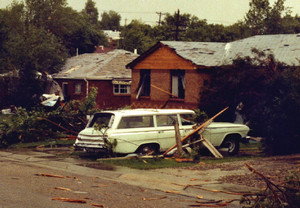
On June 3, 1981, Thornton was the site of the most destructive tornado in the history of the Denver metro area. The City of Thornton is now evaluating options to warn residents of severe weather threats. (City of Thornton archives)
Visitors to ThorntonWeather.com have often asked us if the city was taking any steps to protect its citizens and warn them about severe weather. The city – and Adams County – are lacking any type of alert system. Following last year’s ‘Summer of Storms,’ we were told the city would look into it.
Current options for citizens range from the Emergency Alert System used by television and radio broadcasters, free and pay Internet services as well as NOAA Weather Radio All Hazards (weather radio). As we have discussed previously, these systems have their limitations.
At this week’s city council update session, the Thornton City Council heard a presentation from city staff on the alternatives available. Utilizing Reverse 911 and contracting with a third party provider were two of the items discussed.
Read the presentation city staff gave to the Thornton City Council below
In trying to identify ways to keep citizens aware of deteriorating weather conditions, city staff told council, “Technology is changing so quickly that supporting a single system would not be efficient.”
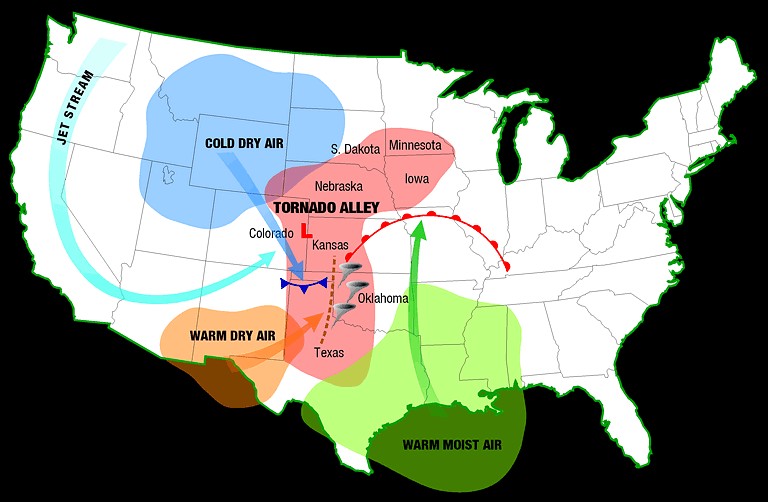
The Denver area is at the western edge of Tornado Alley and as we have seen historically and in recent days, the danger is real. Click image for larger view. Image courtesy NOAA.
Rather than implement their own system, staff recommended the city rely upon the federal government and the Federal Emergency Management Agency’s (FEMA) forthcoming Integrated Public Alert and Warning System (IPAWS).
Slated for widespread deployment in 2010, IPAWS will take the old Emergency Alert System and move it into the modern age by leveraging new communication technologies such as email and cellular phones.
Mayor Erik Hansen told ThorntonWeather.com, “The City of Thornton recognizes the dangers of severe weather and we are actively working to identify solutions to protect its citizens.”
While the city waits for IPAWS, staff said they recommend the “development of a Weather Awareness Public Education Program that would be implemented in the spring of each year.” They further would work to encourage residents to purchase weather radios.
ThorntonWeather.com’s Take
We are pleased that the city is finally taking some steps in the right direction – albeit 29 years late.
NOAA Weather Radio All Hazards is essential to protecting you and your family.
The implementation of a severe weather education program is also a step in the right direction, assuming it takes the form of something more substantial than the simple brochure the city developed this year.
Each spring the National Weather Service (NWS) offers storm spotter training seminars. These would likely be overkill for average citizens however we think it would be ideal for the City of Thornton to partner with the Denver / Boulder NWS office to offer education sessions for citizens. These could be taped and then shown on Channel 8 and on the city’s website.
We do have our reservations about waiting for and relying on the forthcoming IPAWS system when commercial systems are available, proven and ready now for the city to implement. Big government projects rarely are completed on time and often do not perform as expected. Hopes are high for IPAWS but we are cautious on giving it any sort of endorsement.
Granted, severe weather on par with the 1981 tornado is rare however last year’s severe weather and the Windsor tornado of two years ago show the danger is present. If a warning system saves one life, the cost incurred is well worth it and we hope the city continues to stay on top of this issue – we will certainly be watching.
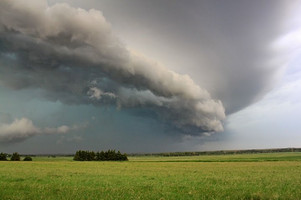
A shelf cloud moves across Nebraska farmland. (Tony Hake / ThorntonWeather.com)
Certainly the highlight of storm chasing is tornadoes and ThorntonWeather.com’s Storm Chase 2010 had plenty of those – five in one day in fact. However, as great of satisfaction can be derived from simpler, less violent storms. The images from a week of chasing on the Great Plains show the fury and the beauty of Mother Nature.
Storm chasing is as much an art as a science – there are no guarantees that tornadoes will appear as forecast. Other types of severe weather and the amazing structure they display can bu just as impressive.
Scud clouds hovering over a coal train in Nebraska, egg sized hail pummeling storm chaser vehicles, the sun setting on the Oklahoma plains and the now infamous Baca County, Colorado tornado ripping through ranchland all were highlights of Storm Chase 2010.
The images in the slideshow below represent some of the most stunning and beautiful images captured during the week.
Weather, natural disasters & climate news and information.




 Get the rest of this story including more photos and video explaining the phenomena at the Denver Weather Examiner!