Denver has seen a record-setting summer with extraordinarily warm temperatures and dry conditions. The question on everyone’s mind now is whether or not September will bring some relief.
Current indications are that overall the month will remain unseasonably warm and dry. However, temperatures will cool as is normal for September.
As temperatures start to drop, September usually reminds us that summer is at an end and fall is now here. Sunshine is predominant though as the month actually has the highest percentage of sun out of any month. Sunny days and clear, cool nights are the standard weather pattern for the month.
September 2 to September 8 - This Week in Denver Weather History
Normally September is a relatively quiet month however we do occasionally see some extraordinary conditions. Our look back at this week in Denver weather history shows the earliest seasonal snowfall in Denver history, damaging lightning and the destruction of the Fourmile Canyon wildfire.
From the National Weather Service:
1-5
In 1995…record breaking heat occurred on the first 5 days of the month when the temperature climbed into the 90’s on each day. Record high temperatures of 97 degrees on both the 1st and 4th equaled the all-time record maximum for the month. High temperature of 95 degrees on the 3rd was a record for the date. High temperatures of 94 degrees on both the 2nd and the 5th were not records. The low temperature of 64 degrees on the 4th equaled the record high minimum for the date.
1-7
In 1978…the temperature reached 90 degrees or more on seven consecutive days with the highest temperature…94 degrees… Recorded on both the 4th and 6th.
2
In 1938…heavy cloudbursts in the foothills near the top of Genesee Mountain caused flash flooding on Bear Creek at Morrison. Nearly 8 inches of rain fell just north of Morrison in 6 hours and drowned 6 people in a car between Morrison and Kittredge. Damage was estimated at nearly a half million dollars. Flash flooding also occurred on south Boulder Creek in Eldorado Springs. Rainfall totaled 4.42 inches in Eldorado Springs…and rainfall was estimated to more than 6 inches in the foothills west of the town. Many buildings and residences were damaged in Eldorado Springs…and bridges were swept away. The high waters forced residents from their homes as far downstream as Erie. This was the flood of record on South Boulder Creek.
In 1973…hail to 3/4 inch diameter was reported in Boulder.
In 1987…lightning struck two men who were standing under a tree in downtown Denver. Both were seriously injured and hospitalized.
In 1996…lightning sparked a brush fire in the south buffer zone of the Rocky Flats Environmental Test Facility. No structures were damaged…but the fire burned about 100 acres of grassland before being contained.
2-3
In 1892…there was a trace of rainfall each day. This… Together with a trace of rain on both the 7th and 8th…was the only rainfall of the month…making the month the driest on record. The monthly record was equaled in 1944.
3
In 1901…a thunderstorm produced rain…hail of unknown size… And south winds sustained to 40 mph with gusts to 43 mph.
In 1961…Labor Day snow storm is the earliest date of the first snow…trace and measurable…of the season. The heavy wet snow broke many limbs from trees that were still in full foliage. The storm produced 4.2 inches of snowfall at Stapleton Airport with nearly a foot of snow in western suburbs and in the foothills. Minimum temperature of 33 degrees was a record for the date and the coldest ever recorded so early in the season.
In 1999…severe thunderstorms dumped large hail across metro Denver. Hail as large as 1 inch in diameter was measured near Cherry Creek in Aurora and near Bennett. Hail to 3/4 inch in diameter fell in the city of Denver.
In 2002…a thunderstorm produced a wind gust to 51 mph at Denver International Airport.
In 2003…very heavy thunderstorm rain washed out parts of the Virginia Canyon Road above Idaho Springs. Up to 4 feet of mud reportedly washed down the road during the storm. Several vehicles were trapped on the road. In Idaho Springs…several streets…including the main street… Were also buried in mud and gravel. Some buildings in town experienced minor flooding…including the basement of the town library and the police station.
Denver's August 2012 will go into the books as the 5th hottest and 4th driest August since 1872.
There would be no break from the hot and dry summer of 2012 in August as records continued to tumble and the ground remained parched. While a few cold fronts provided some relief, they were short-lived and high pressure dominated during the month.
Denver recorded an average temperature of 75.0 degrees which was 2.5 degrees above normal. This ties August 1994 as the 5th warmest August since record keeping began in 1872.
In all, 20 days recorded high temperatures at or above 90 degrees at Denver International Airport. By the end of the month 2012 moved into the record books as having the most seasonal 90 degree days of any year (66 as of 8/31). Highs ranged from 98 degrees on the 3rd, 6th, 9th, and 27th to a low of 47 degrees on the 17th.
Here in Thornton our average temperature was quite a bit cooler, although still above average in comparison to recent years. Thornton’s average for the month came in at 72.7 degrees.
Thornton recorded 17 days of 90 degree or hotter high temperatures. Our hottest temperature was 96 degrees which occurred on the 27th and 29th. The coldest temperature recorded was 48 degrees on the 17th and 19th.
Precipitation continued to elude the Mile High City as a mere 0.11 inch fell into the rain bucket during the month, and that all came in a single day. This was far below the normal of 1.68 inches for August and put 2012 into the books as the 4th driest August on record.
Thornton fared only slightly better on the precipitation front as we recorded 0.31 inch of rain. As with Denver, that total came all in a single day, the 1st of the month.
...THE DENVER CO CLIMATE SUMMARY FOR THE MONTH OF AUGUST 2012...

CLIMATE NORMAL PERIOD 1981 TO 2010
CLIMATE RECORD PERIOD 1872 TO 2012

WEATHER         OBSERVED          NORMAL  DEPART  LAST YEAR`S
                 VALUE   DATE(S)  VALUE   FROM    VALUE  DATE(S)
                                          NORMAL
................................................................
TEMPERATURE (F)
RECORD
 HIGH             105   08/08/1878
 LOW               40   08/26/1910
                        08/25/1910
                        08/24/1910
HIGHEST            98   08/27        87      11       99  08/25
                        08/03
                        08/06
                        08/09
LOWEST             47   08/17        40       7       55  08/20
AVG. MAXIMUM     91.0              87.2     3.8     92.7
AVG. MINIMUM     58.9              57.9     1.0     61.3
MEAN             75.0              72.5     2.5     77.0
DAYS MAX >= 90     20              11.5     8.5       22
DAYS MAX = .01         1               8.6    -7.6        3
DAYS >= .10         1               4.3    -3.3        1
DAYS >= .50         0               1.2    -1.2        0
DAYS >= 1.00        0               0.3    -0.3        0
GREATEST
 24 HR. TOTAL    0.11   08/11 TO 08/11           08/03 TO 08/03

SNOWFALL (INCHES)
RECORDS
 TOTAL            0.0  NO SNOW EVER RECORDED IN AUGUST
TOTALS            0.0  NO SNOW EVER RECORDED IN AUGUST

DEGREE_DAYS
HEATING TOTAL       0                10     -10        0
 SINCE 7/1          0                16     -16        0
COOLING TOTAL     319               244      75      382
 SINCE 1/1       1122               688     434      863

FREEZE DATES
RECORD
 EARLIEST     09/08/1962
 LATEST       06/08/2007
EARLIEST                        10/07
LATEST                          05/05
..................................................

WIND (MPH)
AVERAGE WIND SPEED              9.9
RESULTANT WIND SPEED/DIRECTION   3/217
HIGHEST WIND SPEED/DIRECTION    38/330    DATE  08/30
HIGHEST GUST SPEED/DIRECTION    45/330    DATE  08/30

SKY COVER
POSSIBLE SUNSHINE (PERCENT)   MM
AVERAGE SKY COVER           0.50
NUMBER OF DAYS FAIR            8
NUMBER OF DAYS PC             22
NUMBER OF DAYS CLOUDY          1

AVERAGE RH (PERCENT)     34

WEATHER CONDITIONS. NUMBER OF DAYS WITH
THUNDERSTORM              4     MIXED PRECIP               0
HEAVY RAIN                0     RAIN                       0
LIGHT RAIN                9     FREEZING RAIN              0
LT FREEZING RAIN          0     HAIL                       0
HEAVY SNOW                0     SNOW                       0
LIGHT SNOW                0     SLEET                      0
FOG                       0     FOG W/VIS
Denver's radar at Front Range Airport is receiving a major upgrade that will greatly enhance weather monitoring capability. (ThorntonWeather.com)
The National Weather Service has begun a significant upgrade to Denver’s weather radar. The new dual-polarization (dual-pol) radar brings 14 new data types and will greatly enhance the ability of forecasters to monitor and analyze storms.
The information below is from the National Weather Service and describes the dual-pol upgrade and what it brings to the table in terms of enhancements with monitoring severe weather.
During a two-week period, beginning August 30, 2012, the Doppler radar at your National Weather Service Forecast Office will undergo an upgrade to incorporate new technology. For these two weeks, radar data will be unavailable from NWS Denver/Boulder!
This much anticipated upgrade is part of the NWS vision to build a Weather-Ready Nation to better protect lives and livelihoods. This exciting upgrade will incorporate a new technology called dual-polarization, or dual-pol. This new technology will result in 14 new radar products that will enable us to continue providing our suite of high quality products and services to the public. This new technology and data will primarily help forecasters identify the type of precipitation that is falling as well as improve rainfall estimates
Current NWS Doppler radars transmit and receive pulses of radio waves in a horizontal orientation. As a result, the radar only measures the horizontal dimensions of targets (e.g. cloud and precipitation droplets). Dual-polarimetric radar transmits and receives pulses in both a horizontal and vertical orientation. Therefore, the radar measures both the horizontal and vertical dimensions of targets. Since the radar receives energy from horizontal and vertical pulses, we can obtain better estimates of the size, shape, and variety of targets. It is expected that this will result in significant improvements in the estimation of precipitation rates, the ability to discriminate between precipitation types (e.g. hail vs. rain), and the identification of non-meteorological returns, such as chaff, ground clutter, and smoke plumes from wildfires that are not uncommonly detected by weather radar systems such as WSR-88D.
Current NWS Doppler Radar
Dual-Pol Radar
Better estimation of total precipitation amounts
Better estimation of the size distribution of hydrometeors (raindrops, snowflakes, hailstones, drizzle)
Much improved ability to identify areas of extremely heavy rainfall that are closely linked with flash floods
Improved detection and mitigation of non-weather related radar echoes (chaff, smoke plumes, ground clutter)
Easier identification of the melting layer (helpful for identifying snow levels in higher terrain)
Improved ability to classify precipitation type
The full benefit of dual-pol radar, however, will not be fully realized until NWS forecasters and research meteorologists develop real-time expertise.
A radio wave is a set of oscillating electric and magnetic fields, oriented 90 degrees to each other. Polarization of the wave is the direction, or orientation, of the electric field.
Horizontal Polarization
The electric field is oriented horizontally, along the x-axis (blue). The magnetic field is oriented vertically along the y-axis (white).
Vertical Polarization
The electric field is oriented vertically, along the y-axis (orange). The magnetic field is oriented horizontally along the x-axis (white).
July 21, 1969 - Neil Armstrong works on the moon. It is perhaps fitting that this is the only photo of Armstrong on the surface of the moon. The quiet man is one of the United States' greatest explorers and performed his mission for country, not for self.
We returned home from a weekend of camping to the news that Neil Armstrong has passed away and I am surprised by the lack of news coverage of the loss of this great American hero. His name will forever be mentioned in the annals of history along with other great explorers like Columbus, Polo, Lewis & Clark, Cook and Hillary.
On his return from the moon he could have had anything he wanted – politics, fame, riches. Instead he chose to return to his native Ohio and teach aerospace engineering at the University of Cincinnati.
Clearly Armstrong was a great man who believed he was serving a greater good, his nation. He did not go to the moon for himself or for fame or glory.
I shed a tear tonight for Neil Armstrong, one of our nation’s greatest quiet heroes.
May he rest in peace and may one day our nation find the will to continue on the path which he and so many of his predecessors put us on.
August 26 to September 1 - This Week in Denver Weather History
Significant events on Denver’s weather history calendar get a bit less numerous as we enter what is historically a relatively quiet period of the year. That isn’t to say however that major weather events can’t occur. Our look back at this week in Denver weather history includes a massive hail storm in 1944, many events in which lightning injured people and the warmest temperature ever recorded in September.
From the National Weather Service:
19-30
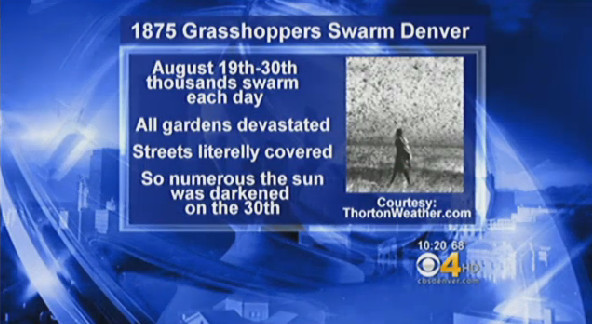
In 1875…grasshoppers appeared in great numbers at 10:00 am on the 19th. Thousands landed on the ground. The streets were literally covered with them. Swarms of grasshoppers were seen on each day. All gardens in the city were devastated…and in the countryside the grasshoppers were very destructive to ripened grain. On the 30th the grasshoppers were so numerous as to almost darken the sun.
24-26
In 1910…the lowest temperature ever recorded in August…40 degrees…occurred on each of these days and on August 22… 1904. The unusually cold weather for so early in the season brought sub-freezing minimum temperatures to much of the Colorado northeastern plains.
26
In 1944…one of the most destructive hailstorms in the city in a decade caused damage estimated at nearly one million dollars. The storm occurred within a period of 10 to 30 minutes…between 2:00 pm and 3:00 pm. The hail varied in size from very small to as large as 1 1/2 inches in diameter. Hail covered the ground to a depth of 5 to 6 inches in some sections of the city. Several people were cut by broken glass. The hail and heavy rain flooded underpasses to a depth of 6 feet…and the occupants of stalled autos had to be rescued. Sewers were unable to handle the sudden amount of water and water backed up and flooded a number of basements. A few first floors of buildings were flooded. The water department had a busy time replacing manhole covers that had been displaced by the water pressure. Trees were stripped…one was severely broken…and telephone lines were downed. Roofs…windows… automobiles…awnings…and gardens were severely damaged. Flowers and gardens in some sections of the city were a total loss. Greenhouses were extensively broken with an estimated 20 carloads of glass shattered. Vegetable and truck crops in and around the city were severely shredded. The next day the American Red Cross was designated by the war agency to grant any and all priorities needed to obtain materials and supplies to replace and repair the damage. In downtown Denver…the thunderstorm produced 0.95 inch of rain and heavy hail along with sustained northwest winds to 25 mph.
In 1961…strong winds blew in the walls of a warehouse under construction in Denver. Two workmen suffered a fractured foot and body bruises.
26-27
In 1980…two heavy thunderstorms hit Arvada and Westminster… Dumping up to 1.50 inches of rain in less than an hour. At least two streets were washed out and a number of homes and cars were damaged when a creek flooded. Three homes in Arvada sustained minor lightning damage.
27
In 1910…a thunderstorm produced south winds sustained to 40 mph.
In 1961…strong thunderstorm winds and heavy rain occurred at 79th and federal blvd. In Westminster. The strong winds blew the roofs off lumber sheds onto parked cars.
In 1967…a young woman was killed by lightning while horseback riding in the suburbs just west of Denver. Her horse died several hours after the incident. A young man and another young woman were also knocked from their horses by the impact of the lightning and required hospitalization.
In 1991…heavy thunderstorm rainfall totaled 0.91 inch at Stapleton International Airport…where 1/4 inch diameter hail was measured.
In 1996…localized street flooding occurred in the Fort Lupton area when 2 to 3 inches of rain fell in 45 minutes. The roof of a community college began leaking…which caused damage to ceiling tiles. The roof was under repair from hail damage which had occurred earlier in the summer. A weak tornado (f0) was sighted near Fort Lupton. No damage was reported.
In 1999…a slow moving thunderstorm dumped 5 inches of rain in 2 hours near Dacono. A severe thunderstorm produced 3/4 inch diameter hail in Castle Rock.
In 2002…severe thunderstorms spread large hail over metro Denver. Hail as large as 2 inches in diameter fell in Jefferson County 5 to 11 miles northwest of Golden. Other large hail reports included: 1 1/2 inches near Golden and in Lakewood; 1 1/4 inches in Nederland; 1 inch hail near Elizabeth…Louviers…Rollinsville…and Blackhawk; 7/8 inch hail near Acequia in Douglas County. A thunderstorm produced a trace of rain and a microburst wind gust to 52 mph at Denver International Airport.
In 2003…lightning struck a house and sparked a fire in Arvada. Damage to the roof and ceiling was extensive.
In 2005…lightning struck an unoccupied home in Parker. The resulting fire damaged the roof…attic…and second floor bedroom. Damage was estimated at 15 thousand dollars.
CBS4 meteorologist Dave Aguilera credited ThorntonWeather.com for information on a particularly noteworthy Denver weather event in our history.
During Sunday night’s 10:00pm newscast CBS4 meteorologist Dave Aguilera talked about one particularly notable historical weather-related event: massive swarms of grasshoppers over the Mile High City this week in Denver weather history. The graphic Aguilera displayed during the broadcast had details on the event with a credit to ThorntonWeather.com as the event was one of many in the This Week in Denver Weather History series that we post every week.
It was pretty neat to see us get credit and we thank Dave for the credit – it is much appreciated. Dave, if you ever want to do a story on personal weather station websites and owners, let us know! 😉
August 19 to August 25 - This Week in Denver Weather History
Funnel clouds, tornadoes, deadly flooding and more highlight our look back at this week in Denver weather history.
From the National Weather Service:
16-19
In 1979…heavy thunderstorm rains on each of 4 consecutive days dumped a total of 2.62 inches of rain on Stapleton International Airport. The heaviest rain…1.05 inches… On the 19th was accompanied by 1/4 inch diameter hail.
18-19
In 1875…nearly 0.75 inch of rainfall in the city overnight… Possibly assisted by heavier rainfall upstream…produced a decided and rapid rise in Cherry Creek…which washed out some bridges. Other small creeks and streams were filled to overflowing.
19
In 1983…heavy rain fell across the northern metro Denver suburbs with 1.50 to 1.80 inches of rain in Broomfield… Arvada…and Thornton.
In 1989…lightning killed a 31-year-old man and injured his 10 year old nephew when it hit a tree they were walking under in the foothills about 5 miles west of Boulder. The boy received mouth to mouth resuscitation on the scene and recovered after being hospitalized overnight. Three other people were knocked to the ground by the bolt…but were uninjured.
In 1990…3/4 inch diameter hail was reported in Wheat Ridge. A thunderstorm over west Denver dumped an inch of rain in 20 minutes…causing minor street flooding. One inch diameter hail was reported over east Denver. Ping pong to golf ball size hail was reported 14 miles northeast of Denver at the intersection of 122nd Ave. and Brighton Blvd. The hail stones knocked out windows and did an unspecified amount of damage to the roof of a house. Close by…heavy thunderstorm rains caused gullies…irrigation ditches…and small streams to overflow their banks near the intersection of 120th Avenue and Riverdale Road. Flood waters 1 to 2 feet deep covered the river bottom land along the South Platte River. However…no structures were threatened by the flood waters.
In 1999…heavy rain…up to 5 inches in two hours…caused east tollgate creek to jump its banks. The bike path adjacent to the creek was underwater at several locations. Several underpasses were also flooded…halting traffic. In addition…an unfinished playground at a local elementary school was completely flooded. Lightning struck a vehicle at east Evans Avenue and Tower Road. The woman inside the vehicle was not injured.
19-30
In 1875…grasshoppers appeared in great numbers at 10:00 am on the 19th. Thousands landed on the ground. The streets were literally covered with them. Swarms of grasshoppers were seen on each day. All gardens in the city were devastated…and in the countryside the grasshoppers were very destructive to ripened grain. On the 30th the grasshoppers were so numerous as to almost darken the sun.
August 12 to August 18 - This Week in Denver Weather History
Denver’s weather calms considerably in August as compared to many other months but the history books show plenty of notable events in our past. Lightning, flooding rain and even a tornado highlight this week in Denver weather history.
8-13
In 1875…clouds of grasshoppers were seen flying through the air on the prevailing winds during each day.
12
In 1876…the temperature climbed to a high of 100 degrees in downtown Denver.
In 1941…excessive thunderstorm rainfall flooded streets and delayed traffic for a few hours in some sections of the city. The basements of a considerable number of homes and commercial buildings were flooded. The total value of the damage was unknown. Only 0.94 inch of thunderstorm rainfall was recorded downtown.
In 1969…a man and a 9-year old boy were injured…when lightning struck a tree near where they were standing. Both were revived after treatment…but the boy later died of respiratory failure due to electrical shock.
In 1984…heavy thunderstorm rains drenched southern metro Denver. Rural roads in Douglas County received minor washouts. Hail…as large as 3/4 inch in diameter…was reported in southeast Aurora with one inch diameter hail reported near Parker. Rainfall totaled 1.00 inch at Stapleton International Airport.
12-13 in 1975…heavy rains caused flash flooding along the foothills from Denver north. Thunderstorm rainfall totaled 1.56 inches at Stapleton International Airport.
In 2004…a brief cool spell resulted in two daily temperature records. The low temperature of 49 degrees was a record minimum for the 12th…as was the low temperature of 48 degrees on the 13th.
13
In 1959…thunderstorm winds gusted to 53 mph at Stapleton Airport.
In 1983…thunderstorms dumped torrential rain in Northglenn… Thornton…and Broomfield. Northglenn was drenched with 1.72 inches in 30 minutes. Street flooding was widespread. Hail…as large as 3/4 inch in diameter…was reported 7 miles northeast of Boulder along with heavy rain which caused some street flooding.
In 2000…lightning sparked 3 small grass fires near Golden. The fires were quickly contained. Hail as large as 3/4 inch in diameter fell in Castle Rock.
NASA's Curiosity rover and its parachute were spotted by NASA's Mars Reconnaissance Orbiter as Curiosity descended to the surface on Aug. 5 PDT (Aug. 6 EDT). Image Credit: NASA/JPL-Caltech/Univ. of Arizona
Landing on Mars has proven over the years to be an extremely difficult task with few space probes seeing success. NASA’s Curiosity rover beat the odds completing its 352 million mile journey with a perfect landing early Monday morning.
The probe was launched on November 26 and as it neared its touchdown on the Red Planet, NASA had been discussing the “7 minutes of terror” involved in inserting the probe into the Martian atmosphere and successfully landing. The craft used an amazing array of equipment to land including a sky crane and a supersonic parachute.
The image above was taken by the Mars Reconnaissance Orbiter in a perfectly choreographed event designed to capture just an image. The photo shows Curiosity dangling under its massive parachute as it descends to the surface.
NASA’s Curiosity rover and its parachute were spotted by NASA’s Mars Reconnaissance Orbiter as Curiosity descended to the surface on Aug. 5 PDT (Aug. 6 EDT). The High-Resolution Imaging Science Experiment (HiRISE) camera captured this image of Curiosity while the orbiter was listening to transmissions from the rover. Curiosity and its parachute are in the center of the white box; the inset image is a cutout of the rover stretched to avoid saturation. The rover is descending toward the etched plains just north of the sand dunes that fringe “Mt. Sharp.” From the perspective of the orbiter, the parachute and Curiosity are flying at an angle relative to the surface, so the landing site does not appear directly below the rover.
The parachute appears fully inflated and performing perfectly. Details in the parachute, such as the band gap at the edges and the central hole, are clearly seen. The cords connecting the parachute to the back shell cannot be seen, although they were seen in the image of NASA’s Phoenix lander descending, perhaps due to the difference in lighting angles. The bright spot on the back shell containing Curiosity might be a specular reflection off of a shiny area. Curiosity was released from the back shell sometime after this image was acquired.
This view is one product from an observation made by HiRISE targeted to the expected location of Curiosity about one minute prior to landing. It was captured in HiRISE CCD RED1, near the eastern edge of the swath width (there is a RED0 at the very edge). This means that the rover was a bit further east or downrange than predicted.
The image scale is 13.2 inches (33.6 centimeters) per pixel .
HiRISE is one of six instruments on NASA’s Mars Reconnaissance Orbiter. The University of Arizona, Tucson, operates the orbiter’s HiRISE camera, which was built by Ball Aerospace & Technologies Corp., Boulder, Colo. NASA’s Jet Propulsion Laboratory, a division of the California Institute of Technology in Pasadena, manages the Mars Reconnaissance Orbiter Project for NASA’s Science Mission Directorate, Washington. Lockheed Martin Space Systems, Denver, built the spacecraft.
Credit: NASA/JPL-Caltech/Univ. of Arizona
Weather, natural disasters & climate news and information.

 Denver has seen a record-setting summer with extraordinarily warm temperatures and dry conditions. The question on everyone’s mind now is whether or not September will bring some relief.