
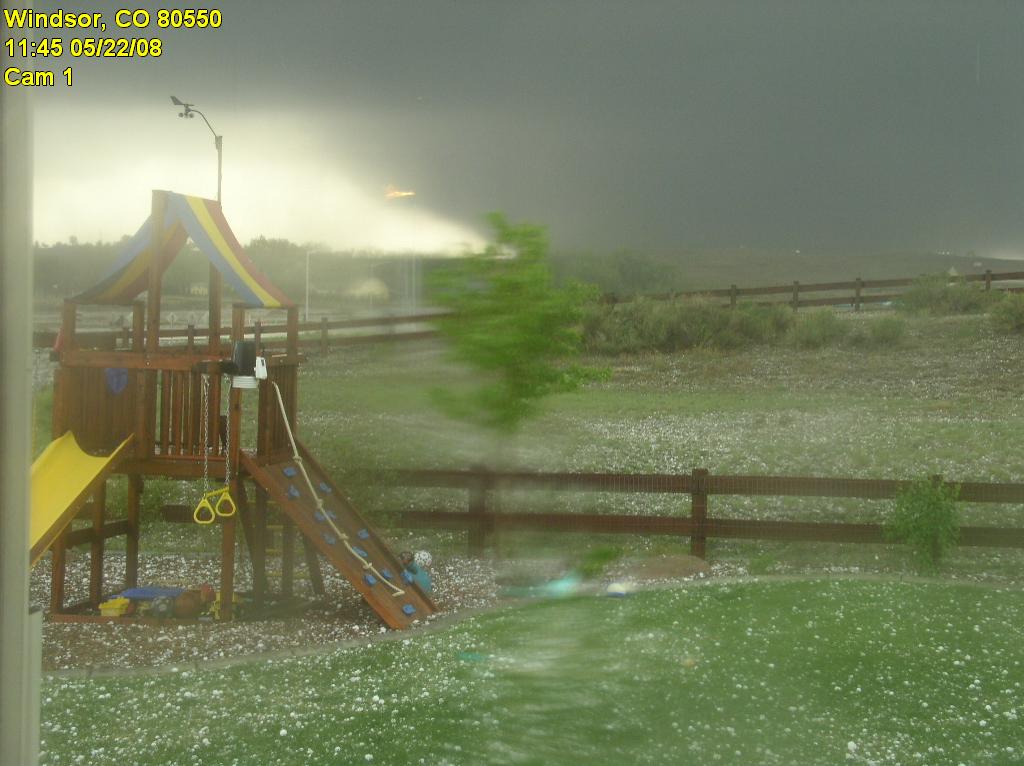
A fast moving jet stream coupled with quickly rising temperatures and unusually high humidity ripened conditions for what we now simply call the ‘Windsor tornado.’ Soon after 11:00am that morning a monstrous supercell thunderstorm could be seen erupting to the north of the Denver area.
Tornado warnings were soon issued by the National Weather Service and a Gilcrest police officer radioed, “We have a tornado on the ground!”
Indeed this was no ordinary Colorado tornado. This was to become an EF-3 monster three quarters of a mile wide and packing winds up to 165 mph, an event more associated with the plains of Oklahoma.
Over the course of 35 miles and 45 minutes the tornado ripped through the landscape. Making the event all the more unusual was its movement to the northwest, far different than typical tornadoes which move to the northeast.
Day became almost as dark as night as the ominous wedge approached Windsor. Hail as large as softballs began to rain down.
At 11:57 a.m. the town became ground zero.
Scared residents rushed for safety as nature’s most violent phenomena arrived. Power poles were snapped like matchsticks, semi-trailers were overturned like toy cars, and homes and buildings were reduced to their basic building materials.
Windsor resident Jill Gallagher told the Windsor Beacon this week of her huddling in her basement with her daughters as the twister struck. After it passed, “That’s when I turned and looked up my stairwell, and that’s when I knew something had majorly happened.”
Gallagher said her stairs were blocked and she was staring up at blue sky instead of her home’s ceiling.
The power of the storm was fully evident in the toll on life and property.
One man was killed west of Greeley at Missile Silo Park Campground and 78 people were injured. Property damages totaled $193.5 million as nearly 300 homes were destroyed or significant damaged and another 850 sustained less substantial damage.
Lying on the western edge of the infamous Tornado Alley, twisters are quite commonplace in the Centennial State. From 1950 to 2012 there have been 1,983 tornadoes scattered across the state. Most though occur on the eastern plains, well away from the higher terrain of the west and the more populous Front Range. Only 20 of those have attained F3 strength.
Today, five years after that deadly day, a drive through Windsor would yield few signs of the tornado that caused so much devastation. The residents however are quick to remember it, particularly in light of the recent deadly tornadoes in Texas, Kansas and Oklahoma.