
Tag Archives: Weather History

The weather and the ‘date which will live in infamy’

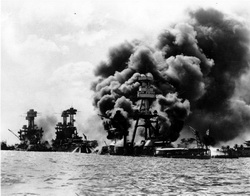
December 7, 1941.  From left, the USS USS West Virginia, USS Tennessee, both damaged and USS Arizona, sunk.  The weather played a key part in the attack on Pearl Harbor.
December 7, 1941. From left, the USS USS West Virginia, USS Tennessee, both damaged and USS Arizona, sunk. The weather played a key part in the attack on Pearl Harbor.

The weather that morning was beautiful over Pearl Harbor as one might expect in paradise.  The USS Tennessee reported winds at 11 to 16 miles an hour and slight wind ripples on the water of the bay.  The USS Oklahoma reported clear skies with “intermittent moving fleecy clouds.”  Little did the men making those weather reports know that hell was about to rain down on them.

69 years ago today, the United States was forced into World War II with the brutal surprise attack on Pearl Harbor.  Over 2,300 servicemen lost their lives on that fateful day, a “date which will live in infamy.” Relatively unknown in the stories of that fateful day is how the weather played a key and prominent role.

On December 4th, a Japanese intelligence officer at their embassy in Washington D.C. was listening to Radio Tokyo as he had been for the last two weeks.  The weather report:  “Higashi no kaze ame”, or “east wind, rain.”  That seemingly innocent phrase was in actuality code to Japanese diplomats to destroy all of their cryptographic equipment, books and top secret documents as an attack was imminent.  A weather report sounded the alarm that war was coming.
 
On Oahu, December and January are actually the cloudiest months and this was a concern for the Japanese in the planning of their attack.  Timing was of the essence as winter in the Pacific can be brutal and if they were forced to wait till late December, success would be in doubt.  The clouds would be good for hiding the planes on their approach to the islands but if they couldn’t see their targets, the attack could not be successful.

220 miles north of Oahu and heading east into a steady wind, the Japanese fleet launched its planes at 6:10am.  The wind provided the extra lift for the bomb-laden planes and low clouds at 5,000 feet helped to provide cover for the fleet and its planes.  The question remained however – would there be clouds over the target?

As the planes headed toward Pearl, U.S. code breakers intercepted a message from Tokyo to Japanese diplomats telling them to break off talks with the United States.  At 7:33am, Army Chief of Staff, General George C. Marshall, believed this could be the harbinger of an attack and he sends a warning to Lt. Gen. Walter C. Short, commander of U.S. Army forces in Hawaii.  Atmospheric static however prevents the message from being sent by radio and Marshall’s message is sent via commercial telegraph instead. Short’s headquarters receives the message at 11:45am and he did not see it until 3:00pm – more than eight hours after the attack had started.

Flying between 9,000 and 14,000 feet, the clouds provided the cover that the Japanese planes needed.  Using a Honolulu radio station to guide them, the planes neared the north coast at 7:30am and heard the radio announcer report, “clouds, mostly over the mountains.  Visibility good.”  That is exactly what they wanted to hear.  Their approach over the mountains of the island was concealed by the clouds and as they neared Pearl Harbor, those clear skies reported by the USS Oklahoma and Tennessee provided the bombers the visibility they needed to hit their targets.  At 7:55am, metal rain began to fall on our soldiers, sailors and airmen.

Our nation was forever changed that day and as is often the case, the weather played a key role in this moment in history.  After the attack, Japanese Admiral Isoroku Yamamoto said, “We have awakened a sleeping giant and have instilled in him a terrible resolve.”  Indeed that was the case but the price was heavy as nearly 300,000 United States service members would lose their lives in the years to come.

Dallas City Hall, Veterans Day, November 11, 2004. Houston James, a survivor of the attack on Pearl Harbor, hugs Marine Staff Sergeant Mark Graunke Jr., a member of an explosive disposal team who lost his left hand, one leg and an eye in Iraq.

On  personal note, I ask all of our readers to take the time today to acknowledge and remember not only those that paid the ultimate sacrifice on December 7, 1941 and in the following years, but also remember that more than 16 million men and women served in the armed forces during World War II.  Of those, a mere 2.3 million are still with us today and 1,000 World War II veterans die each and every day.  As we mourn their passing, we should also remember that which they stood for – honor, sacrifice, courage, God and country.  There had never been – and there never will be – a generation like theirs.  I thank them for their service and hope they may have the peace in heaven that they did not see while on earth.  God bless you all. 

For more information:  Please help Thornton build a memorial to honor not only World War II veterans but all veterans from all branches of service and all wars.  The owner and operator of ThorntonWeather.com is a significant contributor to the project and asks that our visitors consider donating to the project.  Please visit the Thornton Veterans Memorial website for more information.
December 4 to December 11 – This week in Denver weather history

December 4 to December 11 - This week in Denver weather history

While Denver still waits for its first significant snowfall of the season, in years past it has been much easier to come by.  Looking back we see one five day storm that dumped snow that was measured in feet and many other smaller ones that were significant in their own right.

1-5

In 1913…the 1st marked the start of the heaviest 5-day total snowfall in the city’s history.  During this period snowfall totaled 45.7 inches.  Starting on the 1st…snow fell intermittently for 3 days and accumulated a little over 8 inches.  On the 4th and 5th…an additional 37.4 inches of snow fell.  At Georgetown in the foothills west of Denver even more snow fell…86 inches over the 5 days with the most…63 inches…on the 4th.  In Colorado…snowfall was heavy along the eastern slopes of the mountains from the Palmer Divide north.  High winds during the storm caused heavy drifting…which blocked all transportation.  Snow cover of an inch or more from the storm persisted for 60 consecutive days from the 1st through January 29…1914. Additional snowfall in December and January prolonged the number of days.  This is the third longest period of snow cover on record in the city.

2-17 

In 1939…more than 2 weeks of unseasonably warm weather made the month the 3rd warmest on record.  Seven daily temperature records were set…including the all time record high temperature for the month of 79 degrees on the 5th.  Daytime highs were balmy with 14 days in the 60’s and 70’s.  Low temperatures dipped to freezing or below on only 5 days.  The period was dry with only a trace of snow on the 12th.

3-15 

In 1972…a protracted cold spell held an icy grip on metro Denver when maximum temperatures never reached above freezing for 10 consecutive days from the 3rd through the 12th and minimum temperatures dipped below zero on eleven consecutive days from the 5th through the 15th. Daily low temperature records were set with 15 degrees below zero on the 5th…17 degrees below zero on the 6th… And 18 degrees below zero on the 10th.  Daily record low maximum readings were set with 3 degrees on the 6th and 6 degrees on the 9th.  The very cold temperatures were caused by 3 to 5 inches of snow cover and a Canadian air mass.

Continue reading December 4 to December 11 – This week in Denver weather history

November 27 to December 4 – This week in Denver weather history

November 27 to December 4 - This week in Denver weather history

Cold, snow and wind are part of life on the Great Plains and we see all of those events have struck in abundance during this week in Denver weather history.  Many of the wind events were damaging and the snow accumulations significant.

From the National Weather Service:

25-28

In 1952…the average coldest 4-day period in November in the previous 81 years of record occurred.  Maximum temperatures of 19…15…21…and 25 degrees were recorded.  Minimum temperatures were below zero each day with readings of 7 below…6 below…5 below…and 6 below.

25-29

In 1985…dense fog with visibilities as low as 1/8 mile occurred on five consecutive days at Stapleton International Airport.  The fog was at times accompanied by light snow… Light freezing drizzle…or ice crystals.  Fog occurred all day on both the 26th and 29th.

28

In 1884…a windstorm during the afternoon produced northwest sustained winds to 46 mph.  Two wooden slats were blown out of the weather instrument shelter…and nearly all of the slats on the north and west sides were loosened.
 
In 1898…northwest winds were sustained to 50 mph with gusts as high as 80 mph.
 
In 1902…northwest winds were sustained to 40 mph with gusts to 48 mph.  The strong apparent Bora winds warmed the temperature to a high of only 40 degrees.
 
In 1904…northwest winds sustained to 44 mph with gusts to 58 mph warmed the temperature to a high of 58 degrees.
 
In 1927…strong west winds occurred in Boulder…causing widespread minor damage.  A wind gust to 65 mph was recorded at Valmont east of Boulder.  The west winds possibly produced a cyclonic twist.
 
In 1928…heavy snowfall totaled 7.0 inches over downtown Denver.
 
In 1957…a vigorous cold front produced north-northeast wind gusts to 54 mph at Stapleton Airport.  Light snow following the front totaled only 0.2 inch.
 
In 1970…strong Chinook winds reached 77 mph in downtown Boulder.
 
In 1978…wind gusts 60 to 90 mph were reported in and near the foothills.
 
In 1984…high winds of 60 to 80 mph occurred along the Front Range eastern foothills.  In Boulder…the high winds blew the roof off a service station.  Several trees were felled… Damaging some cars.  An elderly woman was injured when she was knocked down by a wind gust and blown 20 feet into some bushes.  Northwest winds gusted to 36 mph at Stapleton International Airport.
 
In 1994…winds gusted to 72 mph in Boulder.  No damage was reported.  Northwest winds gusted to 35 mph at Stapleton International Airport.

Continue reading November 27 to December 4 – This week in Denver weather history

November 21 to November 27 – This week in Denver weather history

November 21 to November 27 - This week in Denver weather history

Weather is a big part of the holidays.  With many people hitting the road to visit friends and family the weather can make or break those holiday plans.  Our look back at this week in Denver weather history shows a number of Thanksgivings when the weather put a damper on travel plans.

19-21

In 1979…a heavy snowstorm buried most of Colorado under at least a foot of snow.  Snowfall at Stapleton International Airport totaled 17.7 inches…the greatest snow depth since 1946.  Winds to 60 mph produced 5-foot drifts paralyzing the city as temperatures hovered in the 20’s.  While small airports closed…Stapleton remained open…but with long delays that snarled Thanksgiving holiday traffic.  Schools and businesses closed and postal deliveries were delayed. Almost all major highways leading out of Denver were closed to traffic for periods of time on the 20th and 21st.  Most of the snow…13.5 inches…fell on the 20th.  At Stapleton International Airport…north winds gusted to 35 mph on the 20th and to 38 mph on the 21st.

20-21

In 1898…snowfall totaled 4.0 inches in downtown Denver. Northeast winds were sustained to 48 mph with gusts as high as 60 mph behind an apparent cold front on the 20th… When temperatures plunged from a high of 66 degrees to a low of 9 degrees.  On the 21st the high was only 24 degrees and the low was 2 degrees.
 
In 1970…a wind gust to 94 mph was recorded at gold hill in the foothills west of Boulder.  Strong winds also swept across metro Denver.  Wind gusts reached 59 mph in downtown Boulder…while at Stapleton International Airport west- northwest winds gusted to 43 mph on the 21st.  Damage was minor.
 
In 1992…a large Canadian air mass moved into the state at the same time an upper level storm system approached from the west.  The combination of cold air at the surface and very moist air aloft produced heavy snow across the entire state.  Snowfall totaled 6.3 inches at Stapleton International Airport…where north winds gusted to 23 mph on the 20th.  Snow was heavier in the foothills…with 14 inches at Wondervu…13 inches at Aspen Springs…Conifer… Boulder…and Gross Reservoir…8 inches at Rollinsville… And 10 inches at Golden Gate Canyon and Morrison.
 
In 2007…a storm system brought moderate to heavy snowfall to portions of the urban corridor.  Storm totals included: 7 inches…3 miles south-southeast of Fort Collins…with 6 inches in Boulder and at Horsetooth inlet bay.  Elsewhere… Storm totals ranged from 2 to 5 inches.  Snowfall totaled 2.0 inches at the site of the former Stapleton International Airport.

Continue reading November 21 to November 27 – This week in Denver weather history

November 14 to November 20 – This week in Denver weather history

November 14 to November 20 - This week in Denver weather history

Henry Fenton is probably not a name many folks are familiar with however he will forever be engrained in the Denver weather history books.  It was 139 years ago this week that Fenton made the first official Denver weather observations.

From the National Weather Service:

11-14

In 1970…heavy snowfall totaled 7.2 inches at Stapleton International Airport where northeast winds gusted to 22 mph on the 12th and 14th.  Most of the snow… 4.2 inches…fell on the 12th.

12-15

In 1909…light snowfall totaled 6.7 inches in downtown Denver over the 4 days.  This was the first measurable snowfall of the season.  Northeast winds were sustained to 15 mph on the 12th.

13-14

In 1925…heavy post-frontal snowfall totaled 6.4 inches overnight in downtown Denver.  Northwest winds were sustained to 27 mph with gusts to 29 mph on the 13th.
 
In 1974…northwest winds gusted to 52 mph at Stapleton International Airport…warming the temperature to 60 degrees shortly after midnight on the 13th.  A cold front cooled temperatures into the 20’s by late morning and produced snowfall of 3.7 inches.  The low temperature dipped to 14 degrees on the 14th.
 
In 1993…an upper level low pressure system combined with a weak but moist upslope flow to produce heavy snow across metro Denver.  Snowfall amounts averaged 6 to 8 inches with up to 16 inches in the foothills at the Eldora Ski Area. Snowfall totaled 6.0 inches at Stapleton International Airport where north winds gusted to only 20 mph on the 14th.  Most of the snow fell on the 14th.
 
In 1994…heavy snow developed rapidly along the Front Range urban corridor with the heaviest snow over northwest metro Denver.  Sixteen to 18 inches of snow fell in Boulder… Lafayette…and Louisville.  This was the second heavy snowfall over northwest metro Denver in 10 days.  Eleven to 14 inches of snow were measured from Longmont southward into Aurora.  Snowfall totaled 12.1 inches at Stapleton International Airport where northeast winds gusted to 29 mph on the 13th.  Most of the snow…9.0 inches…fell on the 14th.
 
In 1997…heavy snow fell overnight in portions of Jefferson and Boulder counties.  About 5.5 inches of snow were reported in Boulder…while 4 inches were measured 12 miles southwest of Morrison and 6 miles southwest of Golden. Snowfall totaled only 1.8 inches at the site of the former Stapleton International Airport.  Northeast winds gusted to 26 mph at Denver International Airport.

Continue reading November 14 to November 20 – This week in Denver weather history

October 31 to November 6 – This week in Denver weather history

October 31 to November 6 - This week in Denver weather history

Frightening weather does not seem to be in the cards for our Halloween or the immediate future.  That however is not always the case as we look back at this week in Denver weather history.

28-31

In 1929…rain changed to snow on the afternoon of the 28th and continued until midday on the 30th followed by intermittent light snow which continued through the 31st. Snowfall over the four days totaled 16.2 inches in the city.  Most of the snow…8.5 inches…fell on the 29th with 6.1 inches on the 30th.  Temperatures hovered in 20’s during most of the storm.

29-31

In 1889…the first snowfall of the season totaled 14.0 inches over the three days in downtown Denver.  Snowfall was 8.0 inches on the 29th and 5.0 inches on the 31st.  North to northeast winds gusted to 30 mph on the 29th.
 
In 1950…a warm spell resulted in five daily temperature records.  Record highs of 84…80…and 79 degrees occurred on the 29th…30th…and 31st…respectively.  Low temperature of 49 degrees on the 30th was the record high minimum for the date.
 
In 1991…the second surge of cold arctic air in a matter of days plunged metro Denver into the deep freeze.  While low temperatures remained above zero…high temperatures were only in the 20’s.  Three temperature records were set: record lows of 7 degrees on the 30th and 10 degrees on the 31st and a record low maximum of only 21 degrees on the 30th.  Snowfall was light with only 1.9 inches recorded at Stapleton International Airport where east winds gusted to 23 mph.
 
In 2002…snowfall totaled 4.3 inches at the site of the former Stapleton International Airport.  North winds gusted to 32 mph on the 29th behind a cold front…which plunged temperatures well below seasonal normals.  High temperatures of 18 degrees on the 30th and 19 degrees on the 31st were record low maximums for each date.  Low temperatures dipped to 12 degrees on the 30th and 15 degrees on the 31st.

Continue reading October 31 to November 6 – This week in Denver weather history

October 24 to October 30 – This week in Denver weather history

October 17 to October 23 – This week in Denver weather history
October 24 to October 30 - This week in Denver weather history

This year Denver is still waiting for its first snow and we have already passed the average date we see it (October 19).  That however isn’t always the case and October can bring monster snowstorms as we see in our look back at this week in Denver weather history.

From the National Weather Service:

23-24

In 1887…the first measurable snowfall of the season totaled 3.1 inches.  North winds to 20 mph were recorded on the 23rd.  This was the only measurable snow of the month.
 
In 1932…post-frontal snowfall from the late evening of the 23rd continued through the late afternoon of the 24th and totaled 6.2 inches.  Southeast winds were sustained to 25 mph with gusts to 26 mph on the 23rd.  Temperatures cooled from a high of 68 degrees on the 23rd to a low of 25 degrees on the 24th…the coldest reading of the month that year.  Many trees that had not shed their leaves became heavily laden by the wet snow.  Many branches were broken… And a few trees toppled under the weight of the snow.  The landscape became one of rare beauty.

24

In 1956…southwest winds gusted to 56 mph and produced some blowing dust at Stapleton Airport.  A cold front produced a thunderstorm with 1/8 inch hail.  Rain later changed to snow.  Precipitation totaled only 0.11 inch and snowfall only 0.3 inch.
 
In 1973…strong winds raked the eastern foothills…causing damage in Boulder and Jefferson counties.  The heaviest damage occurred in the Boulder area where 20 to 25 mobile homes were hit…some power and telephone lines were blown down…and a store was damaged.  A wind gust to 76 mph was recorded in Boulder at the National Bureau of Standards. Northwest winds gusted to 46 mph at Stapleton International Airport.

24-25

In 1921…rainfall totaled 0.35 inch overnight behind an apparent cold front.  North winds were sustained to 40 mph with gusts to 46 mph on the 25th.  Temperatures plunged from a high of 73 degrees on the 24th to a low of 39 degrees on the 25th.
 
In 1923…rain overnight changed to snow during the morning. The heavy snowfall accumulated to 12.0 inches before ending on the morning of the 25th.  Post-frontal north winds were sustained to 22 mph with gusts to 23 mph on the 24th.
 
In 1997…one of the worst and deadliest blizzards of the decade developed over eastern Colorado as deep east to northeast flow associated with a vigorous upper level low pressure system over the Four Corners…combined with a strong arctic air mass over the central Great Plains. Snowfall totals across metro Denver ranged from 14 to 31 inches.  The heaviest snowfall occurred in the foothills west and southwest of Denver where 2 to 4 feet of snow were measured.  Sustained winds to 40 mph with gusts as high as 60 mph produced zero visibilities and extremely cold wind chill temperatures from 25 below to 40 below zero.  Winds whipped the snow into drifts 4 to 10 feet deep.  Several major and interstate highways were closed as travel became impossible.  Red Cross shelters were set up for hundreds of travelers who became stranded when they had to abandon their vehicles.  Four people died in northeastern Colorado as a result of the blizzard.  None of the deaths were in metro Denver.  At Denver International Airport…4 thousand travelers were stranded when the airport was forced to shut down.  At least 120 cars were abandoned along Pena Blvd….the only arterial leading into and out of DIA.  The blizzard cost air carriers at least 20 million dollars.  Thousands of cattle died in the storm over northeastern Colorado…resulting in losses totaling 1.5 million dollars.  Some of the more impressive snowfall totals included:  51 inches at Coal Creek Canyon; 48 inches at Silver Spruce Ranch…near Ward; 42 inches at Intercanyon…in the foothills southwest of Denver; 37 inches at Sedalia; 35 inches at Aspen Springs and Conifer in the foothills west of Denver; 31 inches at Eldorado Springs… Southeast Aurora…and Englewood; and 30 inches on Table Mesa in Boulder.  Snowfall totaled 21.9 inches at the site of the former Stapleton International Airport…setting a new 24-hour snowfall record of 19.1 inches for the month. Snowfall totaled only 14 inches at Denver International Airport where north winds gusted to 39 mph on the 24th. High temperature of only 21 degrees on the 25th equaled the record low maximum for the date first set in 1873. Low temperature of only 3 degrees on the 26th set a new record minimum for the date.

Continue reading October 24 to October 30 – This week in Denver weather history

October 17 to October 23 – This week in Denver weather history

October 17 to October 23 – This week in Denver weather history

This year Denver is still waiting for its first snowfall but that certainly has not been the case throughout history.  Many times in our past we have seen not only snow around this time of October but heavy snow as well, oftentimes damaging in nature.

15-17

In 1989…an autumn snowstorm hit metro Denver with 2 to 6 inches of snow.  Snowfall totaled 4.4 inches at Stapleton International Airport where the maximum snow depth on the ground was only 3 inches due to melting and north winds gusted to 25 mph on the 15th.  The heavy wet snow caused leafy branches to sag onto power lines…resulting in a number of power outages.  Five thousand homes were blacked out in Boulder on the 16th.  Up to a foot of snow fell in the higher foothills with 19 inches recorded at Echo Lake.

16-17

In 1990…strong downslope winds raked the eastern foothills. Wind gusts from 60 to 75 mph were common.  Strong winds in metro Denver resulted in wave damage to a dock used to moor several private sail boats at Cheery Creek Reservoir. Damage was confined to the dock and two anchor cables. A northwest wind gust to 43 mph was recorded at Stapleton International Airport.

17 

In 1878…strong winds reached sustained speeds of 48 mph.
 
In 1988…a wind gust to 62 mph was recorded in central Boulder.  The strong winds caused a few brief power outages.  An old smoldering brush fire in the foothills west of Boulder was re-ignited by the wind gusts.
 
In 1994…winds gusted to 85 mph atop Squaw Mountain…5 miles south of Idaho Springs.
 
In 2006…a potent storm system brought heavy snowfall to the mountains and eastern foothills.  Snowfall totals in the foothills included:  14 inches at Blackhawk…13.5 inches near Idaho Springs…13 inches at cabin creek…12.5 inches at Aspen Springs and Echo Lake…11.5 inches at Georgetown and Rollinsville…10.5 inches near Jamestown…and 10 inches at grant and Lake Eldora.  Lesser snow amounts…from 4 to 9 inches…were recorded elsewhere in the foothills.  Snowfall totaled only 3.5 inches in the Denver Stapleton area.  At Denver International Airport…north winds gusted to 31 mph.

Continue reading October 17 to October 23 – This week in Denver weather history

October 10 to October 16 – This week in Denver weather history

October 10 to October 16 – This week in Denver weather history

The farther we get into fall the more we start seeing significant snow events in our look back at the week in history.  None of these is more famous than the “Bronco Blizzard” of 1984 that saw the Mile High City buried under nearly a foot of snow – on live television.

From the National Weather Service:

9-10

In 2005…a major winter storm brought heavy…wet snowfall to the Front Range mountains…eastern foothills…portions of metro Denver…and the Palmer Divide.  Snow accumulations ranged from 8 to 26 inches with drifts from 3 to 4 feet in places.  The heaviest snow occurred to the east and southeast of the city…closing most major highways in that area…including I-70 from Denver to Limon.  The Red Cross opened four shelters for people who were stranded along I-70 in eastern Colorado.  Since many trees had not yet shed their leaves…the storm caused significant tree damage.  One woman in Denver was killed when a tree branch… 8 to 10 inches in diameter…snapped under the weight of the heavy…wet snow and struck her as she was shoveling her driveway.  Xcel Energy reported power outages to about 35 thousand customers.  Several incoming flights were delayed at Denver International Airport.  Snow totals included:  16 inches in the foothills near Boulder…12 inches at Genesee and near Golden…22 inches near Watkins…19 inches near Bennett…17 inches southeast of Aurora…14 inches near Parker…13 inches near Castle Rock…12 inches in centennial… 11 inches in Parker…and 10 inches at Denver International Airport and in Littleton.  While many areas of metro Denver received heavy snow…others experienced almost entirely rain. This included west and northwest metro Denver…Boulder…and Longmont.  Rainfall amounts were significant as storm totals ranged between 1.50 and 2.50 inches.  The steady rainfall triggered 3 rockslides in foothills canyons.  Two of the slides occurred on State Highway 119 in Boulder canyon and the longest slide…7 feet in length…on State Highway 74 in Bear Creek Canyon at Idledale.  North winds were sustained to around 23 mph with gusts to 31 mph at Denver International Airport on the 9th.  The high temperature of only 34 degrees on the 10th was a record low maximum for the date.  The low temperature on both days was 32 degrees.

10 

In 1901…an evening thunderstorm produced east winds to 43 mph with gusts to 48 mph.
 
In 1949…strong winds believed to be the worst in Boulder’s history at the time caused over 100 thousand dollars damage in the city.  Peak winds were estimated to 85 mph at Valmont…just east of Boulder.  High winds also occurred over most of metro Denver and caused damage to trees…window glass…and utility lines.  The damage was most pronounced over the northwest metro area…including north Denver and Lakewood.  Falling tree branches caused damage to parked autos and houses.  Wind gusts to 70 mph were recorded at Stapleton Airport.

In 1964…lightning struck and killed a 13-year-old boy…while he was riding his bicycle along a tree-lined residential street in south Denver.  Apparent microburst winds gusted to 54 mph at Stapleton International Airport.

Continue reading October 10 to October 16 – This week in Denver weather history

October 3 to October 9 – This week in Denver weather history

October 3 to October 9 - This week in Denver weather history

The first half of October historically is quiet for the most part but there have been years with plenty of excitement.  We have seen damaging tornadoes and winds and of course significant snowstorms.

From the National Weather Service:

In 1875…very dense haze hid the mountains from view as observed from the city.
 
In 1933…rainfall of just 0.01 inch was the only precipitation of the month.  This was the second driest October on record.
 
In 1954…the low temperature cooled to only 60 degrees…the all-time record high minimum for the month October.

3-4

In 1969…the first snowfall of the season totaled 16.0 inches at Stapleton International Airport.  There was a thunder snow shower on the evening of the 3rd…but otherwise little wind with the storm.  The greatest snow depth on the ground was 8 inches due to melting.  Heavy wet snow accumulated on trees…which were still in full leaf…and caused widespread damage from broken limbs and downed utility lines.

3-5

In 1984…the remnants of Pacific Hurricane Polo produced heavy rain over northeastern Colorado.  Most locations received between 1.00 to 2.50 inches of rain…but 3.45 inches fell in Littleton.  Rainfall totaled 1.73 inches at Stapleton International Airport…where north winds gusted to 24 mph.

In 1912…sustained south winds to 55 mph with gusts to 60 mph raised the temperature to a high of 83 degrees… The warmest temperature of the month that year.
 
In 1924…west winds were sustained to 46 mph with gusts to 50 mph in the city.  The apparent Bora winds cooled the temperature to a high of 57 degrees from a high of 70 degrees on the 3rd.
 
In 2004…several small tornadoes touched down near Brighton… Barr Lake…and Hudson in Adams and southern Weld counties. Most of these caused no damage.  However…a small tornado 5 miles southeast of Brighton caused extensive damage to a recreational vehicle and severely damaged a barn.  The barn was torn from its foundation…and the roof was thrown 100 feet.  Four llamas in the barn were injured when it collapsed.

4-5

In 1997…unusually warm weather resulted in two temperature records.  High temperature of 87 degrees on the 4th exceeded the old record set in 1922 by one degree.  High temperature of 86 degrees on the 5th equaled the record set in 1990 and previous years.

Continue reading October 3 to October 9 – This week in Denver weather history