August 9 to August 15 - This week in Denver weather history
Denver and Colorado as a whole are known for their unusual weather. This week in particular is notable for one extraordinary event in weather history – clouds of grasshoppers!
8-10
In 1979…heavy thunderstorm rains on each of three consecutive days dumped a total of 2.22 inches of rain at Stapleton International Airport. The heaviest rain… 0.95 inches…fell on the 9th. Small hail to 1/8 inch diameter fell on the 8th.
8-13
In 1875…clouds of grasshoppers were seen flying through the air on the prevailing winds during each day.
9
In 1900…a thunderstorm produced west winds sustained to 47 mph with gusts to 55 mph…but only 0.01 inch of rain.
In 1902…a thunderstorm produced no rain and north winds sustained to 52 mph with gusts to 60 mph.
In 1934…heavy cloudbursts in the foothills near Kittredge and at the head of Mount Vernon creek caused flash flooding on both bear creek and Mount Vernon Creek at Morrison… Which resulted in 6 deaths and much property damage. The highway in Mount Vernon Canyon was destroyed by the flood waters.
In 1981…3/4 inch hail fell at Kittredge near Evergreen in Jefferson County.
In 1987…3/4 inch hail fell in Boulder and 9 miles northwest of Castle Rock.
In 1995…lightning struck a 16-year-old counselor in the back of the head while he and a friend were standing under a tree at the singing river ranch…7 miles west of Evergreen. He stopped breathing…but his friend was able to summon help and they were able to revive him. He was hospitalized for a few days and released.
In 1998…brief…weak tornadoes (f0) were sighted near Bennett and Roggen. No damage was reported. Hail as large as 1 inch diameter fell in Franktown with 3/4 inch diameter hail measured near Castle Rock. Thunderstorm winds gusted to 61 mph near Roggen.
August 2 to August 8 - This week in Denver weather history
On first glance our look at this week in Denver weather history appears to be less eventful than many we have looked at previously. However, the severity of the events that appear on the historical weather calendar this week are enough to make you stand up and pay attention. While August is typically a pretty quiet weather month, it is clear that severe weather can certainly strike and Thornton is mentioned in more than one significant event.
From the National Weather Service:
2
In 1878…the high temperature reached 100 degrees in downtown Denver.
In 1911…an apparent dry microburst produced sustained west winds to 42 mph.
In 1972…one workman was killed and another injured when a strong gust of wind destroyed a partially completed apartment building in south Denver. Hail to 1 3/4 inch diameter fell in Golden.
In 1973…hail to 3/4 inch diameter was reported in Boulder.
In 1986…a major outbreak of severe thunderstorms occurred along the Front Range. Thunderstorms developed explosively. Some places were hit by large hail twice. Two inch diameter hail broke car windows on I-25 west of Brighton…and up to 1 1/4 inch hail broke windows in Thornton. Baseball size hail damaged several planes near Watkins. Funnel clouds were sighted around Aurora. Hail over 1/2 inch in diameter covered the ground 3 to 4 inches deep at Hudson northeast of Denver. Most of the hail fell north of metro Denver…but 3/4 inch diameter hail was measured at Stapleton International Airport. Total damage from the hail storms this day was estimated at over 10 million dollars.
In 1991…late afternoon thunderstorms produced heavy rain across metro Denver. Two feet of water covered parts of I-25 in southeast Denver…while one foot of water covered parts of U.S. Highway 285 in Englewood. Thunderstorm rainfall totaled 0.50 inch at Stapleton International Airport.
In 2001…severe thunderstorms producing heavy rain and hail… Either washed out or damaged several County roads in the Watkins and Bennett areas. A small tornado (f0) touched down near Bennett…but did no damage. Hail as large as 1 3/4 inches in diameter fell near Watkins. One inch diameter hail was measured near Hudson and Keenesburg.
In 2008…strong winds blew several trees down in Denver… Damaging homes and downing power lines. A peak wind gust of 67 mph occurred at Centennial Airport…with gusts to 60 mph estimated in Denver. A peak wind gust of 37 mph was measured at Denver International Airport. An elderly man was killed when a wind damaged tree broke free and crushed him while he attempted to remove it. The downed power lines caused outages to about 500 Xcel energy customers.
July 26 to August 1 - This week in Denver weather history
Weather can be deadly – we are all well (hopefully) aware of that. Looking at this week in Denver weather history we are reminded of that and the tragedy that weather can bring to our state. We see numerous cases of lightning causing death and injury but no one incident highlights the dangers of weather more than what occurred on July 31, 1976. The Big Thompson Flood was Colorado’s worth weather-related disaster and claimed 144 lives. More details on all these events are below.
13-5
In 2008…a streak of 26 consecutive days of 90 degrees shattered the previous record of 18 consecutive days established in 1901 and 1874. Ironically…no new single day record high temperatures were set in the month of July. In August however…a record of 104 degrees was set on the 1st…and another record of 103 degrees was set on the 2nd. In addition…a record low min of 70 degrees was set on August 2nd.
26
In 1891…a thunderstorm produced sustained northeast winds to 44 mph with gusts to 60 mph and 0.16 inch of rain.
In 1894…a thunderstorm produced sustained southwest winds to 36 mph with gusts to 58 mph…but only 0.04 inch of rain.
In 1910…the high temperature reached 100 degrees in downtown Denver.
In 1959…a Denver man was stunned while standing by a car that was struck by lightning. He was treated for burns and shock at a local hospital. Thunderstorm winds gusted to 55 mph at Stapleton Airport.
In 1983…two heavy thunderstorms hit the northern and western suburbs. The first drenched Northglenn with an inch of rain in 30 minutes. The second storm dumped an inch or more of rain in Idaho Springs and Evergreen. The heaviest rainfall… 2.90 inches in an hour…caused minor street flooding in Golden.
In 1984…heavy early morning thunderstorms drenched the foothills southwest of Denver. Rainfall to 1 1/2 inches in just 30 minutes occurred between Evergreen and Conifer. In nearby turkey creek canyon…1.80 inches of rain was recorded in 35 minutes.
In 1985…a long rope-like white tornado touched down 5 miles east of Erie and stayed on the ground…mainly over an open field…for 18 minutes. However…the twister damaged a few cars on I-25 and injured 3 people from broken glass. The storm flipped over a van…blew out car windows…and ripped a highway sign. It also blew an outbuilding off its foundation. A tornado also touched down briefly 8 miles north of Bennett. No damage was reported from this storm.
In 1988…a 9-year-old girl was slightly injured by lightning in Parker.
In 2003…a severe thunderstorm in and south of Franktown produced hail as large as 1.75 inches in diameter.
July 19 to July 25 - This week in Denver weather history
This week in weather history we really begin to see the arrival of monsoon season and the heavy rains and flooding it can bring to the Thornton and Denver area. Be sure to check out the events on the 23rd and what the heavy rain brought to the Thornton area in 2004.
13-5
In 2008…a streak of 26 consecutive days of 90 degrees shattered the previous record of 18 consecutive days established in 1901 and 1874. Ironically…no new single day record high temperatures were set in the month of July. In august however…a record of 104 degrees was set on the 1st…and another record of 103 degrees was set on the 2nd. In addition…a record low min of 70 degrees was set on august 2nd.
18-19
In 2003…heavy rain producing thunderstorms caused flash flooding across southern metro Denver. Automated rain gages measured 2 to 3 inches of rain in less than an hour. The heavy rainfall caused many intersections and underpasses to flood…stranding motorists. Sections of I-25 and I-225 were closed due to the high water.
19
In 1875…recent heavy rains produced high waters on many creeks and rivers in the area…which threatened the destruction of property at some locations. Cherry Creek in the city was running the highest in 10 years. Heavy rain in the mining regions over the last 2 days resulted in water running “everywhere” and the suspension of some work.
In 1881…a thunderstorm passing across the city produced lightning with no rain. A woman was seriously injured when struck by lightning several blocks from the weather office in downtown Denver.
In 1934…the temperature reached a high of 100 degrees in downtown Denver.
In 1965…hail…rain…and lightning hit west metro Denver. Hail stones as large as 1 1/2 inches in diameter accumulated to a depth of 2 inches in Evergreen where 2.95 inches of rain in 2 hours caused some flooding in the business section of the town. Lightning caused some power outages.
In 1973…two funnel clouds were observed 5 miles southeast of Littleton. The same funnel clouds were observed for 20 minutes…5 miles west and 5 miles west-southwest of Arapahoe County airport…now Centennial Airport.
In 1975…lightning injured a man in Denver and caused power outages in Aurora…Lakewood…Westminster…and west Denver.
In 1984…strong thunderstorm winds gusting to 45 mph shattered 7 large plate glass windows at Stapleton International Airport.
In 1985…a tornado touched down in the surrey ridge area of northern Douglas County…just west of I-25. Ten homes were damaged; one under construction was nearly destroyed. Two vehicles were thrown off I-25 injuring three people. A pick-up truck was thrown 50 feet by the twister. In addition…a cluster of severe thunderstorms pounded all of metro Denver with torrential rain…hail…and wind. The heaviest rain fell in Aurora where one location reported 2.37 inches in just 40 minutes. One location in northeast Aurora received a total of 4.30 inches from the storm. There was extensive street and basement flooding…and a number of roads were damaged or washed out. An Aurora boy suffered minor injuries when he was washed into a drainage ditch. Golf ball size hail in Aurora piled up to 5 inches deep. An inch of rain fell in 20 minutes at Stapleton International Airport…closing it to air traffic for an hour. Up to 1 1/2 inches of rain fell in just 15 minutes over central Denver with the high water closing I-25. The water was so deep on the freeway…that one vehicle was completely submerged and people were diving into the water from the freeway overpass. Three homes in Littleton were damaged by lightning. Wind blew out several windows from a high rise apartment building in southeast Denver. Rainfall totaled 1.51 inches at Stapleton International Airport.
In 1997…torrential rain and damaging hail pummeled eastern sections of metro Denver. Hail up to 1.25 inches in diameter fell at the national weather service office on the site of the former Stapleton International Airport. The hail continued for about 15 minutes and accumulated to a depth of 2 to 3 inches…causing extensive damage to cars in the area. Heavy rainfall totaled 3.83 inches in about an hour from the nearly stationary thunderstorm. Numerous cars stalled along I-70…and several homes were flooded in east Denver. The roof of a building collapsed under the weight of the water. The next day several “fatalities” were discovered near the national weather service office; two prairie dogs were found dead along with three rabbits that either drowned or were killed by the large hail.
In 1999…lightning struck two residences in Littleton…but caused only minor damage. Lightning triggered a fire at a residence in cherry hills village. A small portion of the roof and ceiling were damaged before the fire could be extinguished.
In 2000…hail as large as 1.25 inches in diameter fell near Roggen northeast of Denver.
In 2004…heavy rainfall caused flooding on the Virginia Canyon Road near Idaho Springs…which had to be closed for repairs.
In 2006…the temperature climbed to a high of 100 degrees. The high temperature was not a record maximum for the date.
In 2007…a severe thunderstorm produced large hail…up to 1 inch in diameter…about 6 miles north of Northglenn.
July 12 to July 18 - This week in Denver weather history
A busy week in Denver weather history for sure. Most notable are the occurences of flooding that seem to happen with regularity as well as the costliest hail storm in American history.
11-12
In 1872…heavy rain from 4:00 pm until 2:00 am caused much damage. Rainfall totaled 1.76 inches.
12
In 1881…during the early evening…a brisk rain fell for 30 minutes from a nearly clear sky containing not one tenth of clouds with the sun shining brightly. Rainfall was 0.16 inch.
In 1885…thunderstorms produced widespread lightning across the city during the evening. Several people were injured when their homes were struck by lightning.
In 1954…the high temperature reached 101 degrees at Stapleton Airport.
In 1962…lightning struck and killed a Denver man…while he was assisting a co-worker with his car.
In 1971…the temperature climbed to a high of 101 degrees at Stapleton International Airport.
In 1974…hail to 3/4 inch in diameter fell in Castle Rock.
In 1991…hail to 2 inches in diameter fell in Thornton with golf ball size hail in Brighton. Dime size hail was recorded in the city of Denver. Very heavy rain caused flooding across metro Denver. Water was up to 2 feet deep in parts of Golden where one foot of water was reported in the lot of a mobile home park. Flood water washed away part of a parking lot at the Colorado school of mines in Golden. Heavy rain caused a rock slide and flooding along I-70 in the foothills just west of Denver. Flood waters were a foot deep at the intersection of I-70 and I-25 just north of downtown Denver. A funnel cloud was sighted just east of the rocky mountain arsenal.
In 1996…very heavy rainfall from a fast moving thunderstorm dumped 2 to 3 inches of rain within an hour over southern Jefferson County. Two people were killed near the town of buffalo creek when a 20-foot wall of water flooded the area. Utility poles and trees were uprooted; cars… Propane tanks…and bridges were destroyed in the flood’s path. Entire buildings were moved from their foundations and heavily damaged by the floodwaters. The first fatality occurred along State Highway 126 when the driver of a pick-up truck was washed off the road by the deadly wall of water. The second death occurred farther upstream when a man in a 5th-wheel trailer was washed away. This was the second disaster to strike the area in the last couple of months. The community was already recovering from a wildfire which burned about 12 thousand acres of forest land in late May. With the forest burned by fire…very little vegetation was available to slow the storm’s runoff…which resulted in the flash flood. Power…water…and sewer service were heavily damaged in the flood and…in some cases…beyond repair. The cost of repairing the roads and water system in the area was estimated at around a half million dollars. Elsewhere across metro Denver…severe thunderstorms produced hail…damaging winds…and small tornadoes. Weak tornadoes (f0) were reported in Broomfield… 3 miles east of Englewood…and in Dacono. No damage was reported…except a trampoline was blown into a window and several trees were downed in Broomfield. Thunderstorm wind gusts estimated as high as 60 mph blew a fence down in Louisville where winds also toppled a tree near a house. The house received only minor damage. Large hail…strong winds and heavy rain caused substantial property damage in portions of southeastern Boulder and northern Jefferson counties. Damage estimates in the Broomfield area alone were about 1 million dollars. Winds gusted to 81 mph in Broomfield. Large hail…3/4 to 1 1/2 inches in diameter fell in Evergreen…Lakewood…Englewood…Broomfield…near Morrison…northeast of Boulder…and just east of Denver International Airport.
In 2000…heavy rain fell across a portion of the hi meadow fire burn area near buffalo creek…causing localized flooding. About 3/4 inch of rain fell in 30 minutes over miller gulch. Some culverts become plugged by debris from the fire. As a result…small sections of a u.s. forest service road along miller creek were washed out. Lightning struck a home in Castle Rock…causing extensive damage to the roof…attic…and second floor.
July 5 - July 11 - This week in Denver weather history.
Our look back at this week in Denver weather history reminds us that severe weather can continue to strike, even during what is normally a relatively calm month. Lightning, hail and flooding are three continuous threats as we see during our look back at history this week.
From the National Weather Service:
29-15
In 2000…the 29th marked the beginning of a near record hot streak for metro Denver. The high temperatures…as recorded at Denver International Airport…exceeded the 90 degree mark for 17 consecutive days from June 29th through July 15th. This was one day short of equaling the all time record. The record of 18 consecutive 90 degree or above days was first set from July 1st through July 18th…1874. The record was equaled from July 6th through July 23rd…1901.
4-5
In 1875…nearly every railroad running into the city was damaged by heavy thunderstorm rains. The heavy rains washed out wooden bridges over normally dry creeks. Some trains were entirely suspended. In the city…heavy thunderstorm rain totaled 1.05 inches on the 4th…but only 0.28 inch on the 5th.
4-8
In 1989…one of the most intense heat waves on record roasted metro Denver. The temperature reached 100 degrees or more on 5 consecutive days. The city had previously never recorded more than 2 straight 100-degree days since records began in 1872. Water and electricity usage reached all time highs. The heat wave created extremely dry weather conditions…which contributed to a major forest fire in Boulder canyon on July 9th. The temperature reached 103 degrees on the 8th…and the mercury climbed to 101 degrees on both the 4th and 5th…and to 102 degrees on both the 6th and 7th. The low temperature of 68 degrees on the 8th equaled the record high minimum for the date.
5
In 1908…a late evening thunderstorm produced sustained north winds to 40 mph…hail…and 0.45 inch of precipitation.
In 1949…a dust devil…possibly a small tornado…was observed 3 miles to the northwest of Stapleton Airport.
In 1973…the temperature reached 100 degrees at Stapleton International Airport.
In 1974…strong thunderstorm winds damaged a mobile home…a barn…two houses…and several sheds near Watkins.
In 1975…a thunderstorm wind gust to 53 mph was recorded at Stapleton International Airport. Hail up to 3/4 inch in diameter fell over the northwest suburbs and in northwest Denver.
In 1977 three houses in Denver were struck by lightning. Some heavy damage and fire occurred.
In 1990…lightning caused minor damage to houses in Castle Rock…Louviers…and Littleton.
In 1996…lightning caused only minor damage when it struck a home in Evergreen. Lightning from a fast moving thunderstorm blasted a large hole in the side of a house in Lakewood. Lightning triggered a minor power outage in the Boulder area. About 200 homes were affected.
In 2001…severe thunderstorm winds gusted to 60 mph at Denver International Airport and to 70 mph…7 miles southwest of the airport.
In 2008…microburst winds downed a large tree and some power lines near a Denver apartment complex. Several of the tenants’ vehicles were damaged.
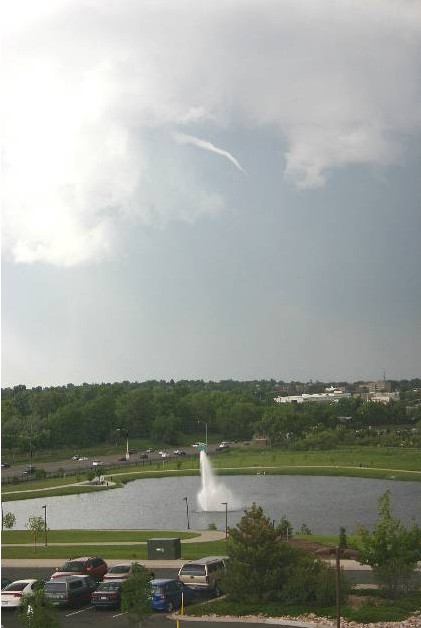
This funnel cloud was seen on Tuesday from the Thornton Civic Center (looking north) on June 10th. Image courtesy Lisa Wilson, the City of Thornton.
June 2009 went down in the history books as one of the more unusual June’s on record. Residents are all of course well aware of the string of severe storms but the Mile High City also were unusually cool and certainly very wet.
In terms of precipitation, a whopping 4.86 inches of rain fell at the official measuring site at Denver International Airport during the month – the second wettest June since recordkeeping began here in 1872. We missed out on breaking the record by only a tenth of an inch as the all-time wettest was back in 1882 when 4.96 inches fell in the rain bucket. Nevertheless, we easily exceed the normal rainfall total for the month which is 1.56 inches. In fact, we beat that in one day on June 23rd when 1.64 inches fell at DIA. Here in Thornton we didn’t measure near as much precipitation having recording 3.44 inches for the month. This is more in line with what areas closer to the actual metro area recorded than what was recorded at DIA. See below for details on the controversy about Denver’s climate records.
Temperature wise, we were very cool as well, never breaking the 90 degree mark during the month. Two days, the 29th and 30th, came close with 89 degrees being recorded as the high temperatures on those days. This was the first time since 2003 no 90 degree days were recorded in June. Before that, you would have to go way back to 1972 to find another June when that happened. The average temperature for June 2009 was 64.4 degrees, 3.2 degrees below the normal of 67.6. That may be cool but it was nowhere near the record low average for June which is 60.6 set in 1967. Thornton was just a touch warmer than the official stats from DIA as we recorded 90.0 degrees on the 29th. Similarly, Thornton’s average temperature was just a bit cooler at 63.2 degrees.
Then of course there were the storms. Tornadoes, funnel clouds and hail will probably be the most memorable events of the month, especially the twister that struck the Southlands Shopping Center in Aurora. In all, DIA recorded 18 days with thunderstorms – eight more than normal. 15 days had precipitation versus the normal of nine. All those storms also took a toll on what is normally a sunny month. On average Denver has 70 percent of possible sunshine during the month. This year we only recorded sunshine 51 percent of the time.
All that rain we have received in the last two months, especially in June, helps to make one other statistic a bit more tolerable. Colorado’s snow season runs from July 1 to June 30 each year and for the 2008 – 2009 snow season, we recorded a meager 38.1 inches of the white stuff. That is a whopping 29 inches below the normal of 67.1 inches. Thornton fared a bit better on the snowfall front but not by a lot having recorded 48.5 inches for the season.
There is always a ‘but’…
As always, we would like to remind everyone that all official Denver weather statistics are now taken out at Denver International Airport. As we outlined a few months ago, moving the official monitoring station 13 miles away has made quite a difference in Denver’s climate records. Evidence suggests that temperatures and precipitation as measured at DIA differ greatly from what would have been recorded at the old site at Stapleton or near downtown Denver.
The National Weather Service has finally acknowledged this and has setup a measuring station at the Denver Museum of Nature and Science (click here to view current conditions from it on the Weather Underground). However, they maintain that Denver’s official statistics will continue to be recorded at DIA and as a result, Denver’s climate records will forever have an asterisk next to them. If you compare June’s statistics from this new station to the ‘official’ ones at DIA, you will notice that much of what we discuss above, including the temperature and precipitation, would be much different were the statistics being kept by the new station closer to where people actually live.
Denver climate summary for the month of June 2009 – From the National Weather Service
CLIMATE NORMAL PERIOD 1971 TO 2000
CLIMATE RECORD PERIOD 1872 TO 2009
WEATHER         OBSERVED          NORMAL  DEPART  LAST YEAR'S
                 VALUE   DATE(S)  VALUE   FROM    VALUE  DATE(S)
                                          NORMAL
................................................................
TEMPERATURE (F)
RECORD
 HIGH             104   06/26/1994
 LOW               30   06/02/1951
HIGHEST            89   06/30       104     -15       95  06/26
                        06/29
LOWEST             41   06/08        30      11       37  06/12
AVG. MAXIMUM     77.7              82.1    -4.4     83.9
AVG. MINIMUM     51.1              53.0    -1.9     50.9
MEAN             64.4              67.6    -3.2     67.4
DAYS MAX >= 90      0               6.3    -6.3       10
DAYS MAX <= 32      0               0.0     0.0        0
DAYS MIN <= 32      0               0.0     0.0        0
DAYS MIN <= 0       0               0.0     0.0        0
PRECIPITATION (INCHES)
RECORD
 MAXIMUM         4.96   1882
 MINIMUM            T   1890
TOTALS           4.86              1.56    3.30     0.73
DAILY AVG.       0.16              0.05    0.11     0.02
DAYS >= .01        15               8.7     6.3        4
DAYS >= .10         9                MM      MM        2
DAYS >= .50         4                MM      MM        1
DAYS >= 1.00        1                MM      MM        0
GREATEST
 24 HR. TOTAL    1.64R  06/23 TO 06/23              0.70     06/04 TO 06/05

SNOWFALL (INCHES)
RECORDS
 TOTAL            0.4   1919
TOTALS            0.0                T
DEGREE_DAYS
HEATING TOTAL      78                60      18       64
 SINCE 7/1       5616              6128    -512     6056
COOLING TOTAL      68               136     -68      144
 SINCE 1/1         94               161     -67      172
FREEZE DATES
RECORD
 EARLIEST     09/08/1962
 LATEST       06/02/1951
EARLIEST                        10/07
LATEST                          05/05
.................................................................
WIND (MPH)
AVERAGE WIND SPEED              8.4
RESULTANT WIND SPEED/DIRECTION   2/147
HIGHEST WIND SPEED/DIRECTION    53/260    DATE  06/26
HIGHEST GUST SPEED/DIRECTION    68/270    DATE  06/26
SKY COVER
POSSIBLE SUNSHINE (PERCENT)   51
NUMBER OF DAYS FAIR            3
NUMBER OF DAYS PC             22
NUMBER OF DAYS CLOUDY          5
AVERAGE RH (PERCENT)     65
WEATHER CONDITIONS. NUMBER OF DAYS WITH
THUNDERSTORM             18     MIXED PRECIP               1
HEAVY RAIN                7     RAIN                      10
LIGHT RAIN               17     FREEZING RAIN              0
LT FREEZING RAIN          0     HAIL                       3
HEAVY SNOW                0     SNOW                       0
LIGHT SNOW                0     SLEET                      0
FOG                      14     FOG W/VIS <= 1/4 MILE      6
HAZE                     10

-  INDICATES NEGATIVE NUMBERS.
R  INDICATES RECORD WAS SET OR TIED.
MM INDICATES DATA IS MISSING.
T  INDICATES TRACE AMOUNT.
June 28 to July 4 - This week in Denver weather history
As always, an interesting week in Denver and Thornton weather history. Various severe weather items are noteworthy, none more so than on July 2, 2006 when a teenager wearing an iPod was struck with lightning. The music player actually contributed to the teen’s injuries by providing a direct route for the electricity into the victim’s head via the headphones.
From the National Weather Service:
21-3
In 2002…the maximum temperature in Denver equaled or exceeded 90 degrees for 13 consecutive days…equaling the 5th longest such streak on record. The record of 18 consecutive days was set during the summer of 1901.
28
In 1873…there was a great deal of smoke over the city from forest fires in the mountains.
In 1875…smoke from forest fires in the foothills south of Denver were visible from the city.
In 1913…an apparent dry microburst produced southwest winds sustained to 44 mph with gusts to 48 mph in the city.
In 1925…a thunderstorm produced north winds sustained to 38 mph with gusts to 44 mph.
In 1958…a microburst caused a brief wind gust to 58 mph at Stapleton Airport.
In 1964…lightning struck several homes in metro Denver… Sparking fires. Some flooding occurred in the stockyards area…at West 45th Avenue and St. Paul Street…and along Harvard Gulch.
In 1997…strong microburst winds of unknown speed downed several trees…signs…and at least one light pole in the Fort Lupton area. Two trees knocked over by the storm downed power lines causing scattered outages.
In 2002…a thunderstorm wind gust to 60 mph was recorded in Parker.
In 2005…severe thunderstorms produced wind gusts to 66 mph near Longmont and to 60 mph near Niwot. No damage was reported. A thunderstorm produced a wind gust to 55 mph at Denver International Airport during the afternoon.
29
In 1874…eight different fires in mountain forests were visible from the city. All of the fires were extensive… And the volume of smoke from each was immense. Three of these fires had been burning from the 18th with varied intensity.
June 21 to June 27 - This week in Denver weather history
A typical week during the spring and summer for Denver – tornadoes, hail, damaging winds and more.
19-21
In 1875…smoke from several large forest fires in the mountains was visible from the city on each of these days.
20-21 in 1897…high winds raked the city overnight. Southeast winds were sustained to 60 mph with gusts as high as 72 mph on the 20th. Southeast winds were sustained to 57 mph with gusts to 60 mph on the 21st.
In 2007…a brief hot spell produced two temperature records. The high temperature of 97 degrees was tied on the 20th. A new record high temperature of 99 degrees was established on the 21st.
21
In 1927…north winds were sustained to 40 mph with gusts to 44 mph.
In 1984…lightning struck and killed two children standing near a tree in a backyard in Lakewood. Strong thunderstorm downbursts caused a wind gust to 58 mph in Northglenn and knocked down two power poles near Brighton.
In 1988…lightning struck a home in Denver…causing about ten thousand dollars damage. Lightning damaged 3 homes in Littleton…and also hit a house in greenwood village that had been struck by lightning 7 years previously.
In 1991…thunderstorms produced widespread hail across metro Denver. Hail as large as 2 1/2 inches fell at several locations across southwest metro Denver. One storm spotter reported hail 8 inches deep near the intersection of I-25 and C-470. Heavy rain with the storms caused some street flooding. In Commerce City…several cars were under water… And in Westminster a police officer reported water up to the doors of his car. Damage to homes and automobiles totaled 55 million dollars.
In 1992…a tornado touched down briefly near Bennett. Another tornado was briefly on the ground near Strasburg.
In 1994…heavy thunderstorm rains caused flooding in metro Denver. Several vehicles were stalled in the high water on I-25. Lightning struck an underground natural gas line in Aurora…causing a fire. Widespread power outages were also observed.
In 1996…three homes were struck by lightning in Parker. The lightning struck the garage of the first home…which started a small fire that burned some siding and spread into the attic. A second home sustained damage to the attic when a small fire was started. The third home received only minor damage. Lightning also sparked two small grass fires in the area. A man in Lakewood received minor injuries when he was struck by lightning while working on a ladder. A funnel cloud was sighted in Castle Rock. Strong thunderstorm winds downed a large tree near crossroads mall in Boulder. A small tornado (f0) briefly touched down near Lafayette. No damage was reported.
In 1997…one inch diameter hail was measured in Boulder.
In 2002…a thunderstorm wind gust to 62 mph was recorded at Denver International Airport.
In 2005…severe thunderstorms produced hail to 1 inch in diameter in Broomfield along with 3/4 inch hail near Arvada.
In 2006…a man riding a motorcycle was struck and killed by lightning on U.S. Highway 36 between church ranch Blvd. And Sheridan Blvd. In Westminster. After the biker was struck…he and his motorcycle crashed into the center concrete median of the highway. The lightning bolt left a crater in the highway asphalt that measured 18 inches long…8 inches wide and 4 inches deep.
May 17 - May 23 - This week in Denver weather history
As we move further into the severe weather season, we begin to see that transition in our look back at Denver weather history. There are many more mentions of lightning, wildfires, tornadoes, hail and other season weather conditions.
14-18
In 1996…a period of unusually warm weather resulted in 4 record maximum temperatures in 5 days. The record high temperatures were 87 degrees on the 14th…89 degrees on the 15th…and 93 degrees on both the 16th and 18th. The temperature climbed to only 81 degrees on the 17th which was not a record.
16-17
In 1981…a heavy rain storm dumped 1 to 2 1/2 inches of rain across metro Denver. Rainfall totaled 1.27 inches at Stapleton International Airport where north winds gusted to 38 mph on 17th.
In 1983…a very strong late spring storm dumped heavy snow over the Front Range. Strong winds with the storm produced blizzard conditions at times. Sustained winds were 20 to 40 mph with a peak gust to 55 mph at Stapleton International Airport. The foothills received 1 to 2 feet of snow with 4 to 12 inches along the foothills. Howling winds whipped the snow into drifts several feet deep…closing schools and highways. Stapleton International Airport was forced to reduce flight operations…closing 2 of 4 runways and stranding hundreds of travelers. Most of the damage and inconvenience caused by the storm was in power outages… Which occurred when wind and heavy wet snow caused hundreds of power poles to snap and topple. About 20 square miles of Denver were blacked out. Precipitation from the storm totaled 1 to 3 inches. At Stapleton International Airport… Snowfall totaled 7.1 inches with a maximum snow depth on the ground of only 2 inches due to melting. The high temperature of 40 degrees on the 17th was a record low maximum for the date. Due to the heavy moisture content of the storm…widespread street flooding occurred on the 18th when much of the snow melted under the warm May sun and temperatures climbed to a high of 57 degrees.
In 1995…significant moisture and upslope flow caused flooding across metro Denver. Moderate to heavy rains… Which began on the evening of the 16th…developed in the foothills and spread eastward over metro Denver throughout the night. The heavy rains brought many creeks and small streams to bankfull or slightly over. Locations along the foothills received between 3 and 4 inches of rainfall from the storm. Boulder received 3.60 inches of rainfall for the 24-hour period…causing minor street flooding near small streams. To the northwest of Boulder…a bridge which crossed Fourmile Creek was washed out. Numerous rock and mudslides occurred in foothills canyons…closing portions of U.S. Highways 6 and 40 and State Highway 119 for a few hours at a time. Rocks were piled 6 feet deep on a stretch of State Highway 119 along with Boulders as large as cars on U.S. Highway 6. A parking lot near a creek in Golden caved in leaving a hole the size of an 18-wheeler. Rushing water washed out a 50-foot stretch of a road in Westminster. Rainfall totaled 1.75 inches at Denver International Airport…but only 1.42 inches at the site of the former Stapleton International Airport.