Denver sets a record low temperature for April 17; fifth cold temperature record of the week

Record Cold Temperatures

Following yesterday’s snowstorm, cold air settled in and resulted in our fifth broken cold temperature record of the week.

As measured at Denver International Airport, the low temperature in Denver fell to 12 degrees this morning. That breaks the record low temperature for April 17th of 13 degrees set in 1901.

Today’s record cold is the fifth record set this week:

  • April 13 – Record low temperature of 15 degrees (17 degrees, 1933)
  • April 13 – Record low maximum temperature of 25 degrees (27 degrees, 1933)
  • April 14 – Record low temperature of 11 degrees (15 degrees, 1933)
  • April 16 – Record low temperature of 19 degrees (22 degrees, 2013 and previous years)
  • April 17 – Record low temperature of 12 degrees (13 degrees, 1901)

Denver sets record low temperature for April 14, third cold temp record in two days

Record Cold Temperatures

When the cold of the past 36 hours or so is called “unprecedented”, that is a very accurate statement as Denver has seen three cold temperature records fall.

The latest record set came this morning when the low temperature in Denver as measured at Denver International Airport dropped to 11 degrees. That shatters the previous record low temperature for the date of 15 degrees set in 1933. Thornton stayed warmer but still in record-setting territory with a low of 14 degrees.

This morning’s record follows on two temperature records set yesterday. The record low temperature and the record low maximum for April 13 were bested in what has been an unusually cold period that began Sunday.

Denver sets record low maximum temperature for April 13

Record Cold Temperatures

A second cold temperature record of the day has fallen.

The high temperature in Denver as measured at Denver International Airport only reached 25 degrees today. That breaks the previous record low maximum for the date of 27 degrees set in 1933. Here in Thornton we were just a touch “warmer” with a high of 26 degrees.

This follows on a record low temperature that was set this morning. Additionally, there is a good chance we will break the record low temperature tomorrow morning for April 14th as well.

Denver sets record low temperature for April 13, more records may fall

Record Cold Temperatures

Our spring cold and snow has claimed one record today and may very well break another before the day is over.

As measured at DIA, Denver hit a lot temperature of 15 degrees this morning. That easily breaks the previous record low temperature for the date of 17 degrees set in 1933. Here in Thornton, our low dipped to 16 degrees.

Additionally, the record low maximum for April 13th is 27 degrees, also set in 1933. It is quite possible that we will fail to get that warm and thus set another cold temperature record today.

Tomorrow’s record low is 15 degrees (1933), and with overnight temperatures tonight forecast to dip that low, there is yet another record that may fall.

April 12 to April 18: This week in Denver weather history

This Week in Denver Weather History

A look back at this week in Denver weather history shows quite the variety of weather conditions.  We have seen everything from high winds and snowstorms to hail, thunderstorms and sub-freezing temperatures.

From the National Weather Service:

7-12

In 1959…snow falling over a 5-day period totaled 20 to 30 inches just east of the mountains…while over the plains blizzard conditions closed schools and blocked highways. The second big storm in two weeks dumped 16.4 inches of snowfall on Stapleton Airport with the most…11.6 inches… Occurring on the 8th. East winds gusted to 37 mph on the 9th. Temperatures dipped into the single digits on the mornings of the 7th and 12th when 7 degrees were registered. The cold temperatures caused streets to glaze with ice…resulting in the death of a pedestrian who was struck by a car in Denver. Three people died from heart attacks while shoveling the heavy…wet snow.

9-12

In 1901…rain changed to snow and totaled 10.8 inches in downtown Denver over the 4 days. Northeast winds were sustained to 28 mph with gusts to 31 mph on the 11th. Temperatures hovered in the 30`s.

10-12

In 1997…a pacific storm produced heavy snow on the 10th and the 11th in and near the foothills with 6 to 8 inches at Louisville and turkey creek canyon…5 inches at Morrison… And only 3.5 inches at the site of the former Stapleton International Airport. Northeast winds gusted to 24 mph at Denver International Airport. The storm also brought unseasonably cold weather with 5 new temperature records equaled or broken. Record low temperatures of 8 and 6 occurred on the 11th and 12th. Record low maximum temperatures of 20…19…and 30 occurred on the 10th…11th… And 12th respectively. This was also only the second time on record that the temperature had failed to reach the freezing mark for 3 consecutive days in April.

10-14

In 1927…post-frontal rain on the 10th changed to snow on the 11th and continued through the 14th. Snowfall totaled 8.5 inches from precipitation of 1.28 inches. North winds were sustained to 26 mph with gusts to 29 mph on the 13th.

11-12

In 1876…heavy snow began during the late afternoon of the 11th and continued through the night. Light snow ended around mid-morning of the 12th. The amount of snow was not measured…but precipitation totaled 0.70 inch… Which would be around 7 inches of estimated snowfall. Strong winds accompanied the heavy snowfall.

In 1896…post-frontal light rain changed to light snow overnight…but totaled only a trace. Northeast winds were sustained to 45 mph with gusts as high as 62 mph on the 12th.

In 1991…a strong pacific storm dumped heavy snow across metro Denver with amounts of 6 to 15 inches at lower elevations and up to almost 2 feet in the foothills west of Denver. Snowfall reports included: 21 inches at Idaho Springs…19 inches at Aspen Springs…15 inches in Arvada… 14 inches at Rollinsville…10 inches in Boulder… 8 inches in Aurora…and 7.3 inches at Stapleton International Airport where northeast winds gusted to 24 mph on the 11th.

12

In 1906…north winds were sustained to 52 mph in the city.

In 1916…post-frontal north winds were sustained to 40 mph with gusts to 42 mph. Light rain also occurred.

In 1964…strong gusty winds raked metro Denver. Wind gusts estimated to 60 mph or higher caused widespread damage to buildings and power lines. Blowing dust closed some roads. A wind gust to 46 mph was recorded at Stapleton International Airport.

In 1967…microburst winds gusted to 51 mph at Stapleton International Airport.

In 1982…wind gusts to 60 mph were reported in and near the foothills. Wind gusts to 44 mph were recorded at Stapleton International Airport.

In 1987…snow fell over metro Denver… Causing traffic tie-ups on the roads and at Stapleton International Airport where some flights were delayed for 90 minutes. I-25 south of Denver was closed for a time due to numerous traffic accidents. While only 4.2 inches of snow fell in Denver… Foothills to the southwest received 6 to 12 inches of snow. North winds gusted to 33 mph at Stapleton International Airport where the maximum snow depth on the ground was only 2 inches due to melting.

12-13

In 1922…post-frontal rain changed to heavy snow… Which totaled 7.0 inches in downtown Denver. This was the second snow in 3 days. North winds were sustained to 29 mph with gusts to 31 mph on the 12th.

In 1993…heavy snow occurred in the foothills northwest of Denver with 21 inches recorded at the Eldora Ski Area. Only 1.9 inches of snow fell at Stapleton International Airport where northeast winds gusted to 32 mph on the 13th. Most of the precipitation from the storm fell as rain across the city with 0.62 inch of precipitation measured at Stapleton International Airport.

12-14

In 1933…heavy snowfall of 5.6 inches occurred in downtown Denver on the 12th and 13th behind a vigorous cold front… Which presented an awe-inspiring spectacle as it approached the station during the late afternoon of the 12th. Brilliant white wind-torn cumulus clouds were sandwiched by a brownish- tan dust cloud at the surface and dark blue cumulus clouds above. The dust cloud storm rapidly enveloped the station with northeast winds sustained to 38 mph and gusts to 44 mph producing much blowing dust…which was accompanied by rapidly falling temperatures and rising pressure. Moist snowfall started in about an hour and continued to midday on the 13th. Record low temperatures of 17 and 15 degrees occurred on the 13th and 14th respectively. The high temperature of only 27 degrees on the 13th was a record low maximum for the date.

12-15

In 1927…snowfall totaled 8.5 inches in downtown Denver. Most of the snow fell on the 14th. Northwest winds were sustained to 27 mph during the storm.

13

In 1873…heavy snow started with fresh and brisk north winds around 9:00 am…and continued heavy until 2:00 pm and lightly until 7:00 pm. Temperatures were below freezing for most of the day…but the snow melted almost as fast as it fell. Precipitation from the melted snow totaled 0.70 inches. This would be around 7.0 inches of estimated snowfall.

In 1912…a severe wind and dust storm struck the city. West winds were sustained to 40 mph with gusts to 42 mph.

In 1967…a late season snow storm affected areas along the eastern foothills from Denver south. Snowfall between 2 and 3 feet closed I-25 between Denver and Colorado springs. In Denver…snowfall was only 3.6 inches… But precipitation from the storm totaled 3.25 inches…the greatest 24-hour precipitation ever recorded during the month of April. North winds gusted to 35 mph at Stapleton International Airport. Temperatures across the city were in the 30`s most of the day.

In 1974…a major spring snow storm dumped 8.5 inches of heavy wet snow at Stapleton International Airport where north wind gusts to 38 mph produced some blowing snow. The storm caused minor damage to public utilities.

In 1986…strong winds howled across metro Denver. Boulder reported a peak gust of 79 mph. Wind gusts of 55 to 60 mph were common across all of metro Denver. There were power outages. The wind toppled a brick wall under construction in Arvada…and also damaged luxury sky boxes under construction atop Mile High Stadium in Denver. Road signs in Arvada were damaged. West winds gusted to 56 mph at Stapleton International Airport.

In 2014…a storm system brought heavy snow to areas in and near the Front Range foothills. Storm totals included: 13 inches near Conifer; 12.5 inches near Ward; 11.5 inches near Nederland; 10 inches near Allenspark…Golden and Gold Hill; with 8.5 inches at Roxborough State Park.

13-14

In 1968…high winds struck Boulder. Sustained winds of 50 mph with gusts as high as 102 mph were recorded at the National Center for Atmospheric Research…while in downtown Boulder winds peaked to 73 mph. The winds damaged a building under construction and some homes in south Boulder. Northwest winds gusted to 35 mph at Stapleton International Airport on the 13th.

In 1996…a potent spring storm strengthened just east of Denver. Blizzard conditions developed over eastern Adams and eastern Arapahoe counties. Strong northerly winds ranging from 25 to 50 mph…cold temperatures… And heavy snowfall combined to create very hazardous conditions. The strong winds whipped snow in drifts 3 to 4 feet high. High winds and heavy wet snow downed power lines and caused traffic accidents. Some roads were closed. Snowfall totaled 15 inches at Strasburg…while only 2.1 inches of snow fell at the site of the former Stapleton International Airport. North winds gusted to 40 mph at Denver International Airport on the 13th.

In 2011…a potent spring snowstorm brought heavy snow to Front Range mountains and foothills. Storm totals included: 16.5 inches near Blackhawk; 16 inches at Nederland; 15.5 inches at Coal Creek Canyon and 5 miles northeast of Ward; 15 inches at Allenspark; 12.5 inches… 5 miles northwest of Idaho Springs; 12 inches at Echo Mountain ski area; and 10.5 inches near Georgetown.

13-15

In 1945…heavy snowfall totaled 9.8 inches in downtown Denver. Most of the snow…4.8 inches… Fell on the 14th. Snow fell for a total of 53 consecutive hours. This was the second big snow in less than 2 weeks. The air mass was very cold for April. High temperatures of 21 degrees on the 14th and 32 degrees on the 15th were record low maximums for those dates.

13-17

In 2001…a huge dust storm over southern and Inner Mongolia during April 3rd through the 6th lifted desert dust into the jet stream. This dust cloud moved over metro Denver on the 13th and persisted through the 17th. The cloud created widespread haze…giving the sky a milkish cast due to the scattering of incoming solar radiation.

Continue reading April 12 to April 18: This week in Denver weather history

April 5 to April 11: This week in Denver weather history

This Week in Denver Weather History

An incredibly busy week on the Denver weather history calendar as we see below.  Thunderstorms, blizzards, tornadoes, hurricane force winds and more have all been seen during this week in Denver weather history.

From the National Weather Service:

2-5

In 1918…snowfall totaled 12.4 inches over downtown Denver. Most of the snow fell on the 3rd and 4th. Temperatures were in the 20`s and 30`s. Northwest winds were sustained to 24 mph on the 2nd.

3-5

In 1996…the foothills west of Denver received 6 to 8 inches of new snow. Only 0.8 inch of snow fell at the site of the former Stapleton International Airport…along with some freezing drizzle on the 4th and 5th. North-northeast winds gusted to 30 mph at Denver International Airport on the 3rd.

3-6

In 1898…snowfall totaled 8.7 inches in downtown Denver over the 4 days. Northeast winds were sustained to 48 mph with gusts as high as 60 mph on the 3rd.

In 1983…a prolonged heavy snow storm blanketed the area along with very cold temperatures. The greatest amounts of snow fell in the foothills where 24 to 42 inches were measured. A foot of snow fell in Boulder. Snow fell for 50 consecutive hours at Stapleton International Airport on the 3rd through the 5th with a total snowfall of 8.8 inches and a maximum accumulation on the ground of 6 inches on the 5th. In Denver…the mercury failed to rise above freezing for 3 consecutive days…on the 4th…5th… And 6th…for the first time ever in April. Five daily temperature records were set from the 4th through the 6th. Record low temperatures of 12 degrees occurred on the 5th with 7 degrees on the 6th. Record low maximum temperatures of 25 degrees occurred on the 4th…27 degrees on the 5th… And 28 degrees on the 6th.

4-5

In 1900…rain changed to heavy snow and totaled 7.8 inches in downtown Denver overnight. A thunderstorm on the 4th produced hail. Precipitation totaled 1.50 inches.

In 1911…north to northwest winds were sustained to 42 mph on the 4th and to 41 mph on the 5th.

In 2002…a whitish-colored haze engulfed metro Denver on both days. The haze was the result of a huge wind storm that kicked up dust and sand from the Gobi desert in Mongolia and China during the latter half of March. Westerly winds aloft transported the dust cloud across the Pacific Ocean and over the western united states…depositing some of it on Colorado.

In 2009…a blizzard developed over the northeast plains of Colorado. Most of the urban corridor was spared from the blizzard…with the exception of eastern Adams and eastern Arapahoe counties. The combination of strong wind and heavy snow snapped 14 power lines along State Highway 36… Near Strasburg. In Arapahoe County…7 poles were snapped in Bennett. Interstate 70 was closed in both directions east of Denver. At Denver International Airport…a peak wind gust of 63 mph was observed from the north…breaking the previous record of 62 mph established in 1986. Officially…only 0.3 inches of snowfall was measured at Denver International Airport.

4-7

In 1909…post-frontal rain changed to heavy snow on the afternoon of the 4th and continued through mid-morning of the 7th. Total snowfall was 18.7 inches…but most of the snow…14.0 inches… Fell from 6:00 pm on the 4th to 6:00 pm on the 5th. North to northeast winds were sustained to 32 mph on the 4th and to 30 mph on the 7th. Total precipitation from the storm was 1.78 inches.

5

In 1873…a heavy rain and hail shower in the afternoon changed to snow…and accumulated to 6 inches on the streets at 9:00 pm. Precipitation (rain and melted snow) totaled 0.56 inch.

In 1925…southeast winds were sustained to 46 mph with gusts to 50 mph. This was the strongest wind of the month that year.

In 1950…a well-developed dust devil was observed 4 to 5 miles south-southwest of Stapleton Airport for about 8 minutes.

In 1977…the earliest date of the last freeze of the season occurred when the temperature dipped to a low of 31 degrees.

In 1988…a wind gust to 74 mph was recorded at Rollinsville. West winds gusted to 35 mph at Stapleton International Airport.

In 1990…a heavy… Wet snow fell in many areas in and along the Colorado Front Range. Snowfall amounts of 4 to 7 inches were common around the Boulder area with lesser amounts elsewhere. Only 2.0 inches of snow fell at Stapleton International Airport where north winds gusted to 28 mph. Icy roads contributed to numerous fender-benders and a 20-vehicle pileup near the junction of I-70 and I-25 in the city.

In 2000…high winds developed in the Front Range foothills… From about I-70 northWard. Peak wind gusts included: 83 mph at the National Center for Atmospheric Research in Boulder…75 mph near Louisville… And 70 mph at the National Wind Technology Center…south of Boulder. West winds gusted to 41 mph at Denver International Airport.

In 2005…a surface low pressure center deepened over eastern Colorado and produced damaging high winds across metro Denver. The strong wind gusts ranging from 50 to 70 mph damaged roofs and fences. Cross-winds blew several empty semI-trailers on their sides along I-70 and I-76 east of Denver. Peak north wind gusts included: 60 mph near Bennett and Keenesburg…59 mph near Brighton… And 53 mph at Denver International Airport. Over the Palmer Divide south of Denver…the high winds combined with heavy snow to produce blizzard conditions. Snowfall accumulations ranged from 3 to 8 inches over eastern Douglas and western Elbert counties. Snowfall totals included: 8 inches at Sedalia…4 inches near Castle Rock… And 3.5 inches near Franktown.

5-6

In 1939…3.0 inches of snow fell in downtown Denver. North winds were sustained to 34 mph on the 5th and to 26 mph on the 6th. The strong winds caused considerable drifting of snow. Several highways leading into the city were closed during the height of the storm due to poor visibility. Streets and highways became coated with ice in places. The temperature dipped to 11 degrees early on the 6th. This was the coldest reading of the month that year. Most vegetation was not far enough advanced to be injured by the cold temperatures…although a few buds froze on early shrubbery.

In 1949…strong winds in Boulder caused limited minor damage. West-northwest winds were sustained to 24 mph with some higher gusts at Stapleton Airport.

5-7

In 1916…rain changed to snow behind a cold front on the 5th and totaled 4.5 inches in the city. A thunderstorm produced snow on the 6th. North winds were sustained to 35 mph with gusts to 38 mph on the 7th.

6

In 1904…northwest winds were sustained to 40 mph with gusts to 48 mph.

In 1919…post-frontal rain changed to snow but totaled only 0.1 inch. However…north winds were sustained to 40 mph with gusts to 44 mph in the city.

In 1954…a vigorous cold front produced northeast winds at 38 mph with gusts as high as 50 mph. The strong winds briefly reduced visibility to 1 1/2 miles in blowing dust at Stapleton Airport.

In 1972…wind gusts to 68 mph were recorded at the National Bureau of Standards in Boulder. Winds peaked to 54 mph in downtown Boulder. Minor damage was reported. Northwest winds gusted to 44 mph at Stapleton International Airport where the strong Chinook winds warmed the temperature to a high of 80 degrees…equaling the record maximum for the date.

6-7

In 1872…rain changed to snow overnight. Snow with high north winds continued all day on the 7th. Precipitation (rain and melted snow) totaled 0.50 inch. Due to problems on the lines…the morning weather report was not sent by telegraph until 3:10 pm and the midnight report was not sent at all.

In 1957…heavy snowfall totaled 6.6 inches at Stapleton Airport where north winds gusted to 46 mph. This was the second heavy snow event in less than 4 days.

In 1969…winds gusting as high as 50 to 60 mph caused only light damage along the eastern foothills. The strong winds contributed to the spread of a forest fire near Boulder. Sustained winds of 25 mph with gusts to 53 mph were recorded in Boulder. Southwest winds gusted to 38 mph on the 6th and 44 mph on the 7th at Stapleton International Airport.

In 1980…high winds howled along the foothills each day. A wind gust to 72 mph was recorded in Lakewood. The strong winds blew a camper top off a pickup truck in Denver. At Stapleton International Airport…west winds gusted to 41 mph on both days.

In 1998…a spring storm brought a mix of snow and thunder to metro Denver…the foothills… And Palmer Divide. Conifer and Elizabeth both measured 4 inches of new snow. On the 6th…only 0.1 inch of snow fell at the site of the former Stapleton International Airport where thunder was heard on both days. Precipitation totaled 0.60 inch at Denver International Airport where west winds gusted to 43 mph on the 6th.

6-8

In 1973…a major spring snow storm dumped 11.6 inches of snowfall over metro Denver. North wind gusts of 30 to 35 mph produced some blowing snow. Most of the heavy wet snow… 10.1 inches…fell on the 7th when temperatures remained in the 20`s. Snow accumulated on the ground to a maximum depth of 9 inches. Low temperature of 5 degrees on the 8th was a new record minimum for the date and the lowest for so late in the season.

Continue reading April 5 to April 11: This week in Denver weather history

March 2020 weather recap: Temperatures and precipitation come in above normal

The month of March was a relatively quiet one for the most part. We didn’t see any particularly notable extremes and only one significant snowstorm.

The month started out on the cool side and we received our first snow of the month on the 2nd. We then put together a stretch lasting two weeks with largely calm and dry conditions.

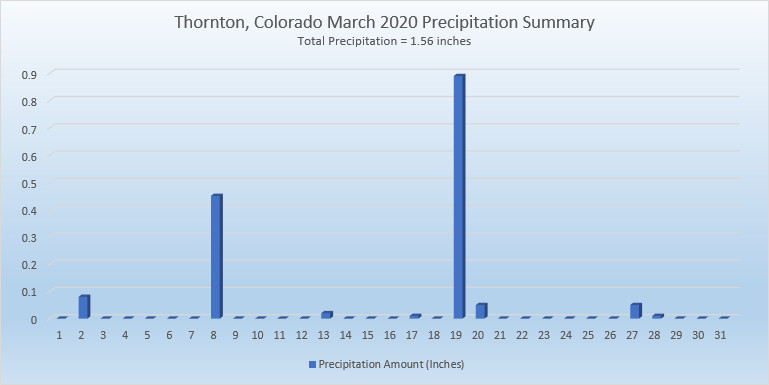
The 19th offered up a return to wintry conditions as after some rain early in the day, a transition to snow began and we received a healthy 7.5 inches of the white stuff.

Mostly dry conditions were the feature of the last 10 days of the month with a few days seeing temps above normal but most coming in below.

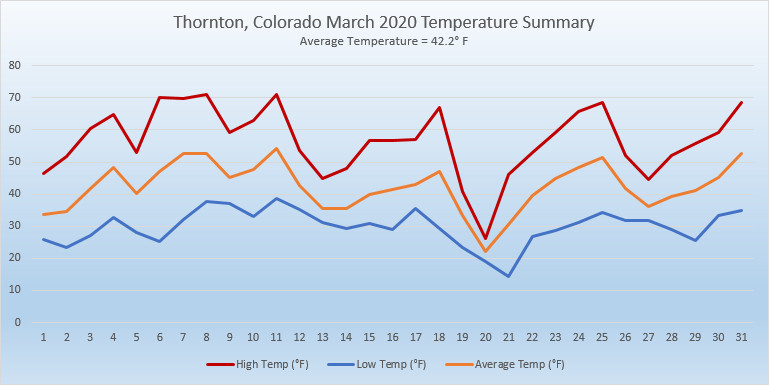
Thornton’s overall average temperature for the month came in at 42.2 degrees. This was a good bit above Denver’s March average of 40.4 degrees. Out at Denver International Airport where the Mile High City’s official records are kept, the reading nearly matched ours at 42.5 degrees.

Our warmest day on the 11th delivered a high of 71.1 degrees while our coldest, the 21st, saw a morning low of 14.2 degrees. Denver’s maximum reading of 68 degrees came on four different days. Their coldest of 11 degrees came on the 21st.

In terms of precipitation, Denver averages 0.92 inches in March. Thornton bested that easily with 1.56 inches and Denver did as well with 1.26 inches.

Both Thornton and Denver fell short of March’s average monthly snowfall of 10.7 inches. Thornton came closest with 9.3 inches while at the airport 7.5 inches was measured.

Click here to view Thornton’s March 2020 climate report.

Thornton, Colorado's March 2020 temperature summary. (ThorntonWeather.com)
Thornton, Colorado’s March 2020 temperature summary. (ThorntonWeather.com)
Thornton, Colorado's March 2020 precipitation summary. (ThorntonWeather.com)
Thornton, Colorado’s March 2020 precipitation summary. (ThorntonWeather.com)

Thornton’s April 2020 weather preview: Winter, spring and summer all in one month

Thornton's April weather previewApril marks a transition between winter and summer for most of the country but for Denver it is especially true as we can see a stunning variety of weather.

The proverbial April showers are certainly a possibility for Denver. Snow? Tornadoes? Thunderstorms? You bet – all can happen!

For good measure throw in a chance for hail and even dust storms and April gives every type of weather condition you could like – or hate.

March 2020 top shots: Monthly photo slideshow

The first sunrise of March 2020 is a stunner. (Alycia Gilliland)

The month of March is the start of meteorological spring and while conditions do begin warming, winter weather is certainly out of the question.  From hot to cold, snow to rain, the conditions can be very conducive to great pictures as we see in our slideshow.

March in Denver typically means frequent and rapid weather changes. The days grow longer and we start enjoying more sunshine and sometimes summer-like weather. However, on occasion arctic air masses can still force their way south into Colorado dropping temperatures quickly and markedly.

With the active wildlife, increased outdoor activities by us humans, and of course the weather, March imagery contains a wide variety of subjects and extremes.

  • Slideshow updated March 31, 2020. To learn more about how to send your photo to us for inclusion in the slideshow, see below the slideshow.

Showcasing images captured by ThorntonWeather.com readers as well as some of our own, our monthly slideshow covers the entire gamut of weather-related imagery.

Sunsets, sunrises, wildlife and of course every type of weather condition are vividly depicted in images captured from yours and our cameras.

[flickr_set id=”72157713421651497″]

What is missing in the slideshow above?  Your photo!

Our monthly photo slideshow is going to feature images that we have taken but more importantly images that you have captured.  The photos can be of anything even remotely weather-related.

Landscapes, current conditions, wildlife, pets, kids.  Whimsical, newsy, artsy.  Taken at the zoo, some other area attraction, a local park, a national park or your backyard.  You name it, we want to see and share it!

Images can be taken in Thornton, Denver or anywhere across the extraordinary Centennial State.  We’ll even take some from out of state if we can tie it to Colorado somehow.

We’ll keep the criteria very open to interpretation with just about any image eligible to be shown in our slideshows.

What do you win for having your image in our slideshow?  We are just a ‘mom and pop’ outfit and make no money from our site so we really don’t have the means to provide prizes.  However you will have our undying gratitude and the satisfaction that your images are shared on the most popular website in Thornton.

To share you images with us and get them included in the slideshow just email them to us or share them with ThorntonWeather.com on any of the various social media outlets.  Links are provided below.

So come on, get those camera’s rolling!

Weather, natural disasters & climate news and information.