July 10 to July 16: This Week in Denver Weather History

This Week in Denver Weather History

Our look back at this week in Denver weather history demonstrates why July is considered the Mile High City’s stormiest month. Many instances of flooding rains, damaging wind and hail and dangerous lightning are seen in our past.

From the National Weather Service:

1-18

In 1874…a streak of 18 consecutive days of 90 degrees tied for second with another streak that was later set in the summer of 1901. The record of 24 consecutive days was established in the summer of 2008.


1-31

In 2012…it was the hottest July on record in Denver since weather records began in 1872. The average temperature for the month was 78.9 degrees which was 4.7 degrees above normal. There were 27 days in which the high temperature equaled or exceeded 90 degrees…which established a new record. There were also 7 days in which the temperature equaled or exceeded 100 degrees which tied the record set in 2005.

6-23

In 1901…a streak of 18 consecutive days of 90 degrees tied for second with another streak set in the summer of 1874. The record of 24 consecutive days was established in the summer of 2008.

7-25

In 1934…a streak of 15 consecutive days of 90 degrees ranked 5th on the list of hot streaks. The record of 24 consecutive days was established in the summer of 2008.

9-10

In 1980…a series of severe thunderstorms hit metro Denver… Dumping heavy rain and producing a spectacular lightning display lasting for several hours. A number of homes were damaged by lightning. Winds gusted to 60 mph at Stapleton International Airport where about half an inch of rain fell in just 10 minutes along with 1/4 inch diameter hail. The evening thunderstorms continued into the early morning hours with total rainfall of 1.35 inches at Stapleton International Airport.

In 1998…thunderstorm rainfall totaled 2.04 inches at the site of the former Stapleton International Airport.

10

In 1878…a lunar rainbow was observed during a light mist and fog.

In 1895…the temperature warmed to a high of only 53 degrees… The all-time record lowest maximum temperature for the month of July.

In 1967…golf ball size hail damaged aircraft at Jefferson County Airport near Broomfield.

In 1983…two people were injured when struck by lightning just southwest of Morrison. A man was injured when he was swept downstream by a flash flood on a tributary of clear creek in the canyon 8 miles west of Golden. Heavy thunderstorm rains caused mudslides which closed several roads. Rainfall amounts included: 1.75 inches in 20 minutes in southeast Denver…1.26 inches in 35 minutes in Boulder…2.14 inches in 2 hours in Lakewood…1.70 inches in 45 minutes in Aurora…and 1.25 inches in 30 minutes atop Floyd Hill in the foothills west of Denver.

In 1992…storm spotters reported 3/4 inch diameter hail near the construction site of the new Denver airport just northeast of the city.

In 1995…microburst winds toppled a pine tree 60 feet high and 2 feet in diameter in Denver. The tree fell and injured a man nearby. Microburst winds to 59 mph broke the glass on a door at the national weather service forecast office at the site of the former Stapleton International Airport.

In 1998…thunderstorm rainfall totaled 2.35 inches at Denver International Airport.

In 2000…three children were injured…one critically…when lightning hit a nearby tree at panorama point atop Flagstaff Mountain just west of Boulder. Lightning hit the tree…entered the ground…then struck the children. Lightning sparked a grassfire that burned about 50 acres at the Rocky Flats Environmental Test Facility. Also… Lightning sparked at least 6 fires in the Hudson and Keenesburg areas as thunderstorms…accompanied with heavy rain…large hail…and tornadoes…moved through southern Weld County. Over 2 inches of very heavy rain caused flooding along an I-76 exit ramp near Keenesburg. The fire department rescued 15 stranded motorists as high water inundated sections of the exit ramp and adjacent highway. Basements were also flooded in Keenesburg. One home reportedly had 7 feet of standing water in the basement before the rain subsided. A weak tornado (F0) touched down briefly near Brighton…but caused no damage.

In 2001…a severe thunderstorm dumped 7/8 inch diameter hail in wheat ridge.

In 2002…severe thunderstorms pelted the southern suburbs of metro Denver with large hail. Hail as large as 3 inches in diameter fell 6 miles southeast of Parker. Other large hail reports included 2 inch diameter hail around centennial airport and 3/4 inch hail near Sedalia and Deckers. Hail as large as 3/4 inch was also reported in Broomfield. Runoff from heavy thunderstorm rainfall in the Hayman fire burn area flooded lost creek ranch with up to 18 inches of water just off State Highway 126. Floodwaters damaged a very expensive rug in the lodge. A driveway to a residence was washed away. In Douglas County…runoff damaged forest access roads in the Turkey Creek drainage.

In 2011…a severe thunderstorm produced intense microburst winds in southeast Boulder County. A peak wind gust to 75 mph was recorded in Superior with gust to 58 mph…2 miles south of Lafayette. At Denver International Airport…a peak wind gust of 31 mph was recorded.

11

In 1872…heavy rainfall started at 4:00 pm and continued into the night. The heavy rainfall damaged homes and buildings in all parts of the city. Rainfall totaled 1.64 inches.

In 1888…the temperature reached 100 degrees in downtown Denver.

In 1954…the high temperature climbed to 102 degrees at Stapleton Airport.

In 1970…a girl walking in a park in southeast Denver received eye and facial injuries when lightning struck nearby. Lightning also caused numerous power outages and heavy rainfall produced local flooding at several locations across metro Denver.

In 1974…large hail up to 1 1/2 inches in diameter fell in Thornton.

In 1990…the worst hailstorm in American history in terms of dollar damage at the time battered metro Denver. Storm damage totaled 605 million dollars…as it cut a 5-to 10-mile wide swath from just southeast of Estes Park to northeast of Colorado Springs. Hail as large as baseballs (2.75 inches) pounded metro Denver. Hardest hit areas were southeast Boulder County…the Jefferson County Airport in Broomfield… Arvada…east Wheat Ridge…southwest and south-central Westminster…west Thornton…northwest…west-central and downtown Denver…northeast and east-central Lakewood…just east of Littleton…portions of Arapahoe County west of I-25… And northern and central Douglas County near Castle Rock and Franktown. Golf ball to baseball size hail severely damaged roofs on thousands of homes and buildings…battered tens of thousands of automobiles…windows…signs…street lights…and traffic signals…stripped paint…awnings…and trim from buildings…punched holes in the roofs of two homes in Arvada…knocked out power and telephone service to thousands of homes and businesses…defoliated thousands of trees…ripped up greens and fairways on a number of golf courses…and severely damaged several aircraft tied down at Jefferson County Airport. Hail the size of baseballs fell for several minutes in old town Arvada. Later…golf ball size hail and heavy rain pummeled two northwest Denver amusement parks. Hardest hit was Elitch Gardens Amusement Park where 47 people were injured and received treatment for bumps…cuts…and bruises at local hospitals. Many of the injured were stranded on rides during the storm when power failed. Hail clogged storm sewers…causing rain water to back up 3 to 6 feet deep on some roads and intersections in Arvada. Several basements were flooded. In some places hail was washed into drifts several feet deep. In addition… The storm spawned 2 small tornadoes. One touched down briefly in Lakewood near 6th avenue and Kipling Blvd….but did no damage. In Castle Rock…a tornado (F1) did heavy damage to some homes and vehicles in the Founders Village development near Ridge Road.

In 2001…lightning struck two homes in Thornton. Most of the damage was confined to the attics of both homes. Hail as large as 3/4 inch in diameter fell in Keenesburg…Longmont… And near Boulder.

In 2011…severe thunderstorms developed over parts of Adams and Denver Counties. At Denver International Airport…a severe thunderstorm produced a peak wind gust to 66 mph…with another gust to 59 mph measured in Denver. In Commerce City…the intense winds blew down a large tree.

In 2015…a peak wind gust to 55 mph was measured from the northwest at Denver International Airport. A trace of rainfall was also observed.

11-12

In 1872…heavy rain from 4:00 pm until 2:00 am caused much damage. Rainfall totaled 1.76 inches.

12

In 1881…during the early evening…a brisk rain fell for 30 minutes from a nearly clear sky containing not one tenth of clouds with the sun shining brightly. Rainfall was 0.16 inch.

In 1885…thunderstorms produced widespread lightning across the city during the evening. Several people were injured when their homes were struck by lightning.

In 1954…the high temperature reached 101 degrees at Stapleton Airport.

In 1962…lightning struck and killed a Denver man…while he was assisting a co-worker with his car.

In 1971…the temperature climbed to a high of 101 degrees at Stapleton International Airport.

In 1974…hail to 3/4 inch in diameter fell in Castle Rock.

In 1991…hail to 2 inches in diameter fell in Thornton with golf ball size hail in Brighton. Dime size hail was recorded in the city of Denver. Very heavy rain caused flooding across metro Denver. Water was up to 2 feet deep in parts of Golden where one foot of water was reported in the lot of a mobile home park. Flood water washed away part of a parking lot at the Colorado school of mines in Golden. Heavy rain caused a rock slide and flooding along I-70 in the foothills just west of Denver. Flood waters were a foot deep at the intersection of I-70 and I-25 just north of downtown Denver. A funnel cloud was sighted just east of the rocky mountain arsenal.

In 1996…very heavy rainfall from a fast moving thunderstorm dumped 2 to 3 inches of rain within an hour over southern Jefferson County. Two people were killed near the town of Buffalo Creek when a 20-foot wall of water flooded the area. Utility poles and trees were uprooted; cars… Propane tanks…and bridges were destroyed in the flood’s path. Entire buildings were moved from their foundations and heavily damaged by the floodwaters. The first fatality occurred along State Highway 126 when the driver of a pick-up truck was washed off the road by the deadly wall of water. The second death occurred farther upstream when a man in a 5th-wheel trailer was washed away. This was the second disaster to strike the area in the last couple of months. The community was already recovering from a wildfire which burned about 12 thousand acres of forest land in late May. With the forest burned by fire…very little vegetation was available to slow the storm’s runoff…which resulted in the flash flood. Power…water…and sewer service were heavily damaged in the flood and…in some cases…beyond repair. The cost of repairing the roads and water system in the area was estimated at around a half million dollars. Elsewhere across metro Denver…severe thunderstorms produced hail…damaging winds…and small tornadoes. Weak tornadoes (F0) were reported in Broomfield… 3 miles east of Englewood…and in Dacono. No damage was reported…except a trampoline was blown into a window and several trees were downed in Broomfield. Thunderstorm wind gusts estimated as high as 60 mph blew a fence down in Louisville where winds also toppled a tree near a house. The house received only minor damage. Large hail…strong winds and heavy rain caused substantial property damage in portions of southeastern Boulder and northern Jefferson counties. Damage estimates in the Broomfield area alone were about 1 million dollars. Winds gusted to 81 mph in Broomfield. Large hail…3/4 to 1 1/2 inches in diameter fell in Evergreen…Lakewood…Englewood…Broomfield…near Morrison…northeast of Boulder…and just east of Denver International Airport.

In 2000…heavy rain fell across a portion of the hi meadow fire burn area near buffalo creek…causing localized flooding. About 3/4 inch of rain fell in 30 minutes over miller gulch. Some culverts become plugged by debris from the fire. As a result…small sections of a U.S. Forest Service road along Miller Creek were washed out. Lightning struck a home in Castle Rock…causing extensive damage to the roof…attic…and second floor.

Continue reading July 10 to July 16: This Week in Denver Weather History

Denver sets record high temperature for July 9

Record High Temperature

It was a hot one today as the Mile High City set a new record high temperature for the date.

As measured at Denver International Airport, the mercury topped out at 100 degrees. This topped the previous record high for the date of 98 degrees set in 2021, 1989 and 1903.

Here in Thornton, we actually topped the Denver reading with a high of 101 degrees.

July 3 to July 9: This Week in Denver Weather History

This Week in Denver Weather History
In our July weather preview we discussed how the month is not only Denver’s hottest but also its stormiest. Our look back at this week in Denver weather history helps to illustrate that fact. We start seeing 100+ degree days as well as many of the types of fast moving thunderstorm events expected this time of year.

From the National Weather Service:

29-15

In 2000…the 29th marked the beginning of a near record hot streak for metro Denver. The high temperatures…as recorded at Denver International Airport…exceeded the 90 degree mark for 17 consecutive days from June 29th through July 15th. The record of 24 consecutive 90 degree or above days was set from July 13th through August 5th…2008.

1-18

In 1874…a streak of 18 consecutive days of 90 degrees tied for second with another streak that was later set in the summer of 1901. The record of 24 consecutive days was established in the summer of 2008.

1-31

In 2012…it was the hottest July on record in Denver since weather records began in 1872. The average temperature for the month was 78.9 degrees which was 4.7 degrees above normal. There were 27 days in which the high temperature equaled or exceeded 90 degrees…which established a new record. There were also 7 days in which the temperature equaled or exceeded 100 degrees which tied the record set in 2005.

3

In 1874…the temperature climbed to a high of 101 degrees in downtown Denver.

In 1881…the all time highest recorded daily minimum temperature of 77 degrees occurred in the city. This was also the highest daily minimum temperature ever recorded in July.

In 1885…a severe thunderstorm produced hail the size of hazel nuts…which fell with great force. A telegraph pole in west Denver was struck by lightning and shattered to pieces.

In 1955…a brief microburst wind gust to 61 mph was recorded at Stapleton Airport.

In 1960…a major hail storm caused 1.5 million dollars in damage across metro Denver. The heaviest damage occurred in south Denver…Englewood…Littleton…and Golden from wind- driven hail as large as golf balls and heavy rain which caused flooding. Winds were estimated at 60 to 70 mph. Rainfall was estimated at 2 to 3 inches. Hail accumulated 3 to 4 inches deep in some sections. Hail carried by flood waters drifted 3 to 4 feet deep. An Englewood policeman was injured when hail broke the windshield of his car. One inch of rain in 10 minutes…and heavy hail damage were reported in Parker. At some places the hail from the storm was still on the ground the next morning.

In 1967…large hail stones from 1 3/4 to 2 1/2 inches in diameter damaged cars and buildings in southwest Denver and Littleton where hail drifted to depths of 3 to 4 feet. The hail caused a great deal of damage…and streets were flooded by heavy rain over many sections of west metro Denver. At centennial race track near Littleton…a few hail stones were as large as tennis balls. Large hail broke the windshield on a Littleton police car. Golf ball to tennis ball size hail fell in the vicinity of Arapahoe road and south Broadway. One inch diameter hail fell at the intersection of orchard and south university. Golf ball size hail fell in Broomfield. Hail in Westminster was measured from 1 to 1 1/4 inches in diameter. Tornadoes were sighted by the public near Cheery Creek Reservoir… north of Commerce City…and in Arvada…but caused no reportable damage.

In 1993…high winds developed behind a strong cold front along portions of the Front Range. While the strongest winds were reported north of metro Denver…the winds blew out a half inch thick pane of glass from a vacant 9-story building. The glass landed on a parked car below. West winds gusting to 52 mph kicked up some blowing dust at Stapleton International Airport.

In 1996…lightning sparked a small fire near buffalo creek in southern Jefferson County. Only one acre burned before the fire was contained.

In 2002…heavy thunderstorm rain washed out a frontage road 6 miles north of Larkspur. The nearby mountain ranch subdivision was also flooded. Heavy rainfall in the Hayman fire burn area washed out a secondary road when debris from the runoff blocked a culvert. Hail as large as 3/4 inch fell near Keenesburg…in Castle Rock…and 7 miles to the south of Castle Rock.

In 2005…severe thunderstorms produced high winds. Wind gusts to 75 mph were measured near Longmont and to 60 mph just west of Boulder. No damage was reported.

In 2007…severe thunderstorms produced large hail in the foothills and suburbs west of Denver. Large hail from 1 to 2 inches in diameter was reported in the vicinity of Idaho Springs…Rollins and Edgewater.

In 2009…severe thunderstorms produced large hail and north and east of Denver. Hail up to one inch in diameter was observed near Erie and firestone. Hail up to 1 3/4 inches was observed 5 to 6 miles west-southwest of Byers. The golfball size hail caused extensive damage to a wheat field. In Aurora…six children received minor injuries when lightning struck a nearby tree. The injuries occurred when they were knocked down by the blast. None of the children suffered burns or appeared to have been directly hit by lightning.

In 2014…a severe thunderstorm produced large… up to 1 ½ inches in diameter…about 14 miles northwest of Golden.

4

In 1874…the temperature reached a high of 102 degrees in downtown Denver. Large forest fires in the mountains from the west-northwest to the south filled the atmosphere over the city with dense smoke.

In 1885…a thunderstorm produced sustained winds to 44 mph with gusts to 60 mph. A circus tent was tattered by the strong winds.

In 1900…a thunderstorm produced northwest winds sustained to 42 mph with gusts to 51 mph…but only 0.05 inch of rain.

In 1903…the all time lowest temperature ever recorded in July…42 degrees…occurred. The temperature also occurred on July 31…1873.

In 1910…thunderstorm winds were sustained to 42 mph from the southwest.

In 1922…thunderstorm winds were sustained to 37 mph with gusts to 48 mph.

In 1956…a thunderstorm wind gust to 54 mph was recorded at Stapleton Airport.

In 1964…several men were knocked down by a bolt of lightning while playing golf in south metro Denver. They got up and ran for cover when one of them was struck by a second bolt. He suffered burns and shock.

In 1987…a weak tornado was observed for 6 minutes…7 miles northeast of Watkins. Hail 3/4 to 1 1/4 inches in diameter fell in southeast Aurora.

In 1988…lightning struck a group of people at the Jefferson County fairgrounds. A 42-year-old woman was seriously injured and was hospitalized for 3 days. Four other people sustained minor injuries.

In 1993…strong northwest winds uprooted several trees across metro Denver. Wind gusts to 64 mph were reported at Erie north of Denver. A west wind gust to 43 mph was recorded at Stapleton International Airport.

In 1995…lightning struck and injured two people standing in a field in Arvada.

In 1998…heavy thunderstorm rain…up to 2.75 inches…and marble size hail combined to flood local roads and fields near Roggen.

In 2002…heavy thunderstorm rain in the Hayman fire burn area caused flash flooding. In Jefferson County…Gulch Road was washed out. In Douglas County…high water washed out some forest access roads as well…generally to the east of a line extending from signal butte to Deckers.

In 2010…intense thunderstorms produced torrential rainfall… In excess of 5 inches in one hour…and caused flash flooding in the vicinity of Elizabeth. Numerous County roads were washed out. The combination of heavy rain and hail made it necessary to run snow plows through town. Extensive basement flooding was also reported. Severe thunderstorms produced large hail from Aurora south to Elizabeth and Larkspur. The hail size ranged from 1 to 2 inches in diameter. A wet microburst produced 1.84 inches of rainfall at Denver International Airport. A peak wind gust to 48 mph was also observed from the northeast.

In 2017…a microburst produced a wind gust to 61 mph…about 13 miles east-northeast of Denver International Airport.

In 2019…severe thunderstorms brought a wave of large hail across portions of Arapahoe…Broomfield…Denver…Douglas…Jefferson… and Weld counties. The hail ranged in size from 1 to 2 inches in diameter. The city of Lone Tree evacuated Sweetwater Park… where Fourth of July celebrations were underway…and Brighton delayed its Fourth of July concert. The Denver Outlaws game was postponed due to lightning. In Denver County…there was widespread damage from the hail…including damage to roof coverings and vehicles.

4-5

In 1875…nearly every railroad running into the city was damaged by heavy thunderstorm rains. The heavy rains washed out wooden bridges over normally dry creeks. Some trains were entirely suspended. In the city…heavy thunderstorm rain totaled 1.05 inches on the 4th…but only 0.28 inch on the 5th.

4-8

In 1989…one of the most intense heat waves on record roasted metro Denver. The temperature reached 100 degrees or more on 5 consecutive days. The city had previously never recorded more than 2 straight 100-degree days since records began in 1872. Water and electricity usage reached all time highs. The heat wave created extremely dry weather conditions…which contributed to a major forest fire in Boulder canyon on July 9th. The temperature reached 103 degrees on the 8th…and the mercury climbed to 101 degrees on both the 4th and 5th…and to 102 degrees on both the 6th and 7th. The low temperature of 68 degrees on the 8th equaled the record high minimum for the date.

5 Continue reading July 3 to July 9: This Week in Denver Weather History

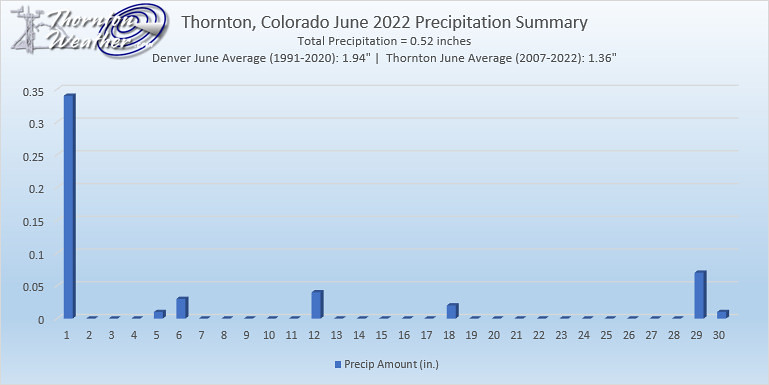
June 2022 in Thornton saw average temps, drier than normal conditions

Thornton, Colorado June 2022 Temperature Summary. Click for larger view.

Last month was one of relatively little drama. Normally we expect June to bring plenty of severe weather but that just was not the case this year. That was, in part, due to a lack of moisture.

Thornton saw only 0.52 inches in the rain bucket, well-below average. While we did see some hot temperatures (two 98 degree readings being tops), overall the monthly average temp came in right near Thornton’s running 16 year average.

See the monthly climate summary for details.

Thornton, Colorado June 2022 Precipitation Summary. Click for larger view.

Thornton’s July 2022 preview: Summer heat really kicks in, thunderstorms common

July

Change is of course the one constant in Denver’s weather but come July, things actually get pretty consistent.

The standard formula for a day in July is a sunny morning, clouds developing in the late morning and early afternoon. Come mid-afternoon, thunderstorms are rolling off of the foothills and into the metro area and the eastern plains. These storms do occasionally reach severe status containing hail, gusty winds and heavy downpours of rain.

Check out our July weather preview for a complete look at what is in store for the month ahead.

Video: Hikers capture massive rockslide in Rocky Mountain National Park

“The large rockfall event happened on the south side of Hallett Peak at around 4:30 p.m. Tuesday that resulted in sliding rock falling into Upper Chaos Canyon. Park officials said the reason for the closure is that the area around the slide is highly unstable and there are forecasted rainstorms for the area until July 3, which could trigger more rockfall activity.” Get the full story here.

June 2022 top shots: Monthly photo slideshow

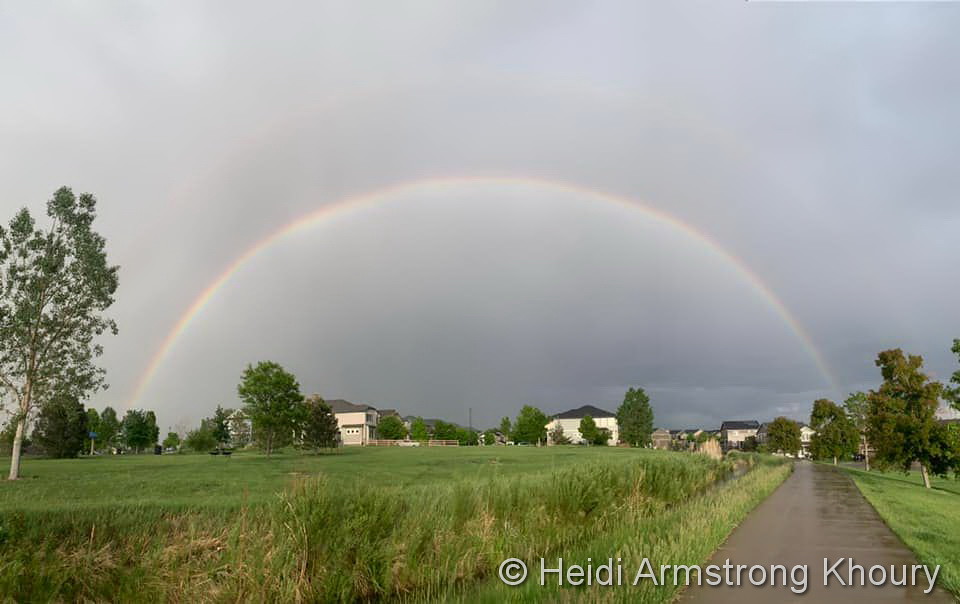
A gorgeous double rainbow after a quick rain shower in Thornton. (Heidi Armstrong Khoury)

The month of June typically sees springtime severe weather reach its height of activity in northeastern Colorado.

This affords the opportunity to capture extraordinary images of amazing weather phenomena from monstrous supercell thunderstorms to heavy rain, hail and even tornadoes.

  • Slideshow updated June 30, 2022

Showcasing images captured by ThorntonWeather.com readers as well as some of our own, our monthly slideshow covers the entire gamut of weather and nature related imagery.

Sunsets, sunrises, wildlife and of course every type of weather condition are vividly depicted.  June brings some very dynamic weather and the photos are a great way to see the stunning variety.

To learn more about how to send your photo to us for inclusion in the slideshow, see below the slideshow.

[flickr_set id=”72177720299575988″]

What is missing in the slideshow above?  Your photo!

Our monthly photo slideshow is going to feature images that we have taken but more importantly images that you have captured.  The photos can be of anything even remotely weather-related.

Landscapes, current conditions, wildlife, pets, kids.  Whimsical, newsy, artsy.  Taken at the zoo, some other area attraction, a local park, a national park or your backyard.  You name it, we want to see and share it!

Images can be taken in Thornton, Denver or anywhere across the extraordinary Centennial State.  We’ll even take some from out of state if we can tie it to Colorado somehow.

We’ll keep the criteria very open to interpretation with just about any image eligible to be shown in our slideshows.

What do you win for having your image in our slideshow?  We are just a ‘mom and pop’ outfit and make no money from our site so we really don’t have the means to provide prizes.  However you will have our undying gratitude and the satisfaction that your images are shared on the most popular website in Thornton.

To share you images with us and get them included in the slideshow just email them to us or share them with ThorntonWeather.com on any of the various social media outlets.  Links are provided below.

So come on, get those camera’s rolling!

June 26 to July 2: This Week in Denver Weather History
This Week in Denver Weather History

Our look back at this week in Denver weather history certainly has plenty of the usual suspects related to severe weather. Most notable however are the many occurrences of lightning strikes and the effects they can have from sparking fires to causing significant injury and death.

From the National Weather Service:

22-26

In 2012…from the 22nd to the 26th…the maximum temperature exceeded 100 degrees for five consecutive days.  Two of the high temperatures on the 25th and 26th peaked at 105 degrees…which set the all time record for the month of June and tied the all-time maximum temperature for Denver.

25-26

In 1969…high winds raked Boulder causing one fatality and some injuries. One man was injured by a falling tree limb. At the National Center for Atmospheric Research in Boulder… Sustained winds of 55 to 60 mph with wind gusts to 123 mph were recorded. In downtown Boulder…winds averaged 30 to 40 mph with gusts to 70 mph. Widespread minor damage occurred… Especially in the Table Mesa area of south Boulder. Much tree damage occurred in the older areas of Boulder where several trees were uprooted. A mobile home was overturned by the winds. At Stapleton Airport…west winds gusted to 43 mph on the 25th and 37 mph on the 26th.

In 1975…strong winds damaged utility lines…buildings… vehicles…trees…and power lines in Boulder and other communities to the north of Boulder. Microburst winds gusted to 45 mph at Stapleton International Airport on the 25th.

In 1983…heavy rain fell in the foothills west of Denver with 1.50 inches in 30 minutes at Intercanyon. Heavy rain continued over metro Denver on the 26th with two-day storm totals at many locations ranging from 1.00 to 2.50 inches. Rainfall totaled 1.37 inches at Stapleton International Airport on the 26th.

In 1985…one to two inches of rain fell over metro Denver. At Stapleton International Airport…rainfall totaled 0.93 inches…thunderstorm winds gusted to 44 mph…and 7/10 inch hail was measured. The air mass was unusually cold for the season…and snow fell in the foothills above 8 thousand feet. The high temperature of only 63 degrees on the 26th equaled the record low maximum reading for the date.

In 2012…Denver broke the all-time record temperature for the month of June on the 25th when it reached 105 degrees. This also tied the all-time record maximum temperature in Denver. The maximum temperature of 105 degrees was then matched once more on the 26th. Sandwiched in between these records…the minimum temperature of 71 on the morning of the 26th… established a new record high minimum for the date.

26

In 1873…there was a great deal of smoke from a large forest fire in the mountains to the southwest of the city and a smaller fire directly to the west.

In 1874…fires at timberline to the west were visible from the city. New and extensive fires were continually started from south to northwest along the ridge line. Carelessness of tourists was the apparent cause of the fires. Large and valuable tracts of timber had already been destroyed.

In 1890…the only thunderstorm of the month produced a trace of rain. A trace of rain also fell on 7 other days. This was the only precipitation recorded during the month… Making it the driest June on record.

In 1893…northwest winds were sustained to 45 mph with gusts to 48 mph.

In 1971…a microburst wind gust to 58 mph was recorded at Stapleton International Airport. Dust devils were sighted.

In 1980…strong gusty thunderstorm winds damaged several mobile homes in Thornton. Thunderstorm winds gusted to 37 mph at Stapleton International Airport.

In 1986…hail piled up 1 1/2 inches deep in Golden Gate Canyon and covered roadways an inch deep in Evergreen.

In 1988…a tornado touched down 2 miles north of Watkins. It was on the ground for 15 minutes and did no reported damage.

In 1989…two inch diameter hail fell at Kassler…1 inch hail at Louviers…and 1 1/2 inch hail at tiny town.

In 1991…high winds…not associated with thunderstorms… Damaged a home in the Green Mountain area. The strong winds picked up a heavy metal and glass table on the deck of a house and threw it into the house. The table was destroyed and the house received considerable damage.

In 1992…3/4 inch diameter hail fell in south Aurora and near Buckley Air National Guard base. Golf ball size hail was reported in Parker.

In 1994…the all-time highest recorded temperature in June and the second highest temperature ever recorded in Denver… 104 degrees occurred. This was the hottest day in Denver since August 8…1878…when the temperature reached 105 degrees.

In 2005…strong thunderstorm winds gusting to 58 mph damaged a garage and some nearby trees near Fort Lupton. Winds also gusted to 58 mph near Watkins. Thunderstorm winds gusted to 60 mph near Roggen. Hail to 3/4 inch in diameter was measured in southwest Aurora.

In 2009…severe thunderstorms moving through Denver and the surrounding metro area produced intense thunderstorm winds. At Denver International Airport…a wind gust blew a luggage car into a southwest airlines airplane causing some damage. Peak wind gusts included: 68 mph at Denver International Airport…4 miles west of rocky mountain metropolitan airport and 12.5 miles north of Lowry AFB; 64 mph near Arvada and Parker; and 60 mph in Aurora/cherry.

In 2014…a severe thunderstorm produced a peak wind gust to 58 mph…9 miles northeast of Denver International Airport. Offically…a peak wind gust to 54 mph was measured from the northeast with just a trace of rainfall.

In 2020…severe thunderstorms produced very strong wind gusts over parts of northern Jefferson and western Adams counties.  A peak wind gust to 67 mph was observed at Rocky Mountain Metropolitan Airport near Broomfield…with a gust to 61 mph in Thornton.

26-27

In 1965…wind gusts to 38 mph were recorded in downtown Boulder…causing widespread minor damage. A microburst wind gust to 41 mph was recorded at Stapleton International Airport.

Continue reading June 26 to July 2: This Week in Denver Weather History

June 19 to June 25: This Week in Denver Weather History

This Week in Denver Weather History

Heavy rain, flooding, lightning, tornadoes and hail are not at all uncommon this time of year and we see plenty of those types of events in our look back at this week in Denver weather history. Probably one of the most notable events occurred 10 years ago when a thunderstorms with large hail ripped through Denver International Airport causing $10 million in property damage and damaged dozens of airplanes.

From the National Weather Service:

19

In 1874…during the afternoon…large columns of smoke from extensive fires in the mountain forests moved over the city from the west and southwest.

In 1875…while no precipitation was measured in the city… rainfall over the Palmer Divide caused Cherry Creek to rise to the highest level in 10 years.

In 1977…hail up to 2 inch diameter damaged two patrol cars in Castle Rock.

In 1983  golf ball size hail fell just north of Bennett.

In 1990…lightning from a thunderstorm struck the roof of a house in south Boulder.  Residents of the house were able to extinguish the ensuing fire with a garden hose…but not before several shingles had burned.

In 1992…thunderstorms produced hail up to 2 inches in diameter in central Douglas County near Castle Rock.  Hail was 3 inches deep on I-25 south of Castle Rock.  A funnel cloud was sighted near Parker.

In 1997…a 66-year-old man was knocked unconscious by a bolt of lightning while he was golfing at the Eagle Country Club in Broomfield.

In 2000…dry microburst winds gusting to near 70 mph were reported across southeast Boulder and northern Jefferson counties.  Peak wind gusts included:  68 mph at the National Wind Technology Center…67 mph at Jefferson County Airport… and 65 mph in Broomfield.

In 2001…severe thunderstorms produced large hail in the foothills southwest of Denver.  Hail as large as 1 3/4 inch in diameter fell near Conifer and Bailey.

In 2002…lightning damaged the Evergreen Fire Protection District radio repeater.  One microwave transmitter…the main fire channel transmitter…and two solar panel controllers were destroyed.  Lightning struck a garage and caused a small fire.  Two vehicles parked in the garage were damaged.  Hail to 3/4 inch in diameter fell near Castle Rock.

In 2004…severe thunderstorms produced hail to 3/4 inch in diameter near Castle Rock…Larkspur…and Golden.

In 2018…very large hail pummeled portions of the Front Range  Urban Corridor and extended across the northeast plains of  Colorado. Reports of collapsed roofs due to hail were  reported…with major hail portions of the Denver metro area.  The Rocky Mountain Insurance Information Association  estimated the property damage from the storm totaled 276.4  million dollars…making it the 8th costliest hailstorm to  strike the state to date.  In Denver and the surrounding  metro area…hail sizes included:  3 inch diameter in  Englewood; 2 3/4 inch in Greenwood Village; 2 inch at  Aurora Cherry Creek…4 miles south of Glendale and near  Smoky Hill; 1 3/4 inch just east of Denver International  Airport and near South Glenn; 1 1/2 inch near Niwot; and 1  inch diameter hail in Southwest Denver and 5 miles northeast  of Parker.

19-21

In 1875…from the 19th to the 21st…smoke from several large forest fires in the mountains was visible from the city on each of these days.

20

In 1888…northwest winds were sustained to 44 mph.

In 1956…a microburst caused a brief wind gust to 58 mph at Stapleton Airport.

In 1964…hail up to 1 inch in diameter was reported 1 mile north of Stapleton International Airport.  A 3 minute hail storm at both Stapleton International Airport and Lowry Field piled small hail to one half inch deep.

In 1967…a strong thunderstorm dumped 1.95 inches of rain in less than an hour at Stapleton International Airport and produced a wind gust to 54 mph.  The storm caused some flooding in east Denver and Aurora.  There was widespread flooding to streets…basements…and store buildings and automobiles.  Hail stones to 3/4 inch in diameter were measured at Buckley Field in Aurora.  A tornado touched down just south of Littleton…damaging a barn and killing several head of cattle.

In 1985…a wind gust to 61 mph was reported at Golden Gate Canyon in the foothills west of Denver.

In 1986…a man was killed by lightning at Highlands Ranch south of Denver.

In 1987…several tornadoes were sighted across metro Denver.  A tornado touched down briefly 5 miles west of Parker.  A tornado was sighted just north of Chatfield Reservoir.  A tornado just northwest of Watkins was on the ground for 15 minutes.  A tornado near Barr Lake was taped by a television news crew.  It had a double vortex and was on the ground for about 10 minutes.  In addition to the 4 tornadoes…severe thunderstorms dumped large hail across metro Denver.  One inch hail was reported in southeast Aurora; 3/4 inch hail fell at the Denver Technology Center…Buckley Field…and Franktown.

In 1992…several short-lived tornadoes occurred in the vicinity of Barr Lake.  No injuries or damages were reported.  A water spout was sighted over the southern end of Barr Lake.  Funnel clouds were also sighted on the grounds of the Rocky Mountain Arsenal by National Weather Service observers at Stapleton International Airport.

In 1994…hail up to dime size covered I-25 south of Denver and near Sedalia.  Heavy rain caused local flooding on the Interstate highway.

In 1996…strong thunderstorm winds downed several large tree limbs in Boulder on the University of Colorado campus.  A stop light in the city was also blown down.

In 1999…lightning sparked an oil tank fire near Brighton.

In 2001…large hail driven by strong thunderstorm winds raked Denver International and Front Range Airports.  Wind gusting to 54 mph along with hail as large 2 inches in diameter punched at least 14 thousand holes and cracks in the flat roofs of several buildings at Denver International Airport. In addition…93 planes and hundreds of cars were damaged. About 100 flights had to be cancelled…stranding 1500 travelers.  The airport was completely shut down for about 20 minutes.  The storm also damaged a ground avoidance radar used to track planes on the ground to prevent collisions. Damage was estimated at 10 million dollars…not counting the damage to the 93 airliners.  The storm moved south and struck Watkins with hail as large as 2 1/2 inches in diameter and winds gusting to 60 mph.  A least 30 private planes at Front Range Airport were destroyed.  The radome protecting the National Weather Service doppler radar…which was tracking the storm…also sustained damage.  The large hail…damaging winds…and heavy rain pummeled a mobile home park near Watkins.  In the park…52 mobile homes…14 recreational vehicles…3 homes…and a commercial building were damaged.  Siding was riddled with holes and windows were broken.  Vehicles sustained extensive damage and car windows were shattered.  A handful of people were treated for minor cuts and bruises.  The strong winds also flipped a tractor trailer along I-70 near Watkins.  The storm caused power outages…which affected about 1200 residents. Excluding the damage at Denver International Airport…damage estimates totaled 49 million dollars…making the storm the costliest in the last 3 years and the 10th costliest since 1984.  A small tornado touched down just east of Brighton… but did no damage.  Hail as large as 2 inches in diameter fell near Fort Lupton with 3/4 inch hail measured in Bennett.  Precipitation from the storm totaled only 0.23 inch at Denver International Airport.

In 2002…heavy rain fell near the Hayman Wildfire burn area. Flash flooding washed out a 40-foot section of the access road to Cheeseman Reservoir.  Some debris was washed against a gate…blocking the road.  Hail to 1 1/2 inches in diameter fell near Central City with 3/4 inch hail near Blackhawk.

In 2003…hail as large as 1 inch in diameter fell near Bennett and Strasburg with 3/4 inch hail measured in Denver…Golden… at Centennial Airport…and near Parker.  Hail as large as 7/8 inch was reported in Arvada.

In 2004…a severe thunderstorm produced hail to 3/4 inch in diameter in and near Brighton.

In 2005…severe thunderstorms produced large hail near the Palmer Divide.  Hail to 1 inch in diameter was measured near Larkspur with 7/8 inch hail near Sedalia and 3/4 inch hail in Greenland.  An apparent thunderstorm outflow produced a wind gust to 59 mph at Denver International Airport during the evening hours.

In 2010…lightning struck a home in Centennial and sparked a fire which caused extensive damage.

20-21

In 1897…high winds raked the city overnight.  Southeast winds were sustained to 60 mph with gusts as high as 72 mph on the 20th.  Southeast winds were sustained to 57 mph with gusts to 60 mph on the 21st.

In 2007…a brief hot spell produced two temperature records. The high temperature of 97 degrees was tied on the 20th. A new record high temperature of 99 degrees was established on the 21st.

Continue reading June 19 to June 25: This Week in Denver Weather History

Weather, natural disasters & climate news and information.