March 27 to April 2 – This Week in Denver Weather History

March 27 to April 2 - This Week in Denver Weather History

With March being historically our snowiest month we would expect to see plenty of snow events this week in Denver weather history and we do indeed. Also notable however is the other extreme – that of dangerously dry conditions. We see one event, in 1963, that scorched 25,000 acres of ranchland in Weld County.

25-27

In 1904…heavy snowfall totaled 7.0 inches in downtown Denver.

26-27

In 1886…heavy snowfall totaled 7.1 inches in downtown Denver.

In 1911…post-frontal north winds were sustained to 48 mph on the 26th and to 47 mph on the 27th.

In 1931…a cold front brought snow and very cold weather to the city. Snowfall totaled 7.3 inches over downtown Denver with most of the snow…6.4 inches…occurring on the 26th… When northwest winds were sustained to 38 mph with gusts to 44 mph. High temperature of 31 degrees on the 26th equaled the low temperature of the previous day as the temperature plunged to a low of 1 degree below zero. High temperature of only 15 degrees on the 27th was a record low maximum for the date. Low temperature of 2 degrees below zero on the 27th was not a record.

In 1975…a major pre-Easter blizzard…the worst since the vicious storm of 1949…battered northeastern Colorado and left livestock losses in millions of dollars…but metro Denver escaped the main brunt of the storm and received only 5.0 inches of snowfall. North winds gusted to 38 mph at Stapleton International Airport where temperatures plunged from a high of 50 degrees to 18 degrees by midnight on the 26th.

In 1991…heavy snow fell over portions of the eastern foothills with 9 inches recorded at Lake Eldora west of Boulder. The snow spread across metro Denver…but snowfall totaled only 1.7 inches at Stapleton International Airport where north to northeast winds gusting to 31 mph on both days produced some blowing snow.

27

In 1873…a severe wind and sand storm damaged buildings in the city. At 11:00 am brisk west winds blew clouds and sand into the city…which continued for an hour when it abated some. At 2:00 pm another terrific sand storm blew a gale from the west. The storm lasted 30 minutes…but winds remained brisk the rest of the day.

In 1884…a windstorm struck the city at mid-morning and lasted until midnight. Sustained winds of 40 to 60 mph unroofed some buildings and blew others down. A few people were injured…but none fatally.

In 1896…southwest winds sustained to 60 mph with gusts as high as 70 mph warmed the temperature to a high of 59 degrees.

In 1905…north winds were sustained to 40 mph.

Continue reading March 27 to April 2 – This Week in Denver Weather History
Winter comes to a close as spring begins on Sunday

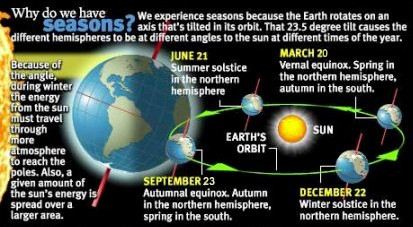
Why do we have seasons?
Why do we have seasons? It is all thanks to the tilt of the Earth's axis. (NASA / NOAA)

We are now in the waning hours of winter as spring is set to arrive in Thornton later today – at 5:21pm to be exact.  The changing of the seasons from winter to spring means longer days, warmer temperatures and a greening landscape.

The Earth experiences seasons thanks to its 23 1/2 degree tilt.  As the planet circles the sun, a process that takes 365 1/4 days, different parts of the Earth are tilted closer to or farther away from the sun.

The vernal equinox (the first day of spring) is the day on which the sun is directly over the Earth’s equator and daylight lasts 12 hours in both the Northern and Southern Hemisphere.  This is because at this point the Earth’s axis is 90 degrees away from the sun.

From now until the summer solstice, those of us in the Northern Hemisphere get closer to the sun and thus enjoy the warming temperatures and experience spring and summer.  In the Southern Hemisphere they experience the opposite and for them today is the first day of autumn.

Animated vernal equinox
The vernal equinox brings nearly equal daytime and nighttime across the globe.

Here is Colorado, thanks to our northern latitude, we have already passed the point of 12 hours of equal daytime and nighttime, something that occurred just a few days ago.  Today in fact daytime will last 12 hours and 7 minutes.

Did you know that there is a difference between the astronomical seasons that we are discussing here and meteorological seasons?

Meteorological seasons differ slightly and are geared toward matching the calendar with the annual temperature cycle.  This is done primarily for meteorological observing and forecasting.

For the Northern Hemisphere, the meteorological spring covers the months of March, April and May.  Summer brings the hottest months of the year and so meteorological summer is June, July and August.  Meteorological fall then is September, October and November followed by the coldest months of December, January and February as meteorological winter.

March 20 to March 26 – This Week in Denver Weather History

March 20 to March 26 - This Week in Denver Weather History

The Colorado Front Range continues to wait for any sort of real, measurable snow this season. That isn’t always the case as we can see looking back at this week in Denver weather history. March is historically our snowiest month and many significant snowstorms have occurred during this period including one just last year on the 23rd and 24th. Read more about that event and others below.

18-21

In 1907…a warm spell resulted in 6 daily temperature records. Record maximum temperatures of 82 degrees occurred on the 18th with 81 degrees on the 19th and 80 degrees on the 20th. Record high minimum temperatures of 52 degrees occurred on the 19th and 20th with 54 degrees on the 21st.

19-20 in 1912…post-frontal heavy snowfall of 6.3 inches was measured in downtown Denver. North winds were sustained to 28 mph with gusts to 30 mph on the 19th. The strong cold front plunged temperatures from a high of 60 degrees on the 19th to a low of 1 degree on the 20th.

In 1959…a major storm dumped heavy snowfall of 7.7 inches on Stapleton Airport where north winds gusting to 44 mph caused much blowing and drifting snow. Many highways were blocked…and there was damage to phone lines along the South Platte River. The storm started as rain and changed to heavy wet snow…which froze on the lines causing the poles to break. The storm caused 2 deaths over eastern Colorado.

In 2006…strong northerly winds…associated with a surface low pressure system that intensified as it moved into the central Great Plains…brought heavy wet snow to the eastern foothills and northeastern plains of Colorado. The hardest hit areas included the foothills of Boulder and Gilpin counties. Storm totals included: 15 inches at Rollinsville… 14 inches at Aspen Springs…12.5 inches near Nederland…and 5.7 inches in the Denver Stapleton area. Strong winds…heavy snow…and poor visibility forced the closure of interstate 70 from Denver east to the Kansas state line. North winds gusted to 32 mph at Denver International Airport on the 19th.

19-21

In 1888…heavy snowfall totaled 8.6 inches over downtown Denver. North winds were sustained to 27 mph on the 19th.

20

In 1915…north winds were sustained to 40 mph with gusts to 42 mph. Only a trace of snow fell.

In 1989…2 to 6 inches of snow fell along the Front Range urban corridor with up to 9 inches in Boulder. Only 1.6 inches of snowfall were measured at Stapleton International Airport where north winds gusted to 36 mph.

20-21

In 1878…warm days with high temperatures in the lower 70’s in the city…caused snow to melt on the palmer divide…which caused the waters in Cherry Creek to rise. The high…rapid running water damaged a home and eroded bridge footings and abutments. Some bridges became unsafe for the passage of trains.

In 1904…southwest winds sustained to 48 mph with gusts to 60 mph warmed the temperature to a high of 68 degrees on the 20th. The high was only 42 degrees on the 21st behind a cold front…which produced 1.3 inches of snow and northeast winds sustained to 27 mph overnight.

In 1923…post-frontal rain changed to heavy snow and totaled 8.2 inches over the city. North winds were sustained to 27 mph with gusts to 29 mph on the 20th. This was the second major snow in a week.

In 1932…rain changed to heavy snow…which totaled 6.2 inches in downtown Denver. North winds gusted to 22 mph on the 21st.

In 1948…heavy snowfall totaled 7.2 inches over downtown Denver.

In 1952…a major snow storm produced north wind gusts to 35 mph and dumped 16.9 inches of snowfall on Stapleton Airport. The maximum snow depth on the ground was 13 inches due to melting.

In 2000…heavy snow fell in and near the foothills of Douglas and Jefferson counties. Snowfall totals included: 9 inches near tiny town and 7 inches in Littleton. Snowfall totaled only 1.8 inches at the site of the former Stapleton International Airport. North winds gusted to 34 mph at Denver International Airport on the 20th.

Continue reading March 20 to March 26 – This Week in Denver Weather History
Turn your eyes skyward tonight for a look at the “super moon”

Be sure to check out the 'super moon' Saturday night.
Be sure to check out the 'super moon' Saturday night. (Wikipedia)

If you get outside after dark tonight be sure to turn your eyes skyward and you will be treated to a rare celestial event.  The moon will be full and it will appear considerably larger than normal as it is at its closest to Earth in 18 years.

NASA explains that full moon vary in size because of the oval orbital path our only natural satellite takes.  Tonight the moon will be at its perigee – its closest point to the Earth which is about 31,000 miles closer than when it is at its farthest (apogee).

The end result is a moon that appears 14% bigger and an astonishing 30% brighter.

Where should you look?

Sunset occurs today at 7:09pm here in Thornton and the moon will soon follow rising at 7:37pm in the east and should appear to be its biggest at that point.  It won’t be setting until early Sunday morning at 6:38 so you have plenty of time to enjoy the show but the start this evening will be the best time to get the full effect.

While it may appear close, the moon will still be 211,600 miles away so there is no danger of it crashing into us.  😉

The video from NASA below has more details:

Disaster in Japan worsens: Aftershocks continue, U.S. military evacuates families

More than 500 earthquakes have been recorded in and near Japan in the past seven days. Click the image for a larger view.
More than 500 earthquakes have been recorded in and near Japan in the past seven days. Click the image for a larger view. (Natural Disasters Examiner)

The situation brought on by last week’s earthquake and tsunami continues to worsen in Japan.  Aftershocks continue at an astounding rate, the humanitarian disaster is growing and the threat of a nuclear disaster has prompted the United States to begin evacuations of military families.

As reported by the Natural Disasters Examiner, the Department of Defense announced this morning that the State Department was planning voluntary evacuations of military families and the families of government employees from Japan. The U.S. will also work to evacuate civilians that live within a 50 mile radius of the Fukushima nuclear power plant.

The power facility sustained significant damage in the earthquake and tsunami that struck Japan last Friday. Critical cooling systems at the plant continue to fail, and Tokyo Electric Power Company, the operator of the plant, has struggled to regain control of the reactors.

Col. Otto Feather, 374th Airlift Wing commander at Yokota Air Base, told his command in a radio address, “I know there are a lot of people trying to figure out how to get out of here, and I’m not surprised that there are people that want to get on the road.”

The international community has joined with Japan’s own resources in aiding with the recovery. More than 100,000 Japanese Self-Defense Force personnel have been deployed, and tens of thousands of agencies from across the globe, including the United States military, are on scene or rushing to provide assistance. The U.S. Navy had aircrews contaminated with radiation and has since repositioned its ships in the area.

The disasters have led to an unfolding humanitarian crisis as more than one million are without power and supplies such as food and water are becoming scarce. The catastrophe the nation faces has been called the worst crisis for Japan since World War II.

On Tuesday, March 9th, a sizeable magnitude 7.2 quake struck off the east coast of Japan.  It triggered a small tsunami and was considered a minor event.  Several smaller quakes followed but they were only the opening act.

The U.S. military has been deployed to aid Japan in recovering from the earthquake and tsunami. Click the image for a slideshow of the military's efforts in Japan. (Examiner.com)

On Friday, March 11th the earth let loose with what was the fourth largest earthquake to strike the globe since 1900.  The massive 9.0 temblor shook the Japanese island of Honshu and triggered a tsunami 23 feet high that struck the coastline.  The waves traveled across the Pacific causing damage as far away as California.

Since that time, earthquakes continue to roil under the ocean and on the Japanese mainland.  The US Geological Survey (USGS) has recorded more than 500 earthquakes over magnitude 4.0 in the past seven days in the area.  Several of these were substantial quakes of magnitude 6.0 or higher.

An animation, seen below, show the tremendous level of activity has been released  and is absolutely astounding to watch.  Two foreshocks are seen before the massive quake on Friday and then the swarm of aftershocks begins with startling frequency and intensity.

More stories from the Natural Disasters Examiner:

We are providing complete coverage of the earthquake and tsunami in Japan on the Natural Disasters Examiner on Examiner.com.

Remember that by visiting our Examiner.com stories, you are helping to support ThorntonWeather.com.

Denver ties record high temperature; Cooler weather on the way

Denver tied the record high temperature for March 16th.

Denver has tied 45 year old high temperature record for March 16th.  While we have enjoyed the warm weather, it has led to high fire danger but thankfully cooler weather is on the way.

The high temperature as measured at Denver International Airport (DIA) reached 74 degrees at 2:25pm today.  This tied the record high for the date last set in 1966.

Here in Thornton we were actually a good bit warmer as we hit a high of 78 degrees at 4:27pm.

We were under a Red Flag Warning for most of the day today and it appears we will be under the same for at least the first part of Thursday.

Cooler weather is expected to arrive however and Thursday night and Friday may very well see us receive some much needed moisture.  Click here for the latest forecast.

For all the latest Thornton weather news, follow us on Twitter and join us on Facebook.

March 13 to March 19 – This Week in Denver Weather History

March 13 to March 19 - This Week in Denver Weather History

Snow is one thing we have not seen a lot of this season however that is not usually the case. March is our snowiest month and our look back at this week in Denver weather history provides evidence of this. It was this week eight years ago that the Denver was struck by a massive snowstorm – the costliest in Denver history. Also, just last year, we saw significant snowfall this same week. Below is a complete look at those and other events.

9-19

In 1906…an extended cold and blustery period occurred with light snow totaling 14.4 inches over 11 consecutive days. The greatest amount of snow on a single day was 4.0 inches on the 15th. Only a trace of snow fell on the 12th and 17th. High temperatures were below freezing for the entire period. The coldest were 14 degrees on the 16th and 18 degrees on the 17th. Both readings were record low maximums for the dates. Low temperatures were mostly in the single digits. The coldest were 2 degrees below zero on the 16th and 5 degrees below zero on the 19th. Northeast winds were sustained to 22 mph on the 9th. North winds were sustained to 36 mph on the 10th…32 mph on the 13th…and 22 mph on the 15th.

12-13

In 2005…a winter storm brought heavy snow to the eastern foothills and western metro Denver overnight. Storm total snowfall included: 15 inches in Jamestown…13 inches near Blackhawk…11 inches in the foothills southwest of Boulder and near Nederland…10.5 inches at Gross Reservoir…9.5 inches at Eldorado Springs…9 inches at Roxborough Park… 8.5 inches near Longmont…8 inches in Boulder…7.5 inches at Centennial…7 inches in Louisville…3.3 inches at Denver Stapleton. At Denver International Airport…west winds gusted to 46 mph on the 12th before the passage of the cold front and north winds gusted 31 mph on the 13th.

12-16

In 1880…a protracted cold spell resulted in 8 temperature records being set. Record low temperatures for the date were set when the temperature dipped to 10 degrees below zero on the 13th and 14th…8 degrees below zero on the 12th and 15th…and 4 degrees below zero on the 16th. Daily record low maximum temperatures were set with 11 degrees on the 12th…12 degrees on the 13th…and 19 degrees on the 15th.

13

In 1973…northwest winds gusted to 51 mph at Stapleton International Airport. The strong winds were accompanied by virga and a very light snow shower.

In 1990…4 to 9 inches of snow fell across metro Denver with 8 to 16 inches in the foothills. Morrison reported 9 inches; Evergreen…11 inches; and Aspen Springs…14 inches from the storm. Blowing snow and reduced visibilities caused 2-hour delays at Stapleton International Airport where only 5.1 inches of snow fell and north winds gusted to 21 mph.

13-14

In 1996…a storm system moving across northern Colorado dumped heavy snow in the mountains and foothills and across metro Denver where snowfall ranged from 5 to 10 inches. A foot of new snow was measured at Nederland with 11 inches at Conifer. Snowfall totaled 8.0 inches at the site of the former Stapleton International Airport. Northeast winds gusted to 30 mph at Denver International Airport on the 13th.

13-15

In 1906…snowfall totaled 8.0 inches over downtown Denver.

Continue reading March 13 to March 19 – This Week in Denver Weather History
Japan devastated by earthquake and tsunami; Untold thousands missing or dead

Slideshow: Recovery efforts begin amongst devastation in Japan. (Examiner.com)
Recovery efforts begin amongst the devastation from the earthquake and tsunami in Japan. Click the image to view a slideshow of images on Examiner.com.

The massive magnitude earthquake that struck Japan on Friday has brought incredible devastation to the nation.  The death toll continues to climb and there are reports of thousands of people missing even as a nuclear power plant threatens to release dangerous radiation.

Commercial buildings and homes were reduced to rubble in the magnitude 8.9 earthquake – the fifth largest seen globally since 1900.  Along the cost of Japan’s main island of Honshu, a monstrous tsunami 23 feet high pushed ashore wiping away everything in its path. The devastation was so massive it was easily spotted by NASA satellites.

The death toll has now climbed over 600 people with at least 1,000 missing.  The Kyodo News Service is reporting that according to city officials, 9,500 people in the town of Minamisanriku in Miyagi Prefecture are missing.  The town normally has a population of 17,000.

An explosion at a damaged nuclear power facility increased concerns that a deadly radiation leak may be imminent.  The blast at Tokyo Electric Power Co.’s Fukushima No. 1 nuclear plant sent smoke billowing into the air and is reported to have injured four workers.

Government officials insist no dangerous levels of radiation have been released.  Nevertheless, they have increased the evacuation radius around the damaged plant from 6 miles (10 km) to 12 miles (20km).  A 6 mile (10 km) evacuation zone around the Fukushima No. 2 plant to the south remains in place.  As many as 300,000 will be evacuated due to the danger.

With the concern of a nuclear disaster possibly being in the offing, rescuers continued to comb through the rubble in search of possible survivors.  Japanese Prime Minister Naoto Kan said more than 3,000 people had been rescued but an untold number likely remain buried.

International aid began streaming into the nation including search and rescue teams and supplies from dozens of nations.

The U.S. military in Japan leapt into action and immediately began delivering relief supplies to stricken areas.  The Marine Corps and the Navy will have extensive resources in the area, particularly once the USS Ronald Reagan aircraft carrier and its strike group arrives tomorrow.

Aftershocks continue to rumble in the ocean near the epicenter of yesterday’s quake.  More than 100 significant temblors have occurred, some onshore on the island of Honshu.

Slideshow: Before and after - NASA satellite images show devastation in Japan (Examiner.com)
Slideshow: Before and after - NASA satellite images show devastation in Japan. Click to view the slideshow on Examiner.com.

More stories from the Natural Disasters Examiner:

We are providing complete coverage of the earthquake and tsunami in Japan on the Natural Disasters Examiner on Examiner.com.

Remember that by visiting our Examiner.com stories, you are helping to support ThorntonWeather.com.

Alabama tornadoes captured on video ripping apart store

March 9, 2011 - This truck was flipped on its side by the tornado that struck Theodore, AL.  (Twitpic/WKRG_Jessica http://twitpic.com/47u3yv)
March 9, 2011 - This truck was flipped on its side by the tornado that struck Theodore, AL. (Twitpic/WKRG_Jessica http://twitpic.com/47u3yv)

The Deep South was the scene of some nasty weather yesterday as severe storms brought damaging winds, flash floods and tornadoes to four states in the region.  One particularly damaging tornado struck Theodore, Alabama and surveillance video captured the effects of the storm as it tore apart a hardware store.

According to the National Weather Service the tornado initially touched down at about 9:00am local time yesterday as an EF1.  As it tracked to the northeast the tornado increased to EF2 strength packing winds up to 120mph.  At its maximum size it was 150 yards across.

Four people suffered injuries from the tornado and 25 residential and commercial structures were damages.  Cars in a strip mall were tossed about like toys and a gas station awning collapsed.

Alexander Hardware and Small Engine was in the path of the tornado when it was at its strongest after it passed over Theodore Dawes Road.  The store sustained a near direct strike from the twister.

Video captured by Alexander’s surveillance cameras provide video proof of the power and fury of the twister.  In one video, employees are seen tentatively looking out the front door before running for cover as the tornado struck.  The second video provides an overall view of the store interior as the tornado hits sending shelves and merchandise flying.

National Weather Service adds storm spotter training in the north Denver area

On June 3, 1981 a tornado struck Thornton in what is the worst twister to have struck the Denver metro area. Are you ready should disaster strike again? Image courtesy the City of Thornton archives.

Last month the National Weather Service announced the first batch of storm spotter training sessions for the spring but notably missing was any in the north metro area.  That has now been rectified as two sessions at Front Range Community College were added for next week.

Severe weather is a fact of life in Colorado – from blizzards to tornadoes we can and do see it all.  Each year the weather is responsible for claiming lives in our state and across the nation and the threat is very real.  Storm spotter training allows you to learn how to protect yourself and your family while providing a public service.

Education is key to knowing how to protect you and your family.  Whether you want to be an official storm spotter or maybe just want to learn more about severe weather, storm spotter training can provide you an incredible opportunity to learn.

The National Weather Service Denver / Boulder office has announced a series of storm spotter training dates for Colorado for the 2011 season.

The storm spotter program is a nationwide program with more than 280,000 trained spotters.  These volunteers report weather hazards to their local National Weather Service office providing vital information when severe strikes.  Data from spotters include severe wind, rain, snow measurements, thunderstorms and hail and of course tornadoes.

Storm spotters are part of the ranks of citizens who form the Nation’s first line of defense against severe weather. There can be no finer reward than to know that their efforts have given communities the precious gift of time–seconds and minutes that can help save lives.

By completing one of these training classes you can become an official storm spotter.  When severe weather strikes, you can report it by calling a special toll free number or submit your report via the National Weather Service’s website.

These are great sessions for anyone wanting to learn more about the severe weather we experience in Colorado, whether you want to be an official spotter or not.  All training is free.  Topics include:

  • Basics of thunderstorm development
  • Fundamentals of storm structure
  • Identifying potential severe weather features
  • Information to report
  • How to report information
  • Basic severe weather safety

To learn more about the program, see here: http://www.crh.noaa.gov/bou/awebphp/spotter.php

Below are the dates, times and locations announced thus far with the first occurring today.  At the current time only one is in the north metro area but more may be added. We will try to keep this updated but you can click here for any new dates on the National Weather Service website.

March, 2011 – Upcoming
Day City, State Time Location
14 Castle Rock, CO
(Douglas County)
6:30pm MDT Black Feather Condominium Club House 403 Black Feather Loop Castle Rock, Colorado, 80104
Contact Information: kc0mht@msn.com
15 Westminster, CO
(Adams County)
3:30pm MDT Front Range Community College 3645 West 112th Ave. room B1101…note room change. Westminster, CO 80031
Contact Information: Rachel.Humphrey@Colorado.EDU
15 Centennial, CO
(Arapahoe County)
6:30pm MDT Arapahoe County Sheriff Dept. 13101 East Broncos Parkway Centennial, CO
Contact Information: CStelter@co.arapahoe.co.us
15 Westminster, CO
(Adms County)
7:00pm MDT Front Range Community College 3645 West 112th Ave. room B1101…note room change. Westminster, CO 80031
Contact Information: Rachel.Humphrey@Colorado.EDU
21 Sedgwick, CO
(Sedgwick County)
6:30pm MDT Sedgwick Fire Department on US 138 on east side of town
Contact Information: sedgwickoem@yahoo.com
22 Holyoke, CO
(Phillips County)
1:00pm MDT Phillips County Fairgrounds Event Center Holyoke, CO
Contact Information: philcoadmin@pctelcom.coop
22 Haxtun, CO
(Phillips County)
6:30pm MDT Haxtun Volunteer Fire Dept.
Contact Information: Robert.glancy@noaa.gov
29 Akron, CO
(Washington County)
6:30pm MDT Washington County Events Center, Washington County Fairgrounds
Contact Information: mmccaleb@co.washington.co.us
31 Greeley, CO
(Weld County)
6:30pm MDT Weld County Training center, 1104 H Street Greeley, co
Contact Information: Rrudisill@co.weld.co.us
April, 2011 – Upcoming
Day City, State Time Location
04 Sterling, CO
(Logan County)
6:30pm MDT Sterling Public Library 425 North 5th Street Sterling, CO
Contact Information: OWENS@sterlingcolo.com
05 Fort Morgan, CO
(Morgan County)
6:30pm MDT note location change to: American Legion Hall 121 Nelson Road Fort Morgan, CO
Contact Information: senfante@co.morgan.co.us
08 Denver, CO
(Denver County)
6:30pm MDT Metropolitan state college of denver Tivoli Union, Room 440
Contact Information: Robert.Glancy@noaa.gov
09 Kiowa, CO
(Elbert County)
9:00am MDT Elbert County Public Health 75 Ute Avenue, Kiowa, CO
Contact Information: cory.stark@elbertcounty-co.gov
12 Parker, CO
(Douglas County)
7:00pm MDT South Metro Fire Parkglenn HQ 10235 Parkglenn Way Room A & B Parker, CO
Contact Information: p.lundquist@comcast.net
16 Commerce City, CO
(Adams County)
10:00am MDT Adams County OEM 4201 East 72nd Ave (2nd floor) Commerce City, CO 80022
Contact Information: r1@rampartsar.com
20 Brush, CO
(Morgan County)
6:30pm MDT Brush Fire Department 1220 West Edison Brush, CO
Contact Information: zach.evelyn@brushfd.com
26 Elizabeth, CO
(Elbert County)
6:30pm MDT Elizabeth Library 651 West Beverly Elizabeth, CO 80117
Contact Information: cory.stark@elbertcounty-co.gov
30 Fort Collins, CO
(Larimer County)
9:00am MDT Fort Collins Police Community Room at 2221 South Timberline Road, Fort Collins
Contact Information: n7dq@comcast.net

Weather, natural disasters & climate news and information.