With the first full month of fall here, October usually brings one of the quietest weather months in the Denver area with plenty of mild, sunny days and clear, cool nights.
October is historically the second sunniest month and conditions are generally calm.
However we also will usually see our first taste of winter during the month with the first freeze and first snowfall of the season. Temperatures as well will start to drop and by the end of the month the average nighttime lows are below freezing.
Don’t miss a thing when it comes to our ever-changing weather! Be sure to ‘like’ us on Facebook, follow us on Twitter and add us to your Google+ circles.
With the mercury stuck stubbornly at the top of the scale and barely a few raindrops falling into the bucket, September 2015 will be going into the books as one of the warmest and driest on record.
High pressure dominated the entire region during the month. This allowed temperatures to consistently climb above normal and helped prevent moisture from arriving in any significant amounts. At Denver International Airport, 27 of the 30 days had above normal temperatures. Thornton’s overall temperatures were cooler than DIA’s but we were still quite a bit warmer than average.
The monthly average temperature in Thornton came in at 67.1 degrees. Out at the airport where the Mile High City’s official measurements are taken, the average was 69.4 degrees.
Denver’s historical average for September is 63.4 so both locations came in well above normal. Officially, September 2015 ranks as the warmest September on record, easily jumping to the number one spot over September 1948 which had an average of 68.3 degrees.
Undoubtedly the big difference between measurements at DIA and other locations in the metro area are yet another example of the airport’s readings consistently being an outlier from the reality seen in more populated areas. This has been an ongoing problem since the National Weather Service moved the official station from Stapleton.
The warmest mercury reading in Thornton during the month was 94 degrees on the 13th. The coldest came on the 19th when temperatures dipped to 40 degrees in the early morning hours. Eight days in Thornton topped out above the 90 degree mark.
At the airport, Denver’s warmest reading of 92 degrees came on September 2. It’s coldest on September 19 (44 degrees). The airport saw seven days with above 90 degree maximums.
Just as the month was exceedingly warm, it also was very dry. Thornton saw a mere 0.09 inches fall in its rain bucket and Denver recorded 0.11 inches. Both were far short of the September precipitation average of 0.96 inches.
DIA’s measurement means September 2015 goes into the books with the 9th least amount of precipitation in September since 1872 (16th driest overall).
Thornton, Colorado’s September 2015 temperature summary. (ThorntonWeather.com)Thornton, Colorado’s September 2015 precipitation summary. (ThorntonWeather.com)
From the National Weather Service:
CLIMATE REPORT
NATIONAL WEATHER SERVICE BOULDER, CO
244 AM MDT THU OCT 1 2015

...THE DENVER CO CLIMATE SUMMARY FOR THE MONTH OF SEPTEMBER 2015...

CLIMATE NORMAL PERIOD 1981 TO 2010
CLIMATE RECORD PERIOD 1872 TO 2015

WEATHER         OBSERVED          NORMAL  DEPART  LAST YEAR`S
                 VALUE   DATE(S)  VALUE   FROM    VALUE  DATE(S)
                                          NORMAL
................................................................
TEMPERATURE (F)
RECORD
 HIGH              97   09/06/2013
                        09/05/2013
                        09/04/1995
 LOW               17   09/29/1985
HIGHEST            92   09/02        91       1       94  09/03
LOWEST             44   09/19        35       9       33  09/12
AVG. MAXIMUM     85.2              78.5     6.7     78.9
AVG. MINIMUM     53.5              48.3     5.2     50.6
MEAN             69.4              63.4     6.0     64.8
DAYS MAX >= 90      7               3.4     3.6        2
DAYS MAX <= 32      0               0.0     0.0        0
DAYS MIN <= 32      0               0.8    -0.8        0
DAYS MIN <= 0 0 0.0 0.0 0

PRECIPITATION (INCHES)
RECORD
 MAXIMUM 5.61 2013
 MINIMUM T 1892 1944
TOTALS 0.11 0.96 -0.85 1.79
DAILY AVG. 0.00 0.03 -0.03 0.06
DAYS >= .01         3               6.5    -3.5        9
DAYS >= .10         0               3.3    -3.3        4
DAYS >= .50         0               0.6    -0.6        1
DAYS >= 1.00        0               0.1    -0.1        1
GREATEST
 24 HR. TOTAL    0.12   08/31 TO 09/01           09/29 TO 09/29
                                                          09/28 TO 09/29
                                                          09/29 TO 09/29
 STORM TOTAL       MM                                 MM
 (MM/DD(HH))            MM                    09/29(00) TO 09/29(00)
                                                 09/29(00) TO 09/29(00)9
                                                 09/29(00) TO 09/29(00)9

SNOWFALL (INCHES)
RECORDS
 TOTAL             MM   MM
TOTALS            0.0               1.3

DEGREE_DAYS
HEATING TOTAL       9               125    -116       91
 SINCE 7/1         27               141    -114       98
COOLING TOTAL     148                76      72       88
 SINCE 1/1        861               764      97      701

FREEZE DATES
RECORD
 EARLIEST     09/08/1962
 LATEST       06/08/2007
EARLIEST                        10/07
LATEST                          05/05
..........................................................

WIND (MPH)
AVERAGE WIND SPEED              9.0
RESULTANT WIND SPEED/DIRECTION   2/195
HIGHEST WIND SPEED/DIRECTION    35/280    DATE  09/07
HIGHEST GUST SPEED/DIRECTION    54/270    DATE  09/07

SKY COVER
POSSIBLE SUNSHINE (PERCENT)   MM
AVERAGE SKY COVER           0.40
NUMBER OF DAYS FAIR           12
NUMBER OF DAYS PC             17
NUMBER OF DAYS CLOUDY          1

AVERAGE RH (PERCENT)     41

WEATHER CONDITIONS. NUMBER OF DAYS WITH
THUNDERSTORM              6     MIXED PRECIP               0
HEAVY RAIN                0     RAIN                       3
LIGHT RAIN                7     FREEZING RAIN              0
LT FREEZING RAIN          0     HAIL                       3
HEAVY SNOW                0     SNOW                       0
LIGHT SNOW                0     SLEET                      0
FOG                       3     FOG W/VIS <= 1/4 MILE      5
HAZE                      1

-  INDICATES NEGATIVE NUMBERS.
R  INDICATES RECORD WAS SET OR TIED.
MM INDICATES DATA IS MISSING.
T  INDICATES TRACE AMOUNT.
September 27 to October 3: This week in Denver weather history
With the end of summer and the arrival of fall, looking back at Denver weather history we start to see more mentions of snow. It is of course not the only notable weather event this time of year. We still have received severe thunderstorms, damaging winds, and 90 degree plus heat.
From the National Weather Service:
From the 25th to the 27th:
in 1996…an early season snowstorm brought heavy snow to the Front Range eastern foothills. Snowfall totals included: 8 to 12 inches around Conifer…7 inches on Floyd Hill…and 6 inches at both bailey and Chief Hosa. Snowfall totaled only 4.7 inches at the site of the former Stapleton International Airport. This was the first measurable snow of the season. After the passage of a strong cold front…north winds gusted to 38 mph at Denver International Airport on the 25th.
From the 26th to the 28th:
In 1936…the heaviest snowfall ever recorded in September and the heaviest snowfall ever recorded so early in the season dumped a total of 16.5 inches of snow on downtown Denver and 21.3 inches at Denver municipal airport. The 15.0 inches of snow measured from 6:00 pm on the 27th to 6:00 pm on the 28th is the greatest 24 hour snowfall ever recorded in September. This was the first snow of the season. The snow was intermittent through the 26th…but continuous from early afternoon on the 27th to around midnight on the 28th…except for a period of rain during the afternoon of the 28th which contributed to a loss of depth on the ground. The greatest snow depth on the ground downtown was 13 inches with 8 inches at Denver municipal airport. There were no high winds with the storm and traffic was interrupted for only a short period. The storm produced property damage estimated at 7 million dollars. With trees and shrubs in full foliage…the leaves caught and held the heavy water-laden snow…until the branches snapped from the weight. More than 3000 workmen were called to remove the debris and snow from the city. The city firemen who were off duty…as well as all the reserves… Were asked to report to their stations. All schools in the city remained open…but attendance was only 50 percent of normal. Grade school students were sent home at noon on the 28th. The early storm caught stockmen with many cattle still in higher ranges. Warm weather followed the snow…which had all melted by the end of the month…except for a few inches in sheltered places.
On the 27th:
In 1877…smoke from heavy forest fires in the mountains spread over the city on upper wind currents.
In 1935…the first snow of the season was 2.8 inches in downtown Denver. The low temperature dipped to 31 degrees for the first freeze of the season.
From the 27th to the 28th:
In 1984…heavy snow fell over the plains and foothills. Snowfall amounts ranged from 2 to 5 inches on the plains with up to a foot at higher elevations in the foothills. The main problem caused by the storm was thousands of power outages caused by snow-laden tree limbs snapping and falling onto power lines. Over 15 thousand homes lost power in metro Denver. Some cars were damaged by falling trees and limbs. The snow also caused some flight delays at Stapleton International Airport where 5.1 inches of snow fell and northeast winds gusted to 29 mph. Maximum snow depth on the ground was 3 inches due to melting. The high temperature of only 34 degrees on the 28th was a record low maximum for the date and equaled the all-time record for the month at that time.
On the 28th:
In 1877…heavy dense smoke from mountain forest fires spread over the city. The smoke was so dense that it obscured the sun at times.
In 1921…post-frontal northeast winds were sustained to 44 mph.
In 1953…a pacific cold front produced a west wind gust to 59 mph at Stapleton Airport where the visibility was briefly reduced to 3/4 miles in blowing dust. Strong winds were also widespread over Boulder during the afternoon.
In 1960…strong…gusty winds tore the roof from 6 units of a motel on west Colfax Avenue in Denver. The roofing sailed over the building and crashed down on a truck…wrecking it. The strong winds were the result of an apparent microburst.
In 1999…snow fell in the foothills west of metro Denver and over the plains. Snowfall totals included 7 inches at Conifer. At the site of the former Stapleton International Airport…3.1 inches of snow were measured. This was the first snow of the season. The heavy wet snow snapped branches from fully leafed trees…downing power lines and causing scattered outages.
In 2004…severe thunderstorms produced hail to 3/4 inch in diameter in Littleton and in Douglas County 14 miles northwest of Castle Rock.
In 2012…a weak tornado (ef-0) tornado touched down near Strasburg. No damage was reported.
From the 28th to the 29th:
In 1959…one of the heaviest September snow storms of record began as rain and changed to heavy wet snow. The storm caused heavy damage to trees and shrubbery…which were still in full leaf. The storm dumped 10.6 inches of snow at Stapleton Airport…the third heaviest September snow amount to date. Falling trees and limbs disrupted traffic…broke power and communication lines…and damaged buildings and cars. One man was killed in Denver by a falling tree limb…and four others died of heart attacks while shoveling snow or trying to move heavy tree limbs. Direct costs of the storm for cleaning up debris…repairing utility lines…and damage to buildings and other property across all of eastern Colorado were estimated to be over a half million dollars. The value of trees destroyed or damaged was estimated to exceed five million dollars. North-northeast winds gusted to 32 mph at Stapleton Airport on the 28th.
In 1985…an unusually cold air mass for this time of year settled over the area. Metro Denver received 8 to 12 inches of powdery snow. The 8.7 inches of snow that fell at Stapleton International Airport was the first measurable snow of the season and the city’s heaviest September snowfall since 1971. The snow caused flight delays of over 2 hours at Stapleton International Airport. I-70 was closed for a time west of Denver. Snow-laden tree limbs snapped over all of metro Denver…causing widespread power outages. Ten thousand people were without electricity for a time in Boulder. The morning of the 29th saw mid-winter temperatures along the Front Range. The temperature dipped to 17 degrees…the lowest temperature ever recorded in September in Denver. The high temperature of only 29 degrees on the 29th was a new record low maximum for the date and lowest ever recorded during the month of September. The low temperature of 21 degrees on the evening of the 28th set a new record low for the date. The cold weather persisted through the 1st with record minimum temperatures of 25 degrees set on the 30th and 27 degrees set on October 1st.
On the 29th:
In 1966…a vigorous cold front moved thru metro Denver. North winds gusting to 51 mph kicked up billows of blowing dust…which briefly reduced the visibility to 1 mile at Stapleton International Airport. The cold air caused temperatures to drop rapidly from a high of 86 degrees to a low of 46 degrees by days end.
In 1985…the lowest temperature ever recorded in September… 17 degrees…occurred. The high temperature warmed to only 29 degrees…the all-time record low maximum for the month.
In 1994…the temperature reached a high of 91 degrees at Stapleton International Airport. This was the 60th day of the year that the temperature had reached 90 degrees or more…establishing a new record at that time. The previous record of 52 “90 degree days” occurred in 1978. Only 43 “90 degree days” were recorded at Denver International Airport during 1994.
In 1995…lightning struck a couple in Aurora as they were walking in the rain. The bolt struck the umbrella the man was carrying…injuring both the man and his wife.
In 2000…late afternoon thunderstorms produced strong wind gusts to 76 mph in Westminster…to 69 mph near Boulder…and to 60 mph at Jefferson County airport near Broomfield. No damage was reported.
In 2014…a storm system that moved through the area produced large hail and street flooding in parts of metro Denver and then spread east into the plains. The storm also caused multiple accidents. A semi became detached from a trailer… Blocking traffic on westbound Interstate 70 west of Tower Road. Downed power poles blocked a roadway on CO 79 near Bennett…at mile marker 10. In addition to the damaging winds…the storms produced large hail… From nickel to golfball size across southern and eastern portions of metro Denver. The hailstorm was the most damaging of the 2014 summer season…with insured losses that topped 213 million dollars. Insurance claims included 29297 automobile claims worth more than 87.2 million dollars and 14287 property claims for 126 million dollars…ranking the storm as the eighth most expensive to hit the state. At Denver International Airport…1.01 inches of rainfall was recorded which was the greatest 24-hr rainfall for the date. In addition…a peak wind gust to 38 mph was observed at the airport.
Wildlife is still quite active along the Front Range and flowers will hold on to their petals for at least the first part of the month. Then of course there is the weather which you never know what to expect. Thunderstorms, heavy rain, and even snow are a possibility.
Slideshow updated September 30, 2015
To learn more about how to send your photo to us for inclusion in the slideshow, see below the slideshow.
Showcasing images captured by ThorntonWeather.com readers as well as some of our own, our monthly slideshow covers the entire gamut of weather-related imagery.
Sunsets, sunrises, wildlife and of course every type of weather condition are vividly depicted in images captured from yours and our cameras.
[flickr_set id=”72157657760243740″]
What is missing in the slideshow above? Your photo!
Our monthly photo slideshow is going to feature images that we have taken but more importantly images that you have captured. The photos can be of anything even remotely weather-related.
Landscapes, current conditions, wildlife, pets, kids. Whimsical, newsy, artsy. Taken at the zoo, some other area attraction, a local park, a national park or your backyard. You name it, we want to see and share it!
Images can be taken in Thornton, Denver or anywhere across the extraordinary Centennial State. We’ll even take some from out of state if we can tie it to Colorado somehow.
We’ll keep the criteria very open to interpretation with just about any image eligible to be shown in our slideshows.
What do you win for having your image in our slideshow? We are just a ‘mom and pop’ outfit and make no money from our site so we really don’t have the means to provide prizes. However you will have our undying gratitude and the satisfaction that your images are shared on the most popular website in Thornton.
To share you images with us and get them included in the slideshow just email them to us or share them with ThorntonWeather.com on any of the various social media outlets. Links are provided below.
Tropical storm Joaquin, which some meteorologists expect could be headed toward the East Coast of the United States over the weekend, was upgraded to a Category 1 hurricane on Wednesday morning by the National Weather Service. Joaquin formed late Monday over the Atlantic Ocean and strengthened east of the Bahamas on Tuesday afternoon, with wind speeds… Continue reading Tropical Storm Joaquin, Upgraded to Hurricane, May Head to East Coast→
NASA will announce on Monday that liquid saltwater exists on the surface of Mars – a discovery that scientists say indicates the “potential” for life on the planet. The historic findings by scientists from NASA and several US universities are based on research on dark, narrow and elongated streaks that appear on the surface of the… Continue reading NASA: Water found on Mars→
Taiwan has evacuated thousands of residents and tourists as “super typhoon” Dujuan headed towards the island, gathering strength on its approach to the east coast. Torrential rains and high winds are forecast across Taiwan from Monday afternoon, with landfall predicted around 15:00 GMT. Almost 3,000 people, most of them tourists, were evacuated on Sunday from Taiwan’s… Continue reading Taiwan evacuates thousands as ‘super typhoon’ nears→
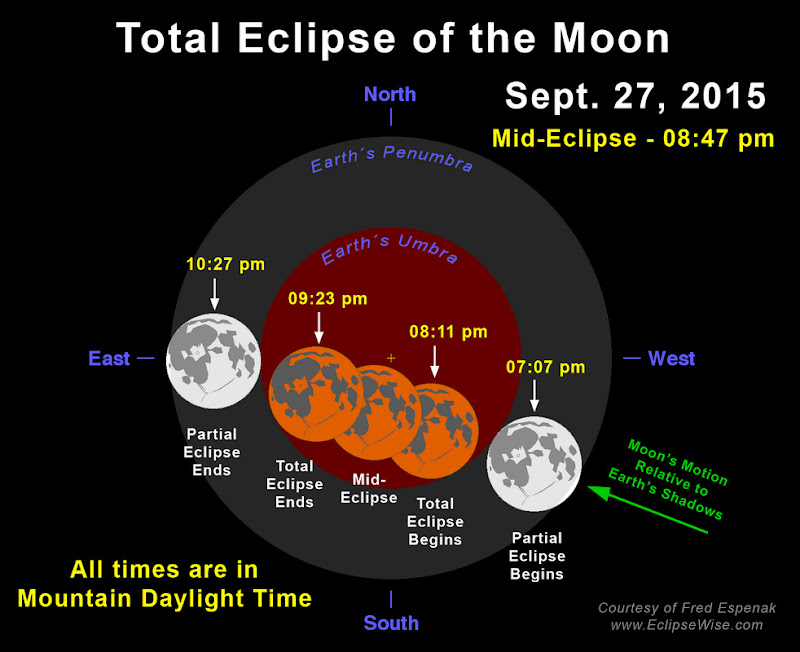
Path of the moon during the total lunar eclipse on September 27, 2015. Click for a larger view. (Fred Espenak)
A total lunar eclipse coupled with a ‘supermoon’ will bring a very unusual scene to the sky on Sunday. Taken separately, the two events are not quite as extraordinary or rare. However, this will be the first time in 33 years they have occurred at the same time and the last for another 18 years.
The moon’s orbit around Earth is not a perfect circle and when it is at its closest to us, it appears quite a bit larger to our eye – hence the name ‘supermoon.’
On Sunday it will be about 31,000 miles closer to Earth than it is at its farthest point. According to NASA, this results in it appearing to be about 14% larger and 30% brighter.
The total lunar eclipse will be our second of 2015 and fourth in the past two – a tetrad of eclipses. During these, the moon finds itself in the Earth’s shadow and without direct sunlight hitting its surface, the moon turns an eerie orange / red color – a ‘blood moon.’
The last time these two events coincided was in 1982 and the next time won’t be until 2033. As NASA scientist Noah Petro said, “That’s rare because it’s something an entire generation may not have seen.”
When and where to watch?
The partial eclipse begins at 7:07pm MDT on Sunday, September 27, 2015 with totality starting at 8:11pm. The moon will then be completely eclipsed for a little more than an hour with mid-eclipse at 8:47am. The waning partial eclipse will end at 10:27pm.
One catch for viewing the entire event here along the Front Range is that when it begins, the moon will actually be just starting to rise on the eastern horizon. However, at mid-eclipse the moon will be 21 degrees above the horizon to the east southeast providing a nice view not far above the landscape.
Anyone in the area with a clear view of the lower, eastern sky should have no problem viewing the event.
Will Mother Nature cooperate?
Our unseasonably warm temperatures will be continuing through the weekend so there are no concerns about it being too cold to go outside. Clouds, however, are something to watch closely for. Some atmospheric moisture is expected late in the day Sunday and it is possible cloud cover may impact the clear viewing.
April 15, 2014 – The lunar eclipse is seen half-way to totality, the total lunar eclipse, and half-way between totality and the end. Click for a larger view. (Tony’s Takes)
During totality, the moon will be rendered orange / red as the Earth’s shadow envelops the moon. Many are calling this a ‘blood moon’ but the meaning behind that term isn’t exactly clear.
As written on EarthSky.org, some attribute it to the lunar tetrad – four successive full lunar eclipses without any partial eclipses. Tomorrow morning’s eclipse is the second in the lunar tetrad with each full lunar eclipse coming six months apart.
The blood moon as it pertains to these eclipses should not be confused with the October full moon which is also referred to as a blood moon in folklore.
The leaves in the high country are changing and certainly give meaning to the moniker ‘Colorful Colorado.’ (ThorntonWeather.com)
This time of year many folks head to the hills west of Denver in search of gold – fall foliage gold.
This year the changing of the colors seems to be a bit spotty and an early freeze last fall followed by a late freeze this spring has impacted the overall quality of the show. That certainly is not to say there isn’t some absolutely gorgeous spots out there.
Where to go? Below are five of ThorntonWeather.com’s favorite ones near Denver – plus a few further out and some bonus ideas. After that, we will tell you where you can find a great website that provides regular updates on viewing conditions.
I-70 Corridor – If you’re looking for the easiest route, then this one is for you. Simply head west on I-70 about 110 miles to Avon. Between Vail and Avon, both sides of I-70 are lined beautifully with aspen.
Rocky Mountain National Park – One of the most popular summer destinations in the state is of course also a prime spot to view aspen in all their glory. Once in the park head toward Bear Lake. Glacier Gorge Junction provides a beautiful spot and you of course also get to enjoy all the splendor that Rocky Mountain National Park has to offer. Extend your viewing by taking Trail Ridge Road all the way through to the west side of the park and the Grand Lake and Granby area.
Peak to Peak Highway – This little road trip can be a dual purpose trip – gambling and fall foliage viewing! Take U.S. 6 through Clear Creek Canyon and then 119 through Blackhawk and Central City. You can of course stop there if your wallet is fat enough and donate some money to the casinos. From there continue on 119 toward Nederland. Take highway 72 toward Ward and Allenspark. There you will find more golden aspen than you can imagine, all with the Continental Divide nearby.
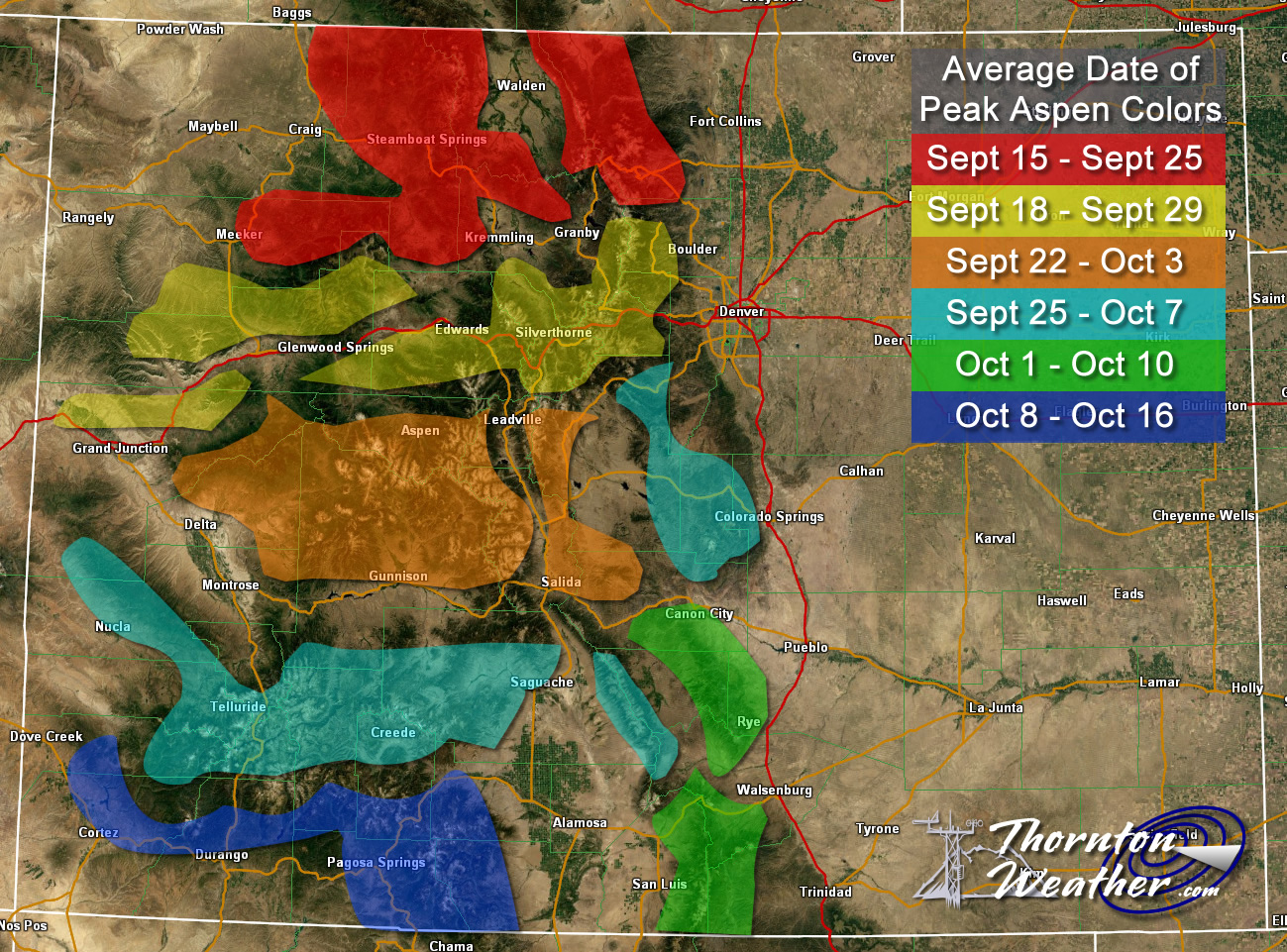
Colorado Fall Foliage – Average Date of Peak Aspen Colors. Click for larger view. (ThorntonWeather.com)
Poudre Valley Canyon – Heading north on I-25 take Colorado 14 west and into Poudre Canyon and Roosevelt National Forest. As you continue west you will come very near timberline as you come to Cameron Pass. Amazing views abound!
Guanella Pass – This is a nice, relatively short drive from Denver. From C470 take 85 through Bailey and Conifer, a nice drive unto itself. When you come to the town of Grant, take the Guanella Pass Scenic and Historic Byway north to Georgetown. The air is pretty thin along the way as you climb in excess of 11,500 views through the Pike and Arapahoe National Forests. Fair warning – about 10 miles of the road is gravel but it is well maintained.
A couple other possibilities further from the Front Range:
Leadville / Aspen – From Denver take I-70 west to Copper Mountain and then Colorado 91 south over Freemont Pass to Leadville. Along the way there are plenty of viewing opportunities and Leadville is a nice little town to make a stop. From here you can take Highway 24 north back through Minturn and Vail. To extend the drive, take Highway 24 south to Colorado 82 and head toward Aspen. You can stop by the Maroon Bells in White River National Forest to view some of the most photographed mountains in Colorado.
Cottonwood Pass – From Denver take Highway 285 to Buena Vista. Head west on Main Street for seven miles then west on County Road 344 / Colorado 82. From there you start the climb up Cottonwood Pass with absolutely stunning views from the top. If you are up for it, you can continue down the west side of the pass into the Taylor Park area. Be forewarned though that the western half of the pass is unpaved and twisty.
Honorable mentions worth considering:
Boreas Pass between Breckenridge and Como (County Road 10)
Kenosha Pass on Highway 285 between Bailey and Fairplay
Independence Pass (Colorado 82 between Aspen and Twin Lakes)
Colorado 103 from Evergreen to Echo Lake. Throw in a drive up Mount Evans for a bonus.
If you do head out, be sure to send us your pictures for inclusion in our monthly photo slideshows!
With only a couple of days left in summer, Mother Nature seems to be indicating the season won’t go down without a fight. Denver broke a high temperature record today that has been on the books for more than a century.
As officially recorded at Denver International Airport, the high temperature today topped out at 89 degrees. This bests the old record for the date of 88 degrees set in 1885 and is well above the average for today’s date of 77 degrees.
Here in Thornton we were only minutely cooler with a high of 88 degrees today.
Looking ahead, we do expect to see some cooling in the days ahead. However, temperatures are expected to remain above normal through at least the weekend. Get the extended forecast here.
Weather, natural disasters & climate news and information.

 With the first full month of fall here, October usually brings one of the quietest weather months in the Denver area with plenty of mild, sunny days and clear, cool nights.




 With only a couple of days left in summer, Mother Nature seems to be indicating the season won’t go down without a fight. Denver broke a high temperature record today that has been on the books for more than a century.