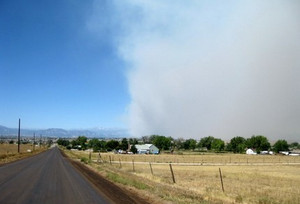
The Fourmile Canyon Fire sent smoke over Thornton on Monday. (ThorntonWeather.com)
A fast moving wildfire burning northwest of Boulder sent smoke over Thornton on monday and more is expected today. The Fourmile Canyon Fire started late Monday morning and has burned 3,500 acres thus far.
Tinder dry fuels, low humidity, warm temperatures and gusty winds fueled the Fourmile Canyon Fire yesterday as it grew quickly. Firefighters took up defensive positions trying to save what homes they could but many were reduced to cinder.
More than 100 firefighters are on scene with 35 engines from 30 local agencies. Boulder County Fire is acting as the primary agency for the fire.
High winds prevented air tankers with retardant from operating for most of the day but the wind eased in the late afternoon and evening allowing some operations. 18 flights by three tankers were carried out before the sun set and they were able to drop 40,000 gallons of retardant on the fast moving fire.
Four additional tankers arrived Monday and will begin operations today, weather permitting.
With plenty of heat and a lack of moisture the fire danger is high along the Front Range on Sunday. (National Weather Service)
September is starting off as a hot one along the Front Range and indeed across the state of Colorado. With temperatures set to approach record highs, low humidity and windy conditions the fire danger has prompted a Red Flag Warning for Sunday.
The record high temperature for September 5th is 97 degrees and that is what Denver’s thermometer is expected to rise to today. Humidity during the heat of the day is forecast to drop below 15% and the afternoon will bring breezy conditions with winds gusting over 30 mph.
All of those factors will serve to dry out the Colorado Front Range and bring what the National Weather Service calls “extreme fire danger” to the area.
The service has issued a Red Flag Warning that will be in effect from 10:00am to 9:00pm today covering the Front Range foothills and adjacent areas including Denver and Thornton. Conditions are expected to be at their peak from 11:00am to 6:00pm.
Similarly, the Western Slope from the Continental Divide west to the Utah border is under a Red Flag warning from noon until 9:00pm.
Colorado has made it through what has been a relatively hot summer without any major wildfires. However conditions today are ripe and should a fire get started, it could spread rapidly and with devastating effects. With the Labor Day holiday weekend many people will be spending time outdoors and extreme caution should be exercised.
This storm cell over north Thornton on Sunday, August 15, 2010 was beautiful as it was lit by the setting sun. See more images in the slideshow below.
Over the last two days, Thornton has seen its share of severe weather. Thunderstorms on Sunday and Monday afternoons provided excitement but calmer weather is forecasted.
On Sunday, thunderstorms boomed over the northern part of town just as the sun was setting. They provided a fantastic light show as the setting sun illuminated the thunder clouds in orange and lightning provided the flash. These storms didn’t produce much within Thornton but further east they produced two tornadoes.
Monday the main event struck the northern half of the city. Around 5:00pm dark, ominous clouds arrived with a green cast that warned severe weather was coming. An astounding 0.53 inch of rain was recorded at ThorntonWeather.com in a mere 25 minutes as it dumped on the area. Some minor street flooding was reported.
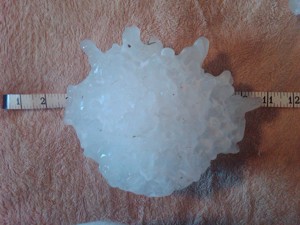
A massive hailstone with a diameter of 8 inches will likely set the record as the largest hailstone in terms of diameter and weight. (NWS)
Hail is one of the most damaging weather events capable of doing thousands of dollars worth of damage to homes and vehicles and utterly shredding crops. Last week in South Dakota the mother of all hail stones appears to have fallen – a beast weighing nearly two pounds and measuring 8 inches in diameter.
On the evening of July 23rd severe weather rolled through the northeastern corner of South Dakota bringing with it a great deal of hail and some tornadoes. Near Vivian in Faulk County, the hail grew to proportions likely not seen anywhere else.
Ranch hand Les Scott watched the drama unfold as the hail pummeled the surrounding land. The stones were large enough that holes the size of coffee cans were left in the ground.
One particular hailstone caught Scott’s eye due to its sheer size. After retrieving it, he stuck it in his freezer. Word soon traveled about the massive chunk of ice and National Weather Service personnel made preliminary measurements placing the diameter at 8 inches with a circumference over 18 ½ inches.
Yesterday, the service returned to Vivian to transport the stone to the closest certified scale at the local post office to have it weighed. The scale tipped at an amazing 1.9375 pounds. It also had lost a bit in size dropping to 17 inches around.
Scott said the hailstone was quite a bit larger when he first found it, possibly as large as 11 inches in diameter. However, power was out in the area for six hours Friday and after he pulled it out to show various people, it lost some of its mass.
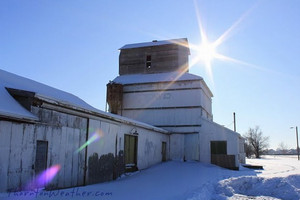
The Eastlake grain elevator, built not long after the turn of the last century, has been added to the National Register of Historic Places and the Colorado State Register of Historic Properties. (ThorntonWeather.com)
The city of Thornton was founded in the 1950’s but it traces its roots much farther back than that. In fact, one could go back to the late 1800’s / early 1900’s and the Eastlake area to find some of the first ‘settlers’ of where modern day Thornton sits. Now, one of the original buildings from those early days has been named to a very auspicious list.
The old Eastlake grain elevator at 126th Ave and Claude Court was built around 1914 not long after the Post Office and was followed by schools, churches and other buildings that were part of a growing town.
The grain elevator is one of the few remaining buildings from those early days and it has recently been named to the National Register of Historic Places and the Colorado State Register of Historic Properties.
This is a great step in helping to preserve our quickly fading past and ThorntonWeather.com is excited the city is working to ensure the elevator remains as a visible reminder of our history.
This past winter, we took some photos in the Eastlake area just after a fresh snowfall, some of which included the Eastlake grain elevator. You can view them in the slideshow below.
Record heat strikes the northeastern U.S. while southern California sees record low maximums. Denver may see its own temperature record today. (Examiner.com)
Triple digit heat broiled the northeastern United States on Tuesday while record setting cool weather struck southern California. Denver may be next to see cool temperatures for the record books as the United States experiencing a wide variety of temperatures.
Allentown, PA – 101 degrees (old record 100 degrees set in 1999)
Atlantic City, NJ – 102 degrees (old record 99 degrees set in 1999)
Baltimore, MD – 105 degrees (old record 101 degrees set in 1999)
Newark, NJ – 103 degrees (old record 102 degrees set in 1999)
New York City, NY (Central Park) – 103 degrees (old record 101 degrees set in 1999)
Philadelphia, PA – 102 degrees (old record 98 degrees set in 1999)
Warwick, RI – 102 degrees (old record 97 degrees set in 1999)
Wilmington, DE – 103 degrees (old record 98 degrees set in 1999)
Windsor Locks, CT – 102 degrees (old record 99 degrees set in 1999)
On the opposite coast of the nation, record low maximum temperatures were recorded from San Diego up to Riverside. Low pressure and a thick marine layer of clouds held temperatures down and residents that would normally be wearing shorts and tank tops traded that clothing for jeans and sweatshirts.
Among the tied or broken record low maximums recorded in southern California on Tuesday were:
Escondido – 69 degrees (old record 78 set in 1987)
Laguna Beach – 62 degrees (old record 68 set in 1968)
Newport Beach – 66 degrees (tied record of 66 last set in 1995)
Oceanside Harbor – 62 degrees (old record 65 set in 2002)
Riverside – 79 degrees (old record 80 set in 1969)
San Diego – 65 degrees (tied record of 65 last set in 1912)
On Wednesday, both the northeastern United States and southern California may see those record-setting temperature trends continue.
According to the National Weather Service, record-setting rain fell in Denver on the 4th of July. But is it accurate to say that? (ThorntonWeather.com)
Heavy rain showers put a damper on a lot of Independence Day celebrations yesterday. Thunderstorms moved across the Front Range dumping rain and hail across northeastern Colorado with enough rain falling to set a record for the 4th of July.
At Denver International Airport (DIA), 1.84 inches of rain was recorded. This easily eclipses the old 4th of July record dating back to 1909 when 1.44 inches fell.
Here in Thornton we weren’t nearly as wet having recorded 0.81 inches for the storms that moved through. Some of the other rainfall totals from across the metro area:
The rain yesterday was heavy in places but nowhere in the central Denver area measured anywhere near the amount DIA recorded (see map below). When the National Weather Service (NWS) announces a “record” like the rain yesterday, it is comparing the measurements at DIA to historical records taken at the old Stapleton International Airport from 1950 to 1995 and downtown from 1871 to 1949.
Is it accurate to claim a weather record when the station doing the recording is 12 miles away from where historical records were made? Of course not and this is a problem.
The National Weather Service either needs to start recording Denver’s official statistics from the new station or it needs to quit comparing data from DIA to that recorded before the move in 1995.
Denver’s climate records are forever being altered and the public is being misled.
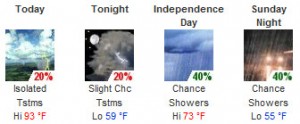
Thornton's weather forecast for the Independence Day weekend as of Saturday morning. Follow the link in the story for the latest forecast.
The holiday weekend is upon us and the weather looks to be a bit of a mixed bag. Plenty of heat will be on tap Saturday but the weather changes considerably on Independence Day, threatening those fireworks shows.
For Saturday, we have a day much like we saw yesterday. Partly cloudy skies will be overhead with high temperatures reaching the low to mid-90’s. This afternoon brings with it a slight chance for isolated thunderstorm and shower activity. Right now, we aren’t expecting any of those storms to turn severe in the metro area.
Independence Day is of course the big day as we celebrate the 234th birthday of our Great Nation. An upper level trough will be moving through late tonight and through Monday and with it comes cooler temperatures and increased chances of moisture.
Highs on Sunday look to be considerably cooler and only in the low to mid-70’s under mostly cloudy skies. The concern right now is the increased chance for rain showers that is expected to arrive in the afternoon and threatens to put a damper on fireworks shows. This will bear watching so check back tomorrow for an update.
On Monday we start to rebound a bit from the cooler weather but temperatures will remain below normal. Highs will be in the low to mid-80’s under partly cloudy skies and a slight chance for thunderstorms.
The balance of next week looks to continue a cooler-than-normal trend with temperatures hovering around 80 Tuesday through Thursday.
It is Colorado’s severe weather season and Thornton received a reminder of that Thursday night. The late afternoon brought various watches and warnings and soon hail as large as ping-pong balls was falling.
What started as a light rain with ominous clouds overhead soon turned to hail that pounded central Thornton near 120th Avenue and Colorado Boulevard. Mercifully, the hail never got any bigger than ping-pong ball sized however that is plenty big enough to have caused damage. Residents should check their vehicles and other property closely for damage.
Following the hail, in a short 20 minute span, the area was inundated with 1/4 inch of rain coming down in sheets. A rainbow soon appeared to the east signifying this round of severe weather was over.
Check out the slideshow below for some of the images from the short-lived but potentially damaging storm.
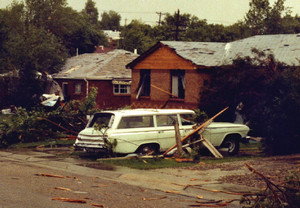
On June 3, 1981, Thornton was the site of the most destructive tornado in the history of the Denver metro area. The City of Thornton is now evaluating options to warn residents of severe weather threats. (City of Thornton archives)
Visitors to ThorntonWeather.com have often asked us if the city was taking any steps to protect its citizens and warn them about severe weather. The city – and Adams County – are lacking any type of alert system. Following last year’s ‘Summer of Storms,’ we were told the city would look into it.
Current options for citizens range from the Emergency Alert System used by television and radio broadcasters, free and pay Internet services as well as NOAA Weather Radio All Hazards (weather radio). As we have discussed previously, these systems have their limitations.
At this week’s city council update session, the Thornton City Council heard a presentation from city staff on the alternatives available. Utilizing Reverse 911 and contracting with a third party provider were two of the items discussed.
Read the presentation city staff gave to the Thornton City Council below
In trying to identify ways to keep citizens aware of deteriorating weather conditions, city staff told council, “Technology is changing so quickly that supporting a single system would not be efficient.”
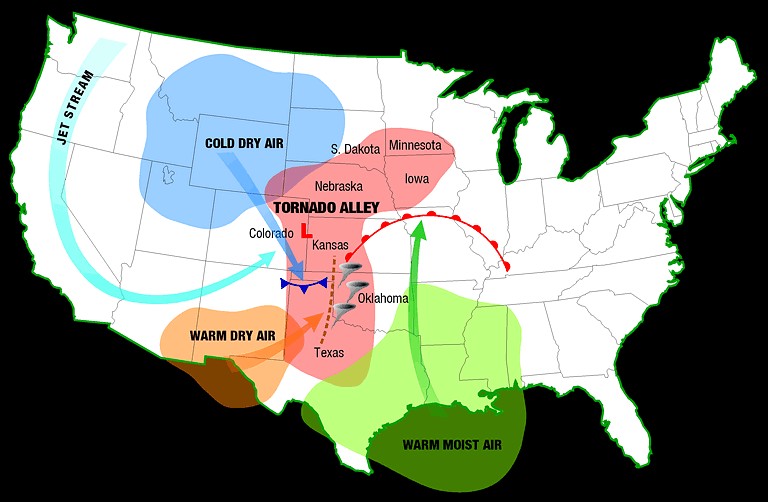
The Denver area is at the western edge of Tornado Alley and as we have seen historically and in recent days, the danger is real. Click image for larger view. Image courtesy NOAA.
Rather than implement their own system, staff recommended the city rely upon the federal government and the Federal Emergency Management Agency’s (FEMA) forthcoming Integrated Public Alert and Warning System (IPAWS).
Slated for widespread deployment in 2010, IPAWS will take the old Emergency Alert System and move it into the modern age by leveraging new communication technologies such as email and cellular phones.
Mayor Erik Hansen told ThorntonWeather.com, “The City of Thornton recognizes the dangers of severe weather and we are actively working to identify solutions to protect its citizens.”
While the city waits for IPAWS, staff said they recommend the “development of a Weather Awareness Public Education Program that would be implemented in the spring of each year.” They further would work to encourage residents to purchase weather radios.
ThorntonWeather.com’s Take
We are pleased that the city is finally taking some steps in the right direction – albeit 29 years late.
NOAA Weather Radio All Hazards is essential to protecting you and your family.
The implementation of a severe weather education program is also a step in the right direction, assuming it takes the form of something more substantial than the simple brochure the city developed this year.
Each spring the National Weather Service (NWS) offers storm spotter training seminars. These would likely be overkill for average citizens however we think it would be ideal for the City of Thornton to partner with the Denver / Boulder NWS office to offer education sessions for citizens. These could be taped and then shown on Channel 8 and on the city’s website.
We do have our reservations about waiting for and relying on the forthcoming IPAWS system when commercial systems are available, proven and ready now for the city to implement. Big government projects rarely are completed on time and often do not perform as expected. Hopes are high for IPAWS but we are cautious on giving it any sort of endorsement.
Granted, severe weather on par with the 1981 tornado is rare however last year’s severe weather and the Windsor tornado of two years ago show the danger is present. If a warning system saves one life, the cost incurred is well worth it and we hope the city continues to stay on top of this issue – we will certainly be watching.