All posts by Thornton Weather

ThorntonWeather.com is your local source for live Thornton, Colorado weather conditions and news!

Denver sets record high temperature for December 22

Record High Temperature

The ridiculously warm temperatures this month have set another high temperature record.

As measured at Denver International Airport, the Mile High City saw a high temperature today of 76 degrees. This breaks the previous record high for December 22 of 70 degrees set in 1955.

The reading is also the second warmest December temperature ever recorded for Denver. December 5, 1939 holds the record with a reading of 79 degrees.

Here in Thornton, we were similarly warm with a high of 76 degrees.

December 21 to December 27: This Week in Denver Weather History

This Week in Denver Weather History

Powerful, damaging winds and monstrous snowstorms are the big highlights of this week in Denver weather history. Two storms are more memorable than most including the pre-Christmas blizzard of 2006 and of course the infamous 1982 Christmas Eve blizzard.

From the National Weather Service:

17-24

In 1924…a prolonged cold spell occurred after mild temperatures during the first half of the month. Most low temperatures dipped below zero with the coldest reading of 15 degrees below zero occurring on the 24th. The high temperature of only 5 degrees on the 18th was a record low maximum for the date.

18-21

In 2010…a winter storm produced a 4-day period of moderate to heavy snow in the mountains. The combination of strong wind and heavy snow forced the closure of several mountain passes due to the threat of avalanches. The Amtrak train route… Which runs from Denver to California…was rerouted through Wyoming when Union Pacific closed its tracks along Interstate 70. Numerous accidents forced the closure of I-70 at times. The wind gusted to 60 mph over the higher mountain passes. Storm totals in the ski areas west of Denver ranged from 16 to 32 inches.

18-24

In 1998…a vigorous cold front with north winds gusting as high as 38 mph at Denver International Airport on the 18th dropped temperatures from a high of 51 degrees to a low of just 6 degrees before midnight. The arctic air mass that settled over metro Denver produced intermittent light snow and a week-long protracted cold spell that caused low temperatures to plunge well below zero for 6 consecutive nights. The coldest temperature was 19 degrees below zero on the morning of the 22nd. High temperatures climbed only into the single digits on 4 consecutive days…from the 19th through the 22nd. At least 15 people…mostly homeless… Were treated for hypothermia at area hospitals. The bitter cold weather was responsible…either directly or indirectly… For at least 5 fatalities. Three of the victims died directly from exposure. The cold weather also caused intermittent power outages. Following the cold snap… Thawing water pipes cracked and burst in several homes and businesses…causing extensive damage. Only one temperature record was set. The high temperature of only 7 degrees on the 19th set a record low maximum for the date.

19-23

In 1990…a surge of very cold arctic air invaded metro Denver. Many temperature records were broken as the mercury remained at or below zero for 85.5 hours at Stapleton International Airport…making it the third longest period of subzero readings in 118 years of record keeping. On the morning of the 22nd…the mercury plunged to 25 degrees below zero…which equaled the all-time record low temperature for the month set on December 24…1876. In the foothills southwest of Denver at tiny town…the mercury plunged to 33 degrees below zero on the morning of the 21st. On the same morning at Castle Rock the temperature dipped to 26 degrees below zero. During the period…other daily temperature records were set at Denver…including: record low maximum of 3 degrees below zero on the 20th and a record low of 17 degrees below zero on the 23rd. The record low was equaled with 16 degrees below zero on the 20th and 21 degrees below zero on the 21st. Snowfall totaled 2.7 inches at Stapleton International Airport from the 19th through the 21st.

20-21

In 1969…high winds caused widespread…but mostly minor damage to roofs…windows…and power lines and overturned some house trailers in areas along and just east of the foothills. Wind gusts of 60 to 70 mph were reported in Boulder and south of Boulder at Rocky Flats. A wind gust to 115 mph was measured in Boulder at the National Center for Atmospheric Research. At Stapleton International Airport…west winds gusted to 44 mph on the 20th and to 45 mph on the 21st. The warm Chinook winds warmed the high temperature to 56 degrees on the 20th and to 65 degrees on the 21st.

In 2006…a major blizzard buried greater metro Denver and the adjacent foothills in deep snow. A slow moving upper level low pressure center produced deep moist upslope flow over the high plains and against the eastern slopes of the mountains…allowing heavy snowfall to persist for 34 hours across metro Denver. Total snow accumulations ranged from 1 to 2 1/2 feet across the city and from 2 to nearly 4 feet in the foothills. Adding to the misery… Strong north winds sustained at 20 to 35 mph with gusts from 45 to nearly 60 mph produced much blowing snow and piled the snow into drifts from 6 to 12 feet high…closing businesses and bringing all transportation to a halt. The storm forced the closure of Denver International Airport for a total of 45 hours which snarled the nation’s air traffic system. This was the longest closure in the airport’s 12 year history. The closure stranded nearly 5000 travelers when 2000 flights were canceled. Many inbound flights were diverted to other airports…stranding even more passengers. Many of the stranded travelers failed to reach their final destinations until days after the airport re-opened due to fully booked flights during the holiday season. Police and national guardsmen rescued hundreds of commuters stuck in their cars…and sent them to temporary shelters set up by the Red Cross. All interstates and other major highways in and out of Denver were closed. Greyhound was forced to cancel all bus trips from Denver. Mail delivery was suspended. The Regional Transportation District suspended all metro Denver bus service for the first time since the March 2003 blizzard. The roof of a discount store in Aurora collapsed under the weight of the heavy snow. In Lakewood…a power outage left 5600 residents without electricity for a brief time. Metro Denver snowfall amounts included: 34 inches 10 miles southeast of Buckley AFB…32 inches in Littleton…30 inches in Thornton and near Castle Rock…29.5 inches near Parker…28 inches in Wheat Ridge…25.5 inches at Centennial Airport…25 inches at Niwot…24 inches in Aurora…22.5 inches at Greenwood Village… 22 inches in Arvada…21.5 inches in Lakewood…20 inches in Longmont…and 15.5 inches in Boulder. Snowfall measured 20.7 inches officially in the Denver Stapleton area. This ranked the snowfall as the 7th greatest in the city since 1946. North winds were sustained to 37 mph with gusts to 55 mph at Denver International Airport. In the foothills snowfall totaled: 42 inches at Conifer and 11 miles southwest of Boulder…40 inches at Evergreen…39 inches at Aspen Springs… 37.5 inches 8 miles north of Blackhawk…33 inches near Nederland…31 inches at Intercanyon and near Tiny Town…30.5 inches atop buckhorn mountain…30 inches near Indian Hills… 29 inches at Rollinsville…24 inches near Gross Reservoir and Ralston Reservoir…22.4 inches atop Crow Hill…and 20 inches near Georgetown. Snowpacked and rutted streets and parking lots persisted for a month or more after the storm and subsequent storms. The heavy snowfall created a snow removal controversy when many citizens complained that residential streets were not cleared in a timely manner in the city and in some suburban areas. This was in spite of the fact that tens of millions of dollars were spent on snow removal. In the city of Denver…snow cover of an inch or more from this storm and subsequent storms persisted for 61 consecutive days…through February 19…2007. This is the second longest period of snow cover on record in the city. Many homeowners who had extensive Christmas lights and decorations in their yards were not able to remove the lights because the wires were buried in deep snow and ice until the end of February or later.

In 2020…very strong downslope winds developed along the Front Range. Peak wind gusts reached 95 mph near Caribou… with a gust of 93 mph near Berthoud Pass. Peak gusts elsewhere included: 87 mph near Tolland…83 mph near White Ranch Open Space…82 mph near Rocky Flats…81 mph near Nederland…80 mph near Georgetown…78 mph near Ward…and 77 mph near Crisman.

20-22

In 1933…strong downslope winds produced a warm spell. Low temperatures of 43 degrees on both the 20th and 21st and 41 degrees on the 22nd were record high minimums for those dates. High temperature of 67 degrees on the 21st was a record maximum for the date. High temperatures of 56 degrees on the 20th and 69 degrees on the 22nd were not records; however…the 69 degrees was the warmest of the month. West to northwest winds were sustained to 20 and 24 mph on the 21st and 22nd respectively.

20-23

In 1918…light snowfall on each day totaled 12.0 inches over downtown Denver. Northeast winds were sustained to 16 mph on the 21st.

20-25

In 1983…an extremely bitter cold spell occurred. The temperature remained below zero for 115 hours in Denver… The longest sub-zero period on record. The mercury dipped to 21 degrees below zero on the 21st…the coldest recorded temperature in over 20 years. The cold was accompanied by winds that plunged chill factors to 50 to 70 degrees below zero. Two people froze to death in Denver; both were found outside dead of exposure. Numerous cases of frostbite were reported. Hundreds of water pipes broke from the intense cold…water mains and natural gas lines also fractured…and electricity consumption reached record levels. Light snow totaling 5.8 inches fell at times…and holiday traffic was delayed at Stapleton International Airport for several hours. Eight daily temperature records were set at the time. The all-time record low maximum temperature for the month of 8 degrees below zero on the 21st still stands today. Other temperature records still standing include record low maximum temperatures of 5 degrees below zero on both the 22nd and 23rd and 4 degrees below zero on the 24th.

Continue reading December 21 to December 27: This Week in Denver Weather History

December 14 to December 20: This Week in Denver Weather History

This Week in Denver Weather History

Bitter cold, powerful winds and major snowstorms are the biggest highlights of this week in Denver weather history.

2-17

In 1939…more than 2 weeks of unseasonably warm weather made the month the 3rd warmest on record. Seven daily temperature records were set…including the all-time record high temperature for the month of 79 degrees on the 5th. Daytime highs were balmy with 14 days in the 60’s and 70’s. Low temperatures dipped to freezing or below on only 5 days. The period was dry with only a trace of snow on the 12th.

3-15

In 1972…a protracted cold spell held an icy grip on metro Denver when maximum temperatures never reached above freezing for 10 consecutive days from the 3rd through the 12th and minimum temperatures dipped below zero on eleven consecutive days from the 5th through the 15th. Daily low temperature records were set with 15 degrees below zero on the 5th…17 degrees below zero on the 6th… And 18 degrees below zero on the 10th. Daily record low maximum readings were set with 3 degrees on the 6th and 6 degrees on the 9th. The very cold temperatures were caused by 3 to 5 inches of snow cover and a Canadian air mass.

12-15

In 1921…downslope Chinook winds produced warm temperatures in the city…which resulted in 4 temperature records. High temperatures of 72 degrees on the 13th and 68 degrees on the 15th were record maximums for the dates. Low temperatures of 47 degrees on both the 12th and 13th were record high minimums for the dates. West winds were sustained to 38 mph on the 12th and to 25 mph on the 13th.

13-14

In 1902…heavy snowfall totaled 6.4 inches in the city overnight. North winds were sustained to 18 mph with gusts to 20 mph on the 13th.

In 1925…heavy apparent post-frontal snowfall totaled 7.8 inches across downtown Denver. Northwest winds were sustained to 34 mph with gusts to 42 on the 13th… And north winds were sustained to 33 mph with gusts to 38 mph on the 14th.

In 1951…heavy snowfall totaled 5.9 inches at Stapleton Airport.

In 1987…a snowstorm dropped 2 to 8 inches of snow along the Front Range foothills. Eight to 12 inches fell just south of Denver. Icy streets and highways contributed to many traffic accidents across metro Denver and flights were delayed at Stapleton International Airport where 2.7 inches of snow fell and northeast winds gusted to 17 mph.

In 1991…high winds pummeled metro Denver. Wind gusts to 93 mph were recorded at Rollinsville. Wind speeds across metro Denver were generally 35 to 50 mph. Northwest winds gusted to 48 mph at Stapleton International Airport on the 13th.

14

In 1926…an intrusion of cold air resulted in temperatures remaining below zero. The high temperature of one degree below zero was a record low maximum for the date. The low temperature was 11 degrees below zero. North winds were sustained to 17 mph.

In 1985…a wind gust to 61 mph was recorded at Table Mesa in Boulder.

In 1996…high winds gusting from 60 to nearly 80 mph moved off the Front Range foothills and over the northeast Colorado plains in the wake of a fast moving cold front. The strongest wind gusts included 79 mph at Golden Gate Canyon and 70 mph near Table Mesa in southwest Boulder. At Denver International Airport…west-northwest winds gusted to only 39 mph.

14-15

In 1988…a snow storm again whitened metro Denver. Snowfall along the Front Range was in the 6 to 12 inch range. Snowfall totaled 5.8 inches at Stapleton International Airport where north winds gusted to 38 mph.

In 1990…high winds howled across metro Denver behind a strong pacific cold front. Boulder was hardest hit by the high winds. A wind gust to 120 mph was recorded in south Boulder where winds stripped the roof off a garage…a vacant gas station…and a house under construction. Elsewhere in Boulder…several trees were blown down. In Boulder canyon…the winds toppled two cinder block walls on a house under construction. Four Boulder County women were treated for injuries caused by the wind. The injuries were confined to a broken wrist…a mild concussion…bruises…and facial cuts. Two semi-tractor trailers were blown over by the fierce winds south of Boulder. Another truck rollover occurred southeast of Golden. Drivers of all three trucks suffered only cuts and bruises. Several vehicles were trapped in a blinding dust storm on the Denver-Boulder turnpike near Broomfield. Drivers were forced to stop along the highway for several minutes during the storm and witness their vehicles being pelted with sand and gravel. A wind gust to 97 mph was recorded in Golden. High winds were also reported in Arvada…Boulder…and Lakewood. Winds toppled a number of utility poles and wooden fences…blew out windows…and caused structural damage to a large apartment complex on the west side of Golden. Wind gusts of 70 to 100 mph caused considerable damage to several large billboards north of Golden…as well as damaging the paint…trim…and glass on numerous vehicles in the area. A west wind gust to 51 mph was recorded at Stapleton International Airport.

Continue reading December 14 to December 20: This Week in Denver Weather History

Denver sets record high minimum for December 11

Record High Temperature

The mild temperatures have put a record in the books for December 11.

As measured at Denver International Airport, the date saw a low temperature of 45 degrees. This breaks the previous record high minimum of 44 degrees for the date set in 1933.

Here in Thornton we were considerably warmer overnight and early morning. Our low temperatures as a mild 56.3 degrees.

December 7 to December 13: This Week in Denver Weather History

This Week in Denver Weather History

Arctic cold, heavy snow and  powerful, damaging winds are the highlights in our look back at this week in Denver weather history.

From the National Weather Service:

2-17

In 1939…more than 2 weeks of unseasonably warm weather made the month the 3rd warmest on record. Seven daily temperature records were set…including the all time record high temperature for the month of 79 degrees on the 5th. Daytime highs were balmy with 14 days in the 60’s and 70’s. Low temperatures dipped to freezing or below on only 5 days. The period was dry with only a trace of snow on the 12th.

3-15

In 1972…a protracted cold spell held an icy grip on metro Denver when maximum temperatures never reached above freezing for 10 consecutive days from the 3rd through the 12th and minimum temperatures dipped below zero on eleven consecutive days from the 5th through the 15th. Daily low temperature records were set with 15 degrees below zero on the 5th…17 degrees below zero on the 6th… And 18 degrees below zero on the 10th. Daily record low maximum readings were set with 3 degrees on the 6th and 6 degrees on the 9th. The very cold temperatures were caused by 3 to 5 inches of snow cover and a Canadian air mass.

5-7

In 1978…a major storm dumped heavy snow across metro Denver. At Stapleton International Airport…snowfall totaled 8.5 inches…northeast winds gusted to 46 mph…and temperatures plunged from a high of 49 degrees on the 5th to a low of only 6 degrees on the 6th. Maximum temperature of 6 degrees on the 7th was a new daily record low maximum reading. Most of the snow…6.7 inches…fell on the 5th.

5-8

In 1983…high winds occurred in and near the foothills each day. Wind gusts to 63 mph were registered in Golden Gate Canyon on the evening of the 5th. On the evening of the 6th…winds knocked down trees…snapped power lines…and blew out windows across metro Denver. Gusts were clocked to 102 mph in southwest metro Denver…while wind gusts to 38 mph were recorded at Stapleton International Airport. On the 7th…winds overturned a tractor trailer near Castle Rock. After midnight on the 8th…gusts to 97 mph were reported in southeast Boulder. Wind speeds of 60 to 70 mph were reported in other parts of metro Denver.

6-7

In 1953…high winds buffeted the eastern foothills. Wind gusts to 80 mph occurred on Lookout Mountain. In Denver winds gusted to 65 mph. Damage in Boulder totaled 15 hundred dollars.

7

In 1897…west winds were sustained to 53 mph with gusts to 66 mph. The Chinook winds warmed the temperature to a high of 62 degrees…the warmest day of the month.

In 1957…a vigorous cold front produced a dust storm as it moved south across metro Denver. West-northwest wind gusts to 59 mph were recorded at Stapleton Airport where the surface visibility was briefly reduced to 1/2 mile in blowing dust. Light snowfall of only 0.8 inch followed the passage of a secondary Canadian cold front.

In 1958…the worst wind storm in several years caused 10 thousand dollars damage in Boulder where wind gusts were estimated to 75 mph.

In 1977 winds up to 115 mph were reported in the Boulder area where one house was unroofed and another damaged. One woman was knocked down by the wind and injured. Several families were evacuated from homes in Boulder. Damage to trailers and motor vehicles was widespread. West winds gusted to 54 mph at Stapleton International Airport where the Chinook winds warmed the temperature to a high of 64 degrees.

In 1987…strong winds buffeted the Front Range foothills. A peak gust to 93 mph was recorded at the National Center for Atmospheric Research in Boulder. Nearby…a metal shed was blown over a fence into a tree two houses away. Wind gusts of 70 to 80 mph were common in Boulder.

In 1988…4 to 8 inches of snow fell across metro Denver and caused traffic gridlock conditions on area highways. The 3.9 inches of snow at Stapleton International Airport caused two-hour flight delays. Northeast winds gusted to 25 mph.

In 2005…a brief cold snap resulted in record breaking temperatures. The low temperature of 13 degrees below zero was a record minimum for the date. The high temperature of only 3 degrees was a record low maximum for the date. The cold temperatures were accompanied by 1.4 inches of light snow that was measured at Denver Stapleton overnight on the 6th and 7th.

7-9

In 1919…an apparent arctic cold front brought extreme cold and light snow to the city. Snowfall totaled only 2.5 inches on the 7th and 8th. Temperatures dipped to lows of 14 degrees below zero on the 8th and to 20 degrees below zero on the 9th. Both readings were daily record minimums. High temperatures were only 4 degrees on the 8th and 7 degrees on the 9th.

In 1923…a major storm dumped 13.5 inches of snowfall on downtown Denver. The apparent post-frontal snowfall started during the late afternoon of the 7th and continued through the evening of the 9th. Temperatures dipped from a high of 66 degrees on the 7th with west winds sustained to 35 mph to a low of only 14 degrees on the 9th…with north winds sustained to 25 mph.

8

In 1880…severe winds buffeted the eastern foothills…causing some damage in Boulder.

In 1987…high winds damaged a chimney and roof of a house near Bergen Park in the foothills west of Denver. Gusts were estimated to 70 mph. Northwest winds gusted to 33 mph at Stapleton International Airport.

8-9

In 1943…4.5 inches of snow fell in downtown Denver. This was the only measurable snow of the month. North winds were sustained to 26 mph on the 8th.

In 2003…snowfall totaled 3 to 6 inches across metro Denver. Snowfall was heavier in and near the foothills with 8.0 inches measured in Boulder and 10 miles southwest of Sedalia. Snowfall was 3.9 inches at the site of the former Stapleton International Airport. Most of the snow fell on the 8th…as the snow ended shortly after midnight. North winds gusted to 29 mph at Denver International Airport.

In 2008…an upslope snowstorm produced heavy snow in and near the foothills of Boulder…Jefferson and Douglas counties… And along the palmer divide south of Denver. Storm totals in the foothills ranged from 8 to 15 inches. In Boulder and in areas west and south of Denver…storm totals ranged from 6 to 13 inches. The snowfall measurement at Denver International Airport was 3.9 inches.

In 2023…a storm system produce a period of moderate to heavy snowfall…especially in and near the Front Range mountains… foothills and Palmer Divide. Storm totals ranged from 6 to 14 inches in the mountains and foothills…with 4 to 7 inches over Boulder as well as western and southern portions of metro Denver. Interstate 70 closed was closed for a few hours west of Denver due to heavy snow as well as vehicle spinouts. Several accidents were also reported around the Denver metro area…with highest impacts on the west side of the city and in Boulder. Officially…just 0.4 inch of snowfall occurred at Denver International Airport while 6.5 inches of snowfall was measured at the National Weather Service in Boulder.

Continue reading December 7 to December 13: This Week in Denver Weather History

November 2025 weather recap: Once again much warmer, much drier than normal

Thornton, Colorado's November 2025 Temperature Summary. (ThorntonWeather.com)
Thornton, Colorado’s November 2025 Temperature Summary. (ThorntonWeather.com)

Yet another month in the books with mercury readings well above average and precipitation lighter than average. In fact, November 2025 goes into the books as the warmest and second driest November in Thornton of the past 19 years.

During the month there was a complete lack of notable weather events – beyond the warmth and dryness. It wasn’t until the third week of the month that we saw any precipitation and then it was a minimal amount of rain.

On the 28th, we finally received our first snowfall of the season, but it was a meager amount (0.6 inches). It also was the second latest first seasonal snowfall ever recorded in Denver.

Overall, Thornton’s November 2025 average temperature was 45.8 degrees. This is far above our 19-year running average temperature for November of 39.9 degrees. It also makes the month the warmest November recorded over that same period.

For Denver, as recorded at Denver International Airport, it was similarly mild. The average temperature was 45.1 degrees. This was 5.7 degrees above the city’s long-term average.

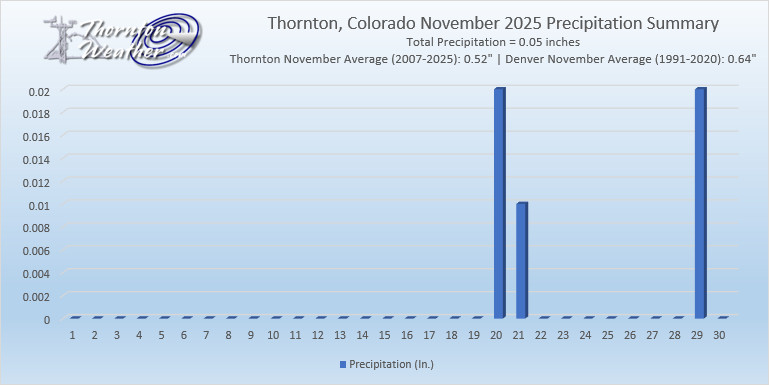
Precipitation was pitiful for the month. Thornton recorded a mere 0.05 inches during the month. This is far below our running average for November of 0.52 inches.

The Mile High City recorded 0.09 inches of precipitation in their bucket. This is far below Denver’s long-term average for November of 0.64 inches.

As previously stated, snow was virtually non-existent during the month. The 28th offered the first snow of the season in Thornton and only totaled 0.6 inches. The month’s total fell far short of our 19-year average of 5.9 inches.

Denver recorded only 0.2 inches of the white stuff at DIA. This was far below the 7.3 inch average for November in the Mile High City.

Click here to view Thornton’s complete November 2025 climate summary report.

Thornton, Colorado's November 2025 Precipitation Summary. (ThorntonWeather.com)
Thornton, Colorado’s November 2025 Precipitation Summary. (ThorntonWeather.com)

Thornton’s December 2025 preview: Winter arrives, typically with cold and snow

Thornton, Colorado's December Weather Preview

Recent months have, overall, been mostly warmer and drier than normal.  What will December hold for us?

The month of December brings with it the official start of winter and oftentimes, colder and snowier weather conditions. It, however, can also offer unseasonably warm temperatures and bone dry conditions.  Given our recent mild and dry weather, we are certainly hoping for a change in the coming month.

Overall December’s monthly mean temperature of 31.2 degrees (1991 – 2020 averages) makes it our coldest month.  Snow is always on everyone’s mind this time of year but December is only our 3rd snowiest month behind March and November with an average of 8.0 inches of the white stuff.

Get all the details on Thornton’s December weather including a look back at historical events and a look at the long range forecast in our December weather preview here.

  • Stay up to date with Thornton’s weather: Be sure to ‘like’ us on Facebook and follow us on Twitter.

November 30 to December 6: This Week in Denver Weather History

This Week in Denver Weather History

Powerful, damaging winds and significant snow events dominate our look back at this week in Denver weather history.

From the National Weather Service:

28-30

In 1991…a winter storm dumped heavy snow in the foothills and near the palmer divide with 10 inches recorded at Conifer and Golden Gate Canyon…12 inches in Morrison… 6 inches at Castle Rock and Parker. Only 3.4 inches of snow fell at Stapleton International Airport where north winds gusting to 35 mph on the 29th…produced some blowing snow. Some light freezing drizzle also fell on the 28th and 29th.

29-30

In 2008…a storm system produced locally heavy bands of snow across Douglas…Elbert and eastern Jefferson counties. Northerly winds gusting to 50 mph caused snow drifts to pile up to 2 feet in depth. Storm totals included: 12 inches just southwest of Kassler…11.5 inches…6.5 miles southwest of Castle Rock; 11 inches…8.4 miles southeast of Aurora and 9 miles west of Littleton; 10 inches at Louviers… 8 inches…2 miles west-southwest of Highlands Ranch and 5 miles south-southeast of Sedalia…and 7.5 inches…14 miles west-southwest of agate and at Castle Pines. At Denver International Airport…2 inches of snow was observed. North winds gusted to 46 mph on the 30th.

30

In 1899…west winds were sustained to 45 mph with gusts as high as 48 mph.

In 1903…west winds sustained to 44 mph with gusts to 54 mph warmed the temperature to a high of 57 degrees.

In 1981…strong winds blasted the foothills. In Wondervu… Winds were clocked to 81 mph with many other locations in the foothills reporting over 60 mph. Northwest winds gusted to 28 mph at Stapleton International Airport.

In 1986…the worst snow storm of the season dumped from 5.0 inches of snow at Stapleton International Airport to 14 inches over the higher southwestern suburbs. On the Sunday after Thanksgiving…one of the busiest travel days of the year at Stapleton International Airport…two of the four runways were closed and flights were delayed up to four hours. Near-blizzard conditions prevailed on the plains east of Denver…closing both I-70 and I-76 for a time. North wind gusts to 36 mph were recorded at Stapleton International Airport.

In 2000…strong winds raked metro Denver. In Thornton…a construction worker was critically injured when the scaffolding on which he was standing collapsed…throwing him 25 feet to the ground. West winds gusted to 54 mph at Denver International Airport.

30-1

In 1929…heavy snow blanketed the city. Snowfall totaled 9.8 inches downtown. North winds were sustained to 32 mph with gusts to 37 mph on the 30th.

In 1970…high winds blasted Boulder and the eastern plains. In Boulder…a wind gust to 112 mph was recorded at the National Center for Atmospheric Research with a gust to 96 mph at the National Bureau of Standards. In downtown Boulder…wind gusts reached 76 mph. At Stapleton International Airport…winds gusted to 47 mph. The high winds caused widespread light to moderate property damage across most of metro Denver. Roofs…signs…trees…power lines…and other property were damaged. Blowing dust reduced visibility to near zero over most of eastern Colorado. Several mobile homes…campers…and semi- trailers were blown off the highways north of Denver.

In 1985…an intrusion of cold arctic air into metro Denver resulted in setting 3 temperature records. The temperature climbed to only 17 degrees on the 30th…setting a record low maximum for the date. On the 1st…the temperature plunged to 6 degrees below zero…setting a record low for the date… And warmed to only 7 degrees…setting a record low maximum for the date.

30-2

In 1975…very strong Chinook winds up to 100 mph caused damage to homes…aircraft…aircraft hangars…mobile homes… Cars…and power lines along the eastern foothills. Strong northwest winds gusted to 39 mph at Stapleton International Airport on both the 30th and the 1st.

1

In 1899…northwest Chinook winds were sustained to 47 mph with gusts to 60 mph. The strong Chinook winds warmed the temperature to a high of 61 degrees…the warmest of the month. The low temperature dipped to only 39 degrees.

In 1972…strong Chinook winds gusted in excess of 65 mph in Boulder. There were no reports of damage. Northwest winds gusted to 38 mph at Stapleton International Airport.

In 1992…strong winds continued through the early morning hours. Wind gusts to over 70 mph were measured at reporting sites in the foothills west of Denver. In west Boulder…wind gusts reached 71 mph with 77 mph measured at Rollinsville. At Stapleton International Airport northwest winds gusted to 39 mph. The walker ranch…an historic site west of Boulder…burned down overnight during the high wind event. Although the winds did not cause the fire…they did hamper efforts to extinguish the blaze.

In 1996…high winds howled in and near the Front Range foothills. Winds gusted to 105 mph at Wondervu southwest of Boulder and to 70 mph at Jefferson County Airport near Broomfield. West winds gusted to only 24 mph at Denver International Airport.

In 2022…very strong winds developed in and near the Front Range mountains and foothills. The strongest wind occurred near Brainard Lake with a peak gust to 106 mph. Elsewhere… peak gusts included: 90 mph at the NCAR Mesa Lab; 89 mph…3 miles southwest of Rocky Flats…83 mph near Empire…and 82 mph near Berthoud Pass…and 55 mph at Centennial Airport. At Denver International Airport…a peak gust to 41 mph was observed from the southwest.

1-2

In 1933…apparent post-frontal heavy snowfall totaled 8.0 inches across downtown Denver. North winds were sustained to 17 mph with an extreme velocity to 18 mph on the 1st.

In 1981 strong winds gusted to over 70 mph along the foothills. A peak gust to 100 mph was recorded at Wondervu. A gust to 94 mph was recorded just west of Boulder. Roofs on houses were damaged in the Evergreen area…and some mobile homes also were damaged. At Stapleton International Airport…northwest winds gusted 44 mph on the 1st and 37 mph on the 2nd.

1-3

In 2023…a prolonged period of strong winds and heavy snow occurred across the mountains and foothills. Peak wind gusts included: 93 mph at the NCAR Mesa Lab…89 mph near Winter Park…85 mph at the junction of state highways 93 and 72…and 76 mph just south of Boulder. Storm totals included: 19.5 inches near Berthoud Pass…16.5 inches near Loveland Pass…and 13.5 inches near Lake Eldora.

1-5

In 1913…the 1st marked the start of the heaviest 5-day total snowfall in the city’s history. During this period snowfall totaled 45.7 inches. Starting on the 1st…snow fell intermittently for 3 days and accumulated a little over 8 inches. On the 4th and 5th…an additional 37.4 inches of snow fell. At Georgetown in the foothills west of Denver even more snow fell…86 inches over the 5 days with the most…63 inches…on the 4th. In Colorado…snowfall was heavy along the eastern slopes of the mountains from the palmer divide north. High winds during the storm caused heavy drifting…which blocked all transportation. Snow cover of an inch or more from the storm persisted for 60 consecutive days from the 1st through January 29…1914. Additional snowfall in December and January prolonged the number of days. This is the third longest period of snow cover on record in the city.

Continue reading November 30 to December 6: This Week in Denver Weather History