
We’ve all seen TV or Internet news of a weather related watch or warning being issued. But, how many really know what they mean? There is a pretty big difference between the two and it is important to be aware just what it means to you so you can take the appropriate precautions.
Dozens of weather related fatalities occur every year in Colorado, many simply out of ignorance. Taking the time to be aware of the conditions around you and taking appropriate action will keep you from becoming a statistic.
Naturally you can get information on current advisories from television as local stations usually do a good job of “crawling” them on the screen when they are issued. This works well if you have a TV available but if not, the radio would be a secondary source. The Internet and the National Weather Service’s website are a great one when at a computer.
The problem with relying on news media or the Internet is that their ability to warn you of a developing weather situation is dependent on your monitoring them. Severe weather can strike without little warning. How will you know if severe weather is about to strike if you don’t have the TV or radio on?
Your first line of defense – NOAA All Hazards Radio
 For just about anywhere, a special radio that picks up the NOAA’s All Hazard Radio broadcasts is the way to go and provides information from the source. Oftentimes simply called a weather radio, we highly recommend every household have one of these.
- What does a weather radio sound like? Click here to listen in live.
These radios are relatively inexpensive and allow you to be immediately notified of official National Weather Service warnings, watches, and forecasts as well as other hazard information like earthquakes, avalanches, chemical spills, and even AMBER alerts. In fact, with these radios, you will be notified at the exact same time the news media is made aware giving you a head start on preparing for a developing situation.
To learn more about these devices and what you should look for when buying one, click here.
A high-tech alternative – Cell phone weather apps
Many people now have smartphones that allow for downloadable apps and weather-related ones are among the most popular.
All of these applications have a number of weather related features in common. All provide current conditions for either the location the user is in now or for saved locations and all provide some sort of radar.
Most can be configured to sound an alert when the National Weather Service issues a watch or warning. While they are no substitue for a weather radio, these apps provide you with immediate notification no matter where you are at.
For a look at some of these weather apps and their features, click here.
Type of Weather Alerts
Statements
A statement generally provides additional or follow up information to an existing weather condition. An example could be a short term forecast from the National Weather Service advising of above normal wind speeds – a common one that is issued here on the Front Range.
Advisories
An advisory is for less serious conditions that can cause significant inconvenience and, if caution is not exercised, could lead to situations that may threaten life and/or property. These usually are occurring at the location the advisory covers and the National Weather Service may activate its spotter system to better track and evaluate these systems.
Watches
A watch is used when the risk of a hazardous weather event has increased significantly, but its occurrence, locations, and/or timing is still uncertain. It is intended to provide advance notice of possible inclement weather. Think of these in terms of, “Watch out! Something is coming!” These help to provide enough notice that those who are affected can implement any plans they might need to in order to prepare for the event should it escalate. If you are in an area under a watch, you should plan where to go for shelter, should the weather situation deteriorate, especially for outdoor activities or driving. The National Weather Service may activate its spotter system to better track and evaluate these systems.
Warnings
These are the most severe and critical types of weather alerts and their importance cannot be overstated. A warning is used for conditions posing an immediate threat to life or property. You might read the last part of that previous sentence again – an immediate threat to life or property. This means taking appropriate action and seeking shelter immediately. Severe thunderstorm warnings, tornado warnings and flash flood warnings in particular are serious matters and you need to be proactive to protect yourself and your property. The National Weather Service will almost certainly activate its spotter system to better track and evaluate these systems.
Common Alerts in Colorado: *
| Tornado Watch (WT) | Conditions are favorable for the development of severe thunderstorms producing tornadoes in and close to the watch area. Watches are usually in effect for several hours, with 6 hours being the most common. (Also automatically indicates a Severe Thunderstorm Watch) |
| Tornado Warning (TOR) | Tornado is indicated by radar or sighted by storm spotters. The warning will include where the tornado is and what towns will be in its path. (Also automatically indicates a Severe Thunderstorm Warning) |
| Severe Thunderstorm Watch (WS) | Conditions are favorable for the development of severe thunderstorms in and close to the watch area. Watches are usually in effect for several hours, with 6 hours being the most common. |
| Severe Thunderstorm Warning (SVR) | Issued when a thunderstorm produces hail 3/4 inch (20 mm) or larger in diameter and/or winds which equal or exceed 58 mph (93 km/h). Severe thunderstorms can result in the loss of life and/or property. Information in this warning includes: where the storm is, what towns will be affected, and the primary threat associated with the storm. Tornadoes can develop in severe thunderstorms without the issuance of a tornado warning. |
| Severe Weather Statement (SVS) | Issued when the forecaster wants to follow up a warning with important information on the progress of severe weather elements. |
| Flash Flood Watch | Indicates that flash flooding is possible in and close to the watch area. Those in the affected area are urged to be ready to take quick action if a flash flood warning is issued or flooding is observed. |
| Flash Flood Warning | Signifies a dangerous situation where rapid flooding of small rivers, streams, creeks, or urban areas are imminent or already occurring. Very heavy rain that falls in a short time period can lead to flash flooding, depending on local terrain, ground cover, degree of urbanization, degree of man-made changes to river banks, and initial ground or river conditions. |
* Source:Wikipedia, Severe weather terminology.
For a comprehensive list of the types of warnings and advisories that may be issued and what they mean, Wikipedia has a nice list of them here: http://en.wikipedia.org/wiki/Category:Weather_warnings_and_advisories
Conclusion
The point to take home from this discussion is that when the National Weather Service issues warnings and watches, it is not a trivial matter. The weather can change very quickly, particularly here in Colorado, and we need to pay attention. In subsequent articles in this series we will talk about specific hazards like tornadoes, thunderstorms, lightning, flooding and more so be sure to check back!
Below is a great video with time lapse images of supercell thunderstorms. You can really get a feel for the power of these storms – and the danger!
National Weather Service Statement for Severe Weather Awareness Week
PUBLIC INFORMATION STATEMENT
NATIONAL WEATHER SERVICE PUEBLO COLORADO
600 AM MDT MON APR 11 2022
…UNDERSTANDING SEVERE WEATHER WATCHES AND WARNINGS…
When the National Weather Service sees the potential for severe weather, a stream of weather information flows from our forecast offices to you.
Each National Weather Service forecast office has a web site, a Facebook page, and a Twitter feed where you can find vital Information highlighting upcoming weather hazards. The hazardous weather outlook, a text product, highlights weather hazards seven days in advance.
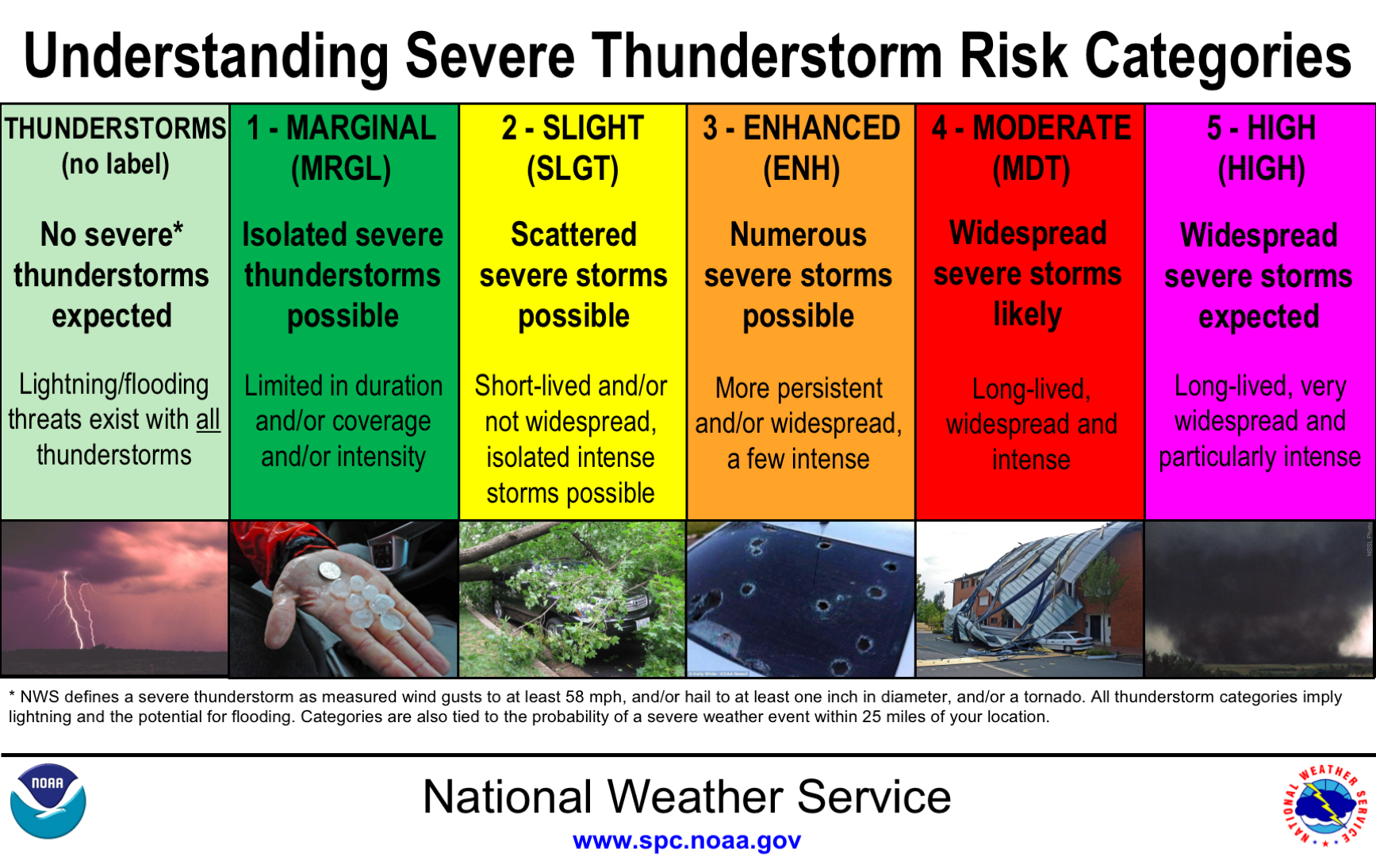
The Storm Prediction Center in Norman Oklahoma forecasts the risk for severe thunderstorm activity across the country several days in advance. These outlooks will tell you if there is a risk for severe weather, and if you are in a marginal, slight, enhanced, moderate, or high risk area for severe weather.
If the potential for severe thunderstorms becomes likely within the next six hours or so, a watch will be issued by the Storm Prediction Center alerting you to the increased risk for severe weather. If you are in or close to the watch area, you should plan where to go for shelter if severe thunderstorms develop.
Then, forecasters at the local National Weather Service forecast office will monitor satellite and radar data, and will issue warnings to alert you of the imminent severe weather threat. The warnings are sent out in many different ways in order to reach the most people possible.
A warning is an urgent message telling you that severe weather or flooding is imminent or is occurring. Warnings are storm-based, and usually issued for an area smaller than a county.
A severe thunderstorm warning is issued for wind gusts of 58 mph or higher, or for hail one inch in
diameter or larger.
A tornado warning is issued when a tornado is imminent or occurring.
A flash flood warning is issued for rapidly developing life-threatening flooding.
Before and during severe weather, you can receive watches, warnings, and advisories on NOAA All Hazards Weather Radio. Most weather radio receivers have a built in tone alert, which is activated by the National Weather Service when watches and warnings are issued. You will also see warnings on the internet, your mobile device with Wireless Emergency Alert (WEA) messages, or hear them on your local radio or television stations.
Do not be caught off guard. Know how to receive watch and warning information, and know what to do when severe weather threatens. Specific safety information will be available each day of this Colorado Severe Weather Awareness Week.
This is part one of a five part series on Colorado’s severe weather.